 Digitam SAGL
AI phone assistant for a medical practice in Ticino: bookings yes, symptoms no
From November to March, the phones in Ticino's medical practices ring more than ever. An AI assistant can book flu jabs and check-ups; symptoms, test results and emergencies stay with people. Within the rules of the FADP and medical secrecy.

77%
of people in Switzerland feel fairly or very safe booking a medical appointment online
gfs.bern, Swiss eHealth Barometer 2025At a glance
- In 2026 Switzerland's national vaccination weeks run from 2 to 7 and from 23 to 28 November; the flu wave usually arrives between mid-December and mid-March.
- An AI assistant can handle appointments, practical questions and prescription requests. Symptoms, test results and emergencies always go to a person or to 144.
- Health data is sensitive personal data: the provider needs a contract under Art. 9 FADP, and the call summary should hold only what the practice needs.
- One public Swiss price list starts at CHF 399 a month per doctor plus at least CHF 5,000 set-up, excluding VAT: count your own calls before you sign.
Tuesday 3 November 2026, 8:02 a.m., a GP practice in Giubiasco. Sara, the medical practice assistant, has just taken a blood sample and is labelling the tube. The phone rings, then the second line. At the desk, a man waits with his health insurance card in his hand. By 8:20 Sara has answered four calls out of nine: two flu jabs, a repeat prescription, a sick note for an employer. Among the five she missed was a daughter calling about her mother: "She's been struggling to breathe since last night." She tried again at 8:40.
Sara and the practice are made up. The morning isn't: it's the first national vaccination week, and in many practices in Ticino the phone sounds like this until spring.
An AI phone assistant for a medical practice can take some of these calls. But a medical practice plays by stricter rules than a garage or a restaurant: there is health data, there is medical secrecy, and some calls can't wait. This article covers what an assistant can do, what it must hand to a person immediately, what to ask whoever sells it to you, and what it costs.
Why does the practice phone never stop from November on?
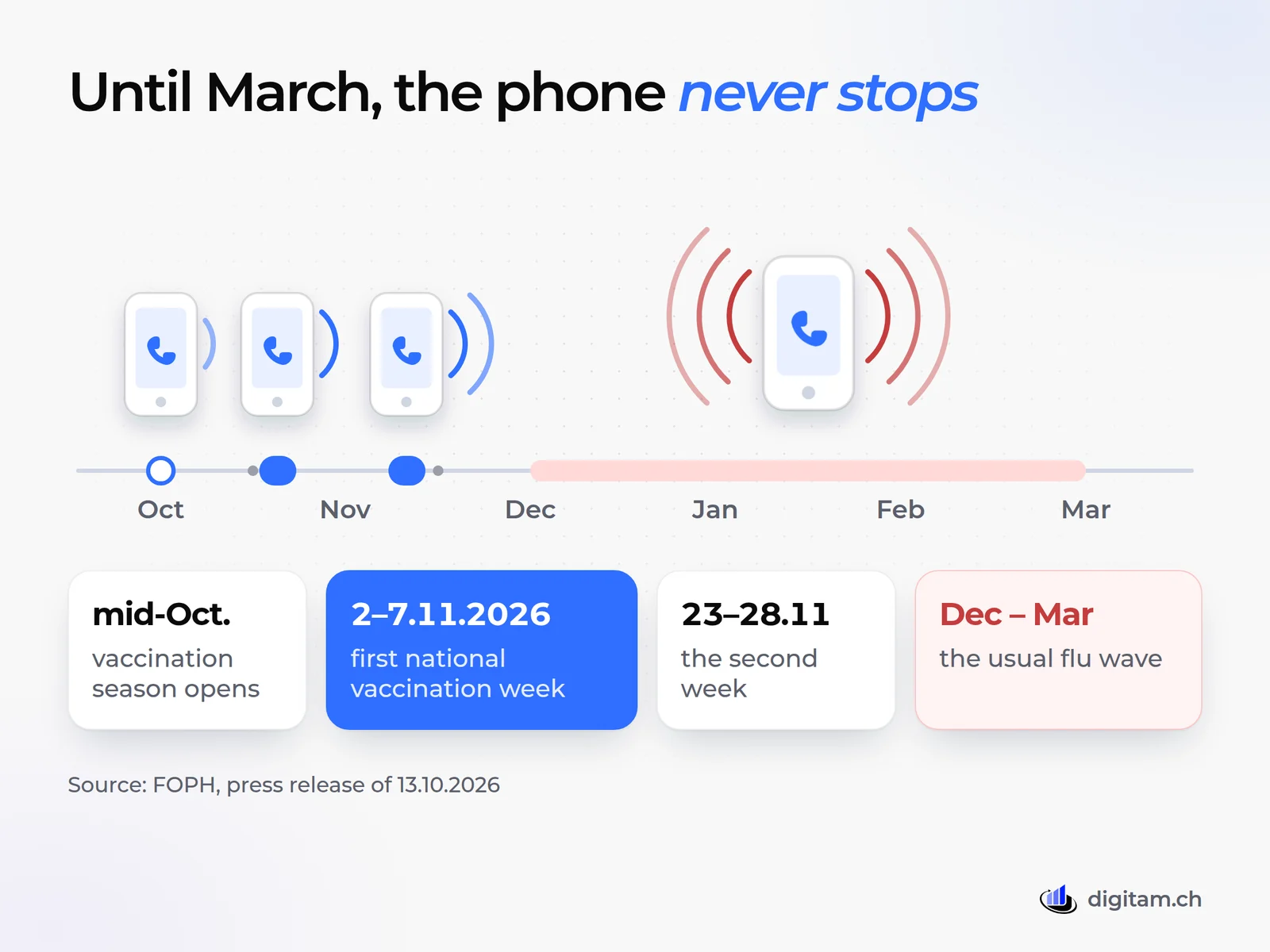
This year there are two national vaccination weeks: 2 to 7 November and 23 to 28 November. They're run by the Swiss College of Primary Care Medicine with the FMH, pharmaSuisse and the Federal Office of Public Health, and the second week was added because part of the flu vaccine supply is delayed1. The recommended window runs from mid-October until the flu wave begins, which usually happens between mid-December and mid-March1. First people call about the jab, then about fevers, sick notes and postponed check-ups.
Staff numbers don't grow with the calls. In the 2025 skills shortage index by Adecco and the University of Zurich, health specialists were still in first place. In Latin Switzerland they were the only occupational group with a clear imbalance between supply and demand2.
In practice, the person answering the phone is the same person doing blood tests, ECGs and the till. Every call taken leaves someone waiting at the desk. Every missed call comes back later, when the queue is long again, or goes to another practice. We worked out what a missed call costs a business in Missed calls in a Ticino SME. A medical practice has one more cost: sometimes the person who can't get through has a serious problem.
Which calls can an AI assistant take, and which can't it?
An AI phone assistant understands what the caller wants, answers with the practice's own information and carries out the tasks you have allowed. In a medical practice, that splits calls into three groups.
Calls it can close on its own. Booking, moving or cancelling an appointment in the practice's real calendar: the flu jab, the blood pressure check, the visit for a sick note. Giving opening hours, parking tips, what to bring and whether to fast before a blood test. Answering in German or French when a patient on holiday in Locarno calls.
Calls it takes, but a person decides. A repeat prescription, a certificate, a question for the doctor: the assistant collects the name, date of birth and reason, and leaves a message in the practice's list. The doctor decides; the practice assistant calls back.
Calls it hands over immediately. Symptoms, test results, side effects, an anxious patient. If the caller describes an emergency, the assistant puts the call through to someone at the practice; if nobody answers, it tells them to dial 144. Out of hours, for an urgent consultation, the on-call doctor service in Ticino is 091 800 18 2845.
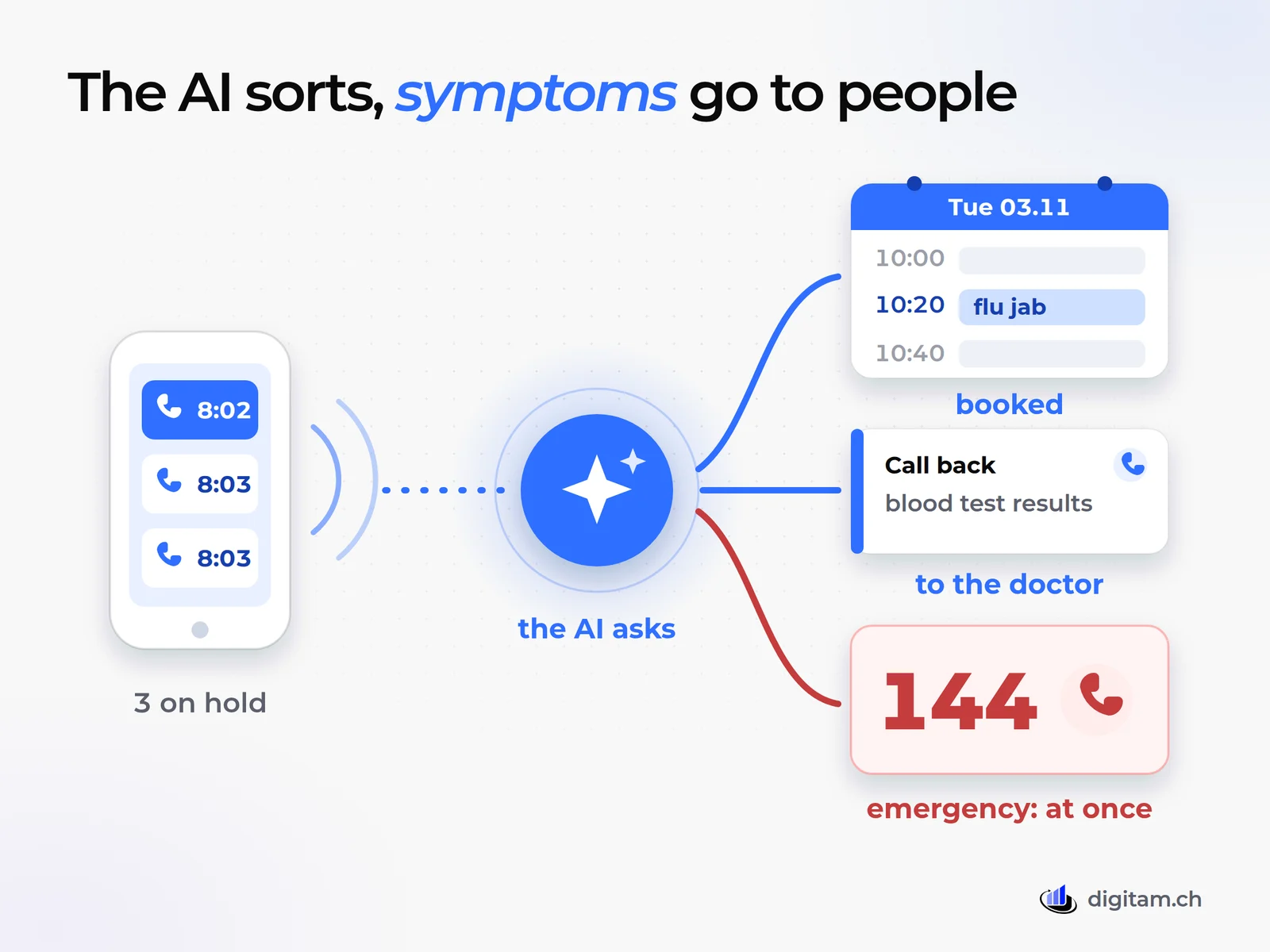
The rule that holds it all together: the assistant does not triage. It cannot tell whether chest pain is anxiety or a heart attack, and it must not try. It recognises the words the doctor has put on the emergency list and passes the call on. In Sara's case, the daughter would have heard within seconds: "I'm putting you through to someone at the practice right now."
Things the assistant never says
- "That doesn't sound serious."
- "You can take another tablet."
- "Your results are fine."
- "The doctor will definitely renew your prescription."
- "Just come in, we'll see you straight away", unless the calendar says so.
What should the assistant say in the first ten seconds?
Callers must understand straight away that they are talking to a machine. The Federal Data Protection and Information Commissioner puts it plainly:
With language models that communicate directly with people, "users have a legal right to know whether they are speaking or corresponding with a machine".
The same statement adds that people must know whether their data is used to improve the software or for other purposes6. The FADP also requires you to tell people who is collecting their data and why (Art. 19)7. In practice, three sentences at the start of the call are enough:
"Giubiasco medical practice, this is the practice's virtual assistant. I can book or move an appointment and take a message for the doctor. If it's an emergency or you'd like to speak to a person, just say so and I'll put you through."
Then add a page on the practice website explaining who processes the data, where and for how long. We've collected the general rules for phone and WhatsApp assistants in AI phone assistants and WhatsApp: the 2026 rules.
Health data on the phone: what do the FADP and medical secrecy require?
Even "I'm calling about my blood sugar check" is health data. Under the FADP, health data is sensitive personal data (Art. 5(c)(2)). Where processing relies on consent, that consent must be explicit for this kind of data (Art. 6(7))7.
When an outside provider handles your calls, four provisions matter7:
- Art. 9: you may hand processing to a provider by contract, provided it only does what you could do yourself and no duty of secrecy forbids it. You must check that it can protect the data, and it may only pass work to others with your permission.
- Art. 16: data may only go abroad to countries the Federal Council recognises as offering adequate protection.
- Art. 22: if the processing may pose a high risk, for example large-scale processing of sensitive data, you need an impact assessment first.
- Arts. 61 and 62: fines of up to CHF 250,000, on complaint, for anyone who intentionally hands over data without meeting Art. 9 or sends it abroad in breach of Art. 16. The same fine applies to anyone who intentionally discloses secret data learned while working for someone bound by secrecy.
On top of that sits professional secrecy under Art. 321 of the Swiss Criminal Code. It covers doctors and their auxiliaries, carries a custodial sentence of up to three years or a monetary penalty, and as a rule is lifted only by the patient's consent or by release from the Cantonal Physician8.
CHF 250,000
maximum fine for handing data to a provider without meeting the requirements of Art. 9 FADP
FADP, Art. 613 years
maximum custodial sentence for breaching professional secrecy
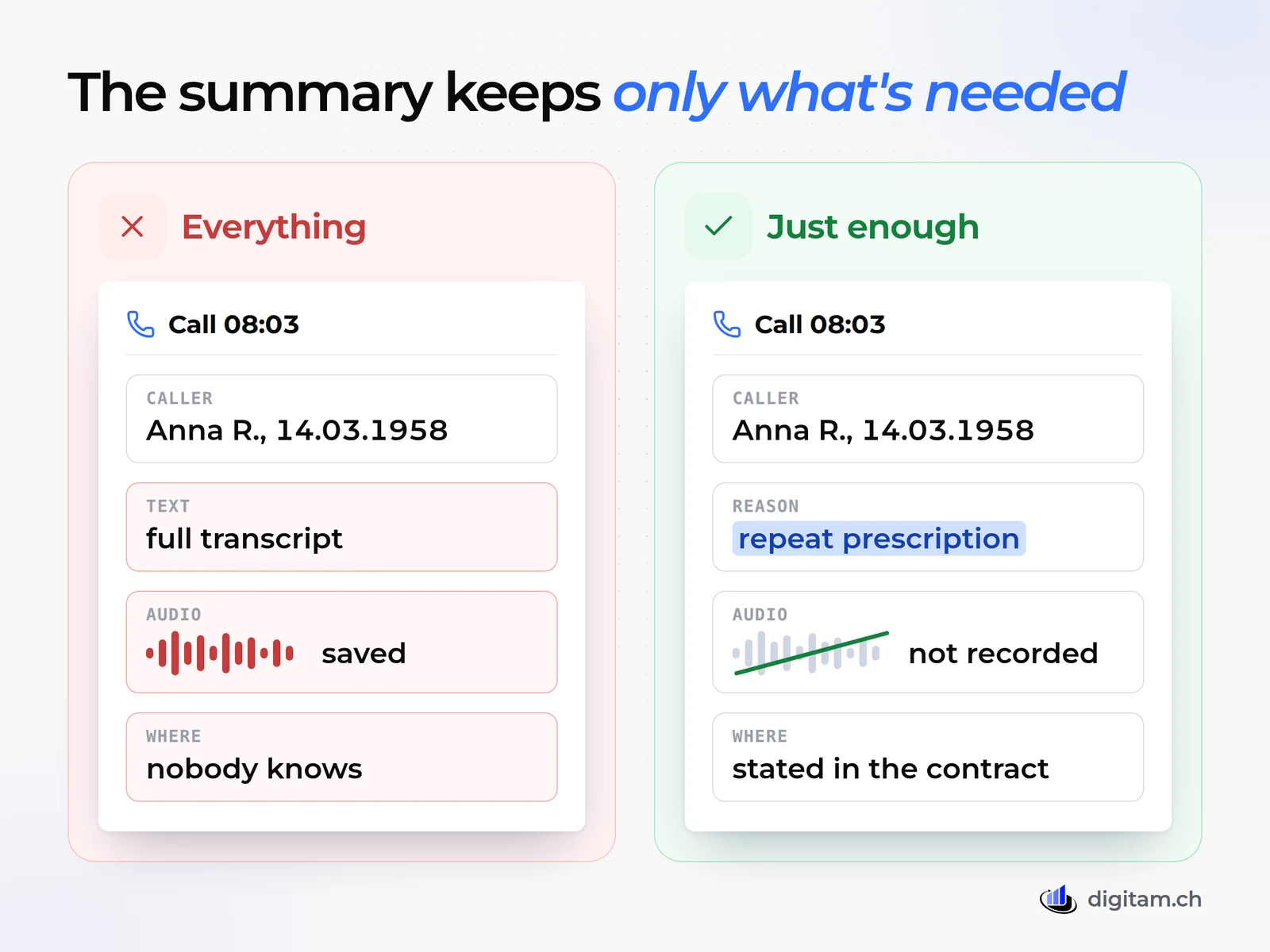
Art. 321 Swiss Criminal CodeThe simplest protection is not to collect what you don't need. A call summary for a repeat prescription needs a name, a date of birth and the reason. It doesn't need a full transcript or an audio file, and you need to know where it ends up.
If your practice already uses ChatGPT or similar tools, the same principles apply there too: see ChatGPT and the FADP.
What does it cost, and what do you pay on top of the subscription?
Public prices are rare. One Swiss provider that specialises in medical practices publishes this price list, excluding VAT: CHF 399 a month for one doctor or calendar, CHF 200 for each additional doctor at the same site, set-up and integration from CHF 5,000. The phone line is extra: for peoplefone it quotes CHF 120 a year per number9.
For a practice with two doctors, that's CHF 599 a month. The first year costs CHF 12,308 (7,188 subscription, 5,000 set-up, 120 line), and from the second year CHF 7,308, all excluding VAT. The same provider warns that unverified averages can produce a misleading business case and recommends measuring your own practice's calls9. It has a point: do the sums with your calls, not someone else's.
Beyond the subscription, check three things:
- The calendar. If the practice software doesn't accept connections, the assistant can only take messages, and someone has to copy them over.
- The doctor's time. The emergency rules are the doctor's to write, and they need reviewing after the first few weeks.
- The information. Opening hours, holidays and locum cover change: someone has to keep them up to date, or the assistant gives out old answers.
| Option | What it solves | What it doesn't |
|---|---|---|
| Answering machine | The out-of-hours message | Callers who ring back still find it busy |
| Online booking | Appointments for people who use it | People who call anyway, questions |
| Outsourced answering service | A human voice in office hours | Evenings and weekends, calendar access |
| AI assistant | Busy lines, out of hours, appointments | Symptoms, results, medical advice |
Online booking doesn't compete with the phone. In the Swiss eHealth Barometer 2025, 77 % of people said they feel fairly or very safe booking an appointment online3. Every patient who books on the website frees the line for someone who won't.
When an AI assistant isn't worth it for a practice
When it's better to wait
- You miss few calls and return them all within an hour: reorganise who covers the desk before you buy anything.
- The calendar is on paper or the software won't connect: the assistant becomes a pricier answering machine.
- Most calls are about symptoms: nearly all of them will end up with a person anyway.
- Nobody has time to read the messages and call back the same day.
- The provider can't tell you in writing where the data is, who sees it and whether it's used to train models.
- You want the assistant to decide who is urgent: that isn't its job.
There are technical limits too. A date of birth said in a hurry or an unusual surname can be misheard: the assistant has to repeat it back and ask for confirmation. An older patient may hang up as soon as they hear a synthetic voice. That's why it often makes sense to let it answer only when the line is busy, after a few unanswered rings and out of hours.
What to do from tomorrow
Five steps before you sign
- CountDuring the second vaccination week, 23 to 28 November, note the time and reason of every call and whether you answered.
- SortGroup the calls into appointments, information, prescriptions and certificates, questions for the doctor, emergencies.
- Write the rulesThe doctor decides which words go straight to a person and what is said in an emergency: 144 and the on-call doctor.
- Ask in writingWhere the data is stored, who sees it, whether it trains models, and a contract under Art. 9 FADP with a duty of secrecy.
- TestMake test calls with your staff, using tricky dates of birth and surnames, before you switch it on for patients.
If your count shows the line is mostly busy around 8 a.m. and half the calls are appointments, an AI assistant makes sense. If it shows something else, you still have the data to reorganise the desk.
Digitam Voice works to these rules: it introduces itself as a virtual assistant, answers in Italian and on request in German, French and English, books appointments in your calendar when it can connect to it, passes emergencies to the person you choose and leaves a written summary. It can answer all calls, only out of hours, or only when nobody can pick up. Before go-live we agree together where conversations are handled, who can access them and which data is kept. In a no-obligation demo you call it yourself, then you get a written quote with the set-up cost and monthly fee.
Frequently asked questions
Can the AI assistant tell a patient whether to come in or go to A&E?
No. It does not assess symptoms and never says whether something is serious. It recognises the words the doctor has defined as warning signs and puts the call straight through to someone at the practice. If nobody picks up, it tells the caller to dial 144; out of hours, for an urgent consultation, it gives the Ticino on-call doctor number, 091 800 18 28.
Do I have to tell patients that an AI is answering?
Yes. According to the FDPIC, people have a right to know they are talking to a machine and whether their data is used to improve the software. The FADP also requires you to say who is processing the data and why. One sentence at the start of the call and a clear page on the practice website cover it.
Is the assistant's provider bound by medical secrecy?
Put it in the contract. The FADP only lets you hand processing to a provider if no duty of secrecy forbids it and you have checked that the data will be protected. Art. 62 FADP fines anyone up to CHF 250,000 who intentionally discloses secret data learned while working for someone bound by secrecy.
Will it work with our practice software?
That depends on the software. If your calendar accepts connections, the assistant books and moves appointments directly. If not, it takes the request and someone at the desk confirms it: it works, but the copying stays with you. Ask before you sign, with the name and version of your program.
What about older patients who don't want to talk to a machine?
They must be able to ask for a person at any time. You can also let the assistant answer only when the line is busy, after a few unanswered rings or out of hours: callers reach your practice assistant first when she or he is free, and the machine only when nobody is.
Sources
- FOPH / admin.ch: Getting vaccinated against flu, COVID-19 and RSV (13.10.2026). National vaccination weeks from 2 to 7 and from 23 to 28 November 2026 (Swiss College of Primary Care Medicine with FMH, pharmaSuisse and FOPH), delays in part of the flu vaccine supply; recommended period from mid-October until the wave starts, usually between mid-December and mid-March.
- Adecco Group and University of Zurich: Swiss Skills Shortage Index 2025. Health specialists remain first for shortages; in Latin Switzerland they are the only group with a clear imbalance between supply and demand. Overall index 22 % lower than the previous year.
- gfs.bern: Swiss eHealth Barometer 2025, population. Commissioned by the FOPH. 1,963 people surveyed from 2.12.2024 to 7.1.2025, 329 of them in Italian-speaking Switzerland; 77 % feel fairly or very safe booking appointments online.
- Ordine dei medici del Cantone Ticino (OMCT). On-call doctor service 091 800 18 28; the association represents more than 2,000 doctors in Ticino.
- EOC: Emergency information. 144 for any urgent case or emergency; the on-call doctor service (Ticino Soccorso) on +41 91 800 18 28 for an urgent consultation between 19:00 and 07:00.
- FDPIC: Current data protection law is directly applicable to AI (8.5.2025). People talking to a language model have a legal right to know they are communicating with a machine and whether their data is used to improve the software; high-risk processing needs a data protection impact assessment.
- Federal Act on Data Protection (FADP), SR 235.1. Art. 5(c)(2) health data, Art. 6(7) explicit consent, Art. 9 processors, Art. 16 transfers abroad, Art. 19 duty to inform, Art. 22 impact assessment, Arts. 61 and 62 fines up to CHF 250,000. In force since 1.9.2023.
- Sentieri nelle Medical Humanities: L'obbligo e il diritto di segnalazione dell'operatore sanitario (31.7.2025). Art. 321 Swiss Criminal Code: doctors and their auxiliaries are bound by secrecy, custodial sentence of up to three years or a monetary penalty, on complaint; release by patient consent or by the Cantonal Physician.
- AIAgens: Virtual receptionist for medical practices, costs in Switzerland. Public price list: CHF 399 a month for one doctor or calendar, CHF 200 for each extra doctor, set-up from CHF 5,000, phone line not included (peoplefone CHF 120 a year per number), excluding VAT.
Written by Alessandro Scerpella. Sources checked on 3 November 2026.











 About Markets