 Digitam SAGL
Phone bookings at a restaurant in Ticino: can an AI take them?
Groups and last-minute guests book by phone, right in the middle of service. What an AI assistant can do, what it costs in Switzerland and what must stay with your staff.

47.7%
of guests at Swiss restaurants come from a phone booking, even though the phone accounts for only 34.4% of bookings
foratable by Lunchgate, Gästeverhalten 2025 (htr hotelrevue)At a glance
- The phone brings 34.4% of bookings but 47.7% of guests: that's where groups book, with 5.1 people on average.
- Late deciders call: 36.5% of guests book on the day itself, often while the dining room is full.
- An AI assistant can book, text a confirmation with your terms and answer in German, as long as it can see real availability in your booking system.
- Allergens, large groups and complaints go to a person: for allergens, Swiss food law requires written information or a knowledgeable person.
Friday, 12:35, a 70-seat restaurant on the lakefront in Lugano. Marta, the owner, has three plates of risotto in her hands and two tables waiting for the bill. Behind the bar, the phone rings for the fourth time in ten minutes.
She takes one call: a man from Zurich asks, in German, for a table for two at one o'clock. Marta writes it on a scrap of paper by the till. The next call, at 12:41, she lets ring. At 15:10, after service, she calls the number back. It was a woman who wanted to book for nine the following Saturday, for her mother's seventieth birthday. "Thanks, we've already found somewhere."
Marta and her restaurant are made up. The problem isn't. In Swiss restaurants the phone brings in fewer bookings than the internet, but more people at the table. And it rings exactly when nobody can answer. This article looks at restaurant phone bookings: who really calls, what an AI assistant can do on a Ticino restaurant's phone, what it costs compared with the alternatives, and what it must never do, starting with allergens.
Who still phones to book a table?
Fewer people than you'd think, but with bigger tables. The most solid figures come from foratable, the booking system made by Lunchgate, which analysed bookings at more than 1,200 venues in Switzerland for its "Gästeverhalten 2025" report1:
- online brings 51.9% of bookings, but only 43.3% of guests;
- by phone brings 34.4% of bookings, but 47.7% of guests;
- walk-ins make up 13.9% of bookings and 9.1% of guests.
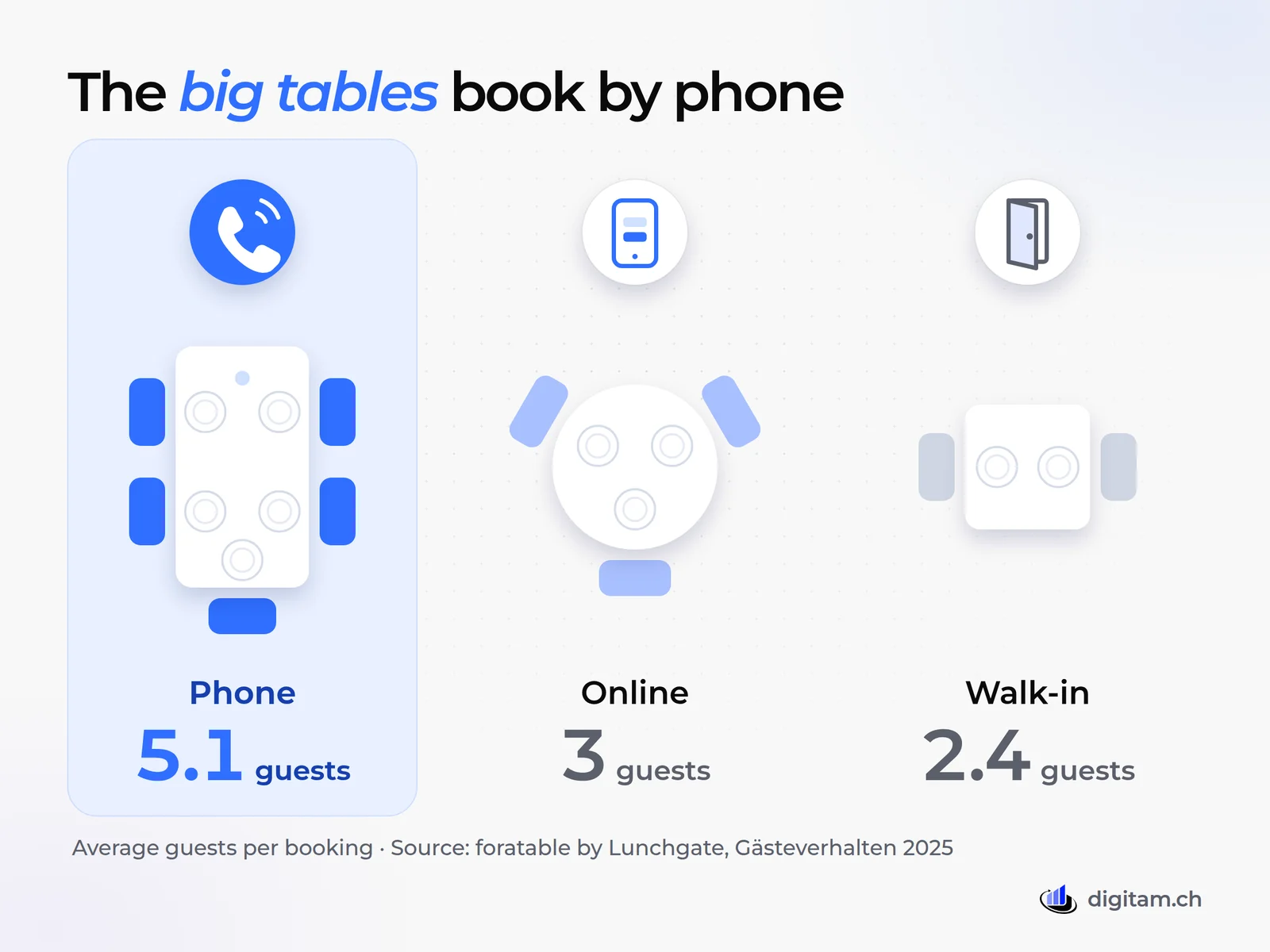
Groups make the difference. A phone booking brings 5.1 people on average, an online booking about 3, a walk-in 2.41. Office dinners, birthdays, family lunches: whoever organises for a crowd wants to talk to someone.
A restaurant in Ticino has one more reason to take the phone seriously. In 2025 hotels in Ticino recorded 2.51 million overnight stays: 60.3% by guests from Switzerland and 10% by guests from Germany5. A good share of the people calling for a table speak German, and expect an answer they understand.
So the call you let ring during service isn't worth a table for two. Often it's worth the table for nine.
Why does the phone ring right in the middle of service?
Because people book later and later. 36.5% of guests book on the day itself1. And late deciders pick up the phone: for bookings made less than an hour ahead, the phone is used more than twice as often as the internet (3% of guests against 1.3%)1. Those are the calls at 12:10 and 19:20, the ones that come in when the room is full.
At the other end are the groups that plan ahead. 36% of guests book at least eight days in advance, and they do it far more often by phone (24.7%) than online (11.2%)1. These calls come whenever they come: whoever is organising a birthday calls in their lunch break, which is your service.
36.5%
of guests book on the day of their visit
foratable by Lunchgate, Gästeverhalten 202524.7%
of guests book by phone at least eight days ahead; online it's 11.2%
foratable by Lunchgate, Gästeverhalten 202560.3%
of hotel overnight stays in Ticino in 2025 were by guests from Switzerland
Ustat, Canton of TicinoAnswering has a cost even when you do answer. Every call takes someone off the floor, and a booking taken with plates in your hands is a booking taken badly: the name scribbled, the phone number missing, the high chair forgotten. Putting someone permanently on the phone is the classic fix, but it costs money: the 2026 minimum wage under the hospitality collective agreement is CHF 3,713 a month for staff without vocational training7, before holidays, the thirteenth salary and social charges. And in the evening, once you close, nobody answers at all.
What does an AI assistant do on a restaurant's phone?
The same job as whoever takes bookings at the bar, with two differences: it has no plates in its hands and it doesn't get tired at 10 pm. A typical call goes like this.
- It says straight away that it's an AI assistant. According to the Federal Data Protection Commissioner, people talking to this kind of system have a legal right to know they are communicating with a machine10. What to say at the start, what to record and where the data goes is covered in our rules for AI phone and WhatsApp assistants.
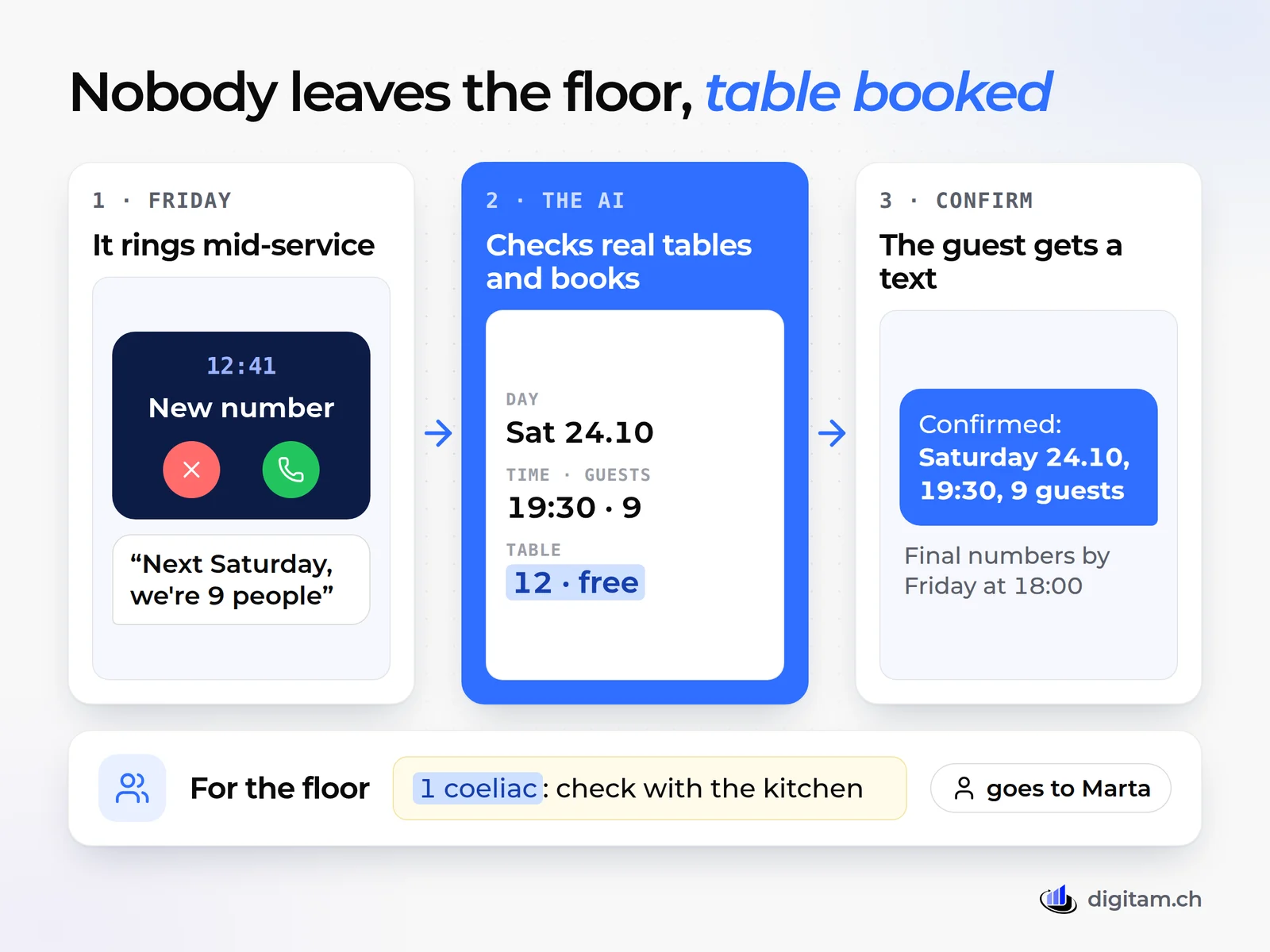
- It asks for what it needs: day, time, party size, name and phone number. It repeats the details and has them confirmed.
- It checks real availability in your booking system, not a list of times written at the start of the season. If 8 pm is full, it offers 7 or 9.
- It books and texts a confirmation, with the terms you decide.
- It answers the usual questions: opening hours, closing day, parking, terrace, dogs, today's menu. Only with the information you give it, and that you update when it changes.
- It passes the call on or arranges a call-back when the question falls outside the rules.
The industry is already heading this way. The trade paper htr hotelrevue puts it like this: AI can take bookings automatically or pass the call to the team when there are individual questions2. The second half of that sentence is the point.
One condition comes before everything else: the assistant must be able to see which tables are free. If bookings live in a paper diary, it can only take a note and have you call back. That's still better than voicemail, but it isn't a booking.
A booking is a contract: how do you avoid empty tables?
For GastroSuisse, a booking is a valid contract. If the guest doesn't show up, the restaurant can claim damages, but in a dispute it has to prove them: the table it couldn't fill, the food bought for nothing6. If a penalty is agreed in the booking confirmation, however, the damage doesn't need to be proven6.
Hence the association's advice: have bookings confirmed in writing, set clear cancellation terms and, for groups, agree when the final number of guests is due. Even just asking for a phone number helps: the booking feels more binding and you can call if the table stays empty6.
At the bar, with a full room, these things get skipped. An assistant does them on every call because they're part of the script: it asks for the number, sends the text and puts your terms in it. For example: "For groups of 8 or more, final numbers by 18:00 the day before." You decide the rule and the amount of any penalty; the assistant repeats them the same way every time, even on the thirtieth call on a Saturday.
Allergens: why a person must give the answer
"Is the risotto gluten-free?" This is the question an AI assistant must not close on its own.
The rule is in the Swiss ordinance on food information (OID in Italian, LIV in German). For dishes served in restaurants, allergen information may be given orally only under two conditions: a clearly visible written notice says it is available on request, and staff have the information in writing or a knowledgeable person can give it straight away (Art. 5 para. 1 let. d)8. The Federal Food Safety and Veterinary Office sums it up: in principle, allergens must be declared in writing9.
The rule talks about staff and knowledgeable people. An assistant on the phone is neither, and if it gets an ingredient wrong, it's the guest who pays, not the software. Our advice is simple:
- the assistant never says whether a dish does or doesn't contain an allergen;
- it notes the allergy in the booking ("1 coeliac"), so the floor and the kitchen see it before the guest arrives;
- it tells the caller that staff will confirm which dishes are suitable, and if the question is urgent it passes the call on or books a call-back.
If you want the assistant to read your allergen chart to callers, ask the cantonal food control authority first. This article isn't legal advice.
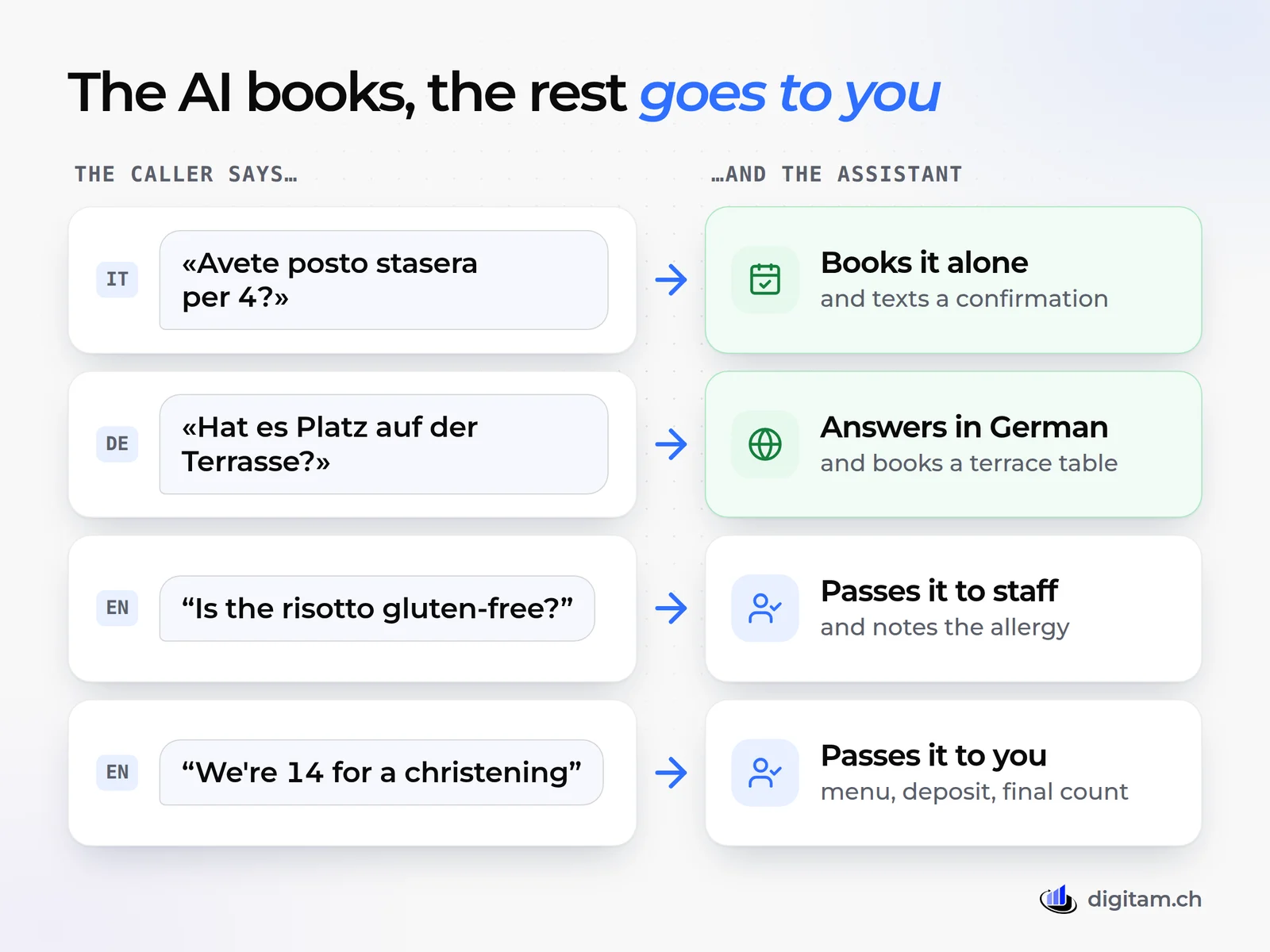
The same goes for large groups and events, where menus, deposits and timings are negotiated, and for complaints: an angry caller wants a person. Write these rules down on day one, one per line.
What does it cost, and what are the alternatives?
There are four routes, and they can be combined.
| Option | What it costs | What's left uncovered |
|---|---|---|
| Floor staff who also handle the phone | 2026 minimum wage from CHF 3,713 a month for staff without training, plus holidays, thirteenth salary and social charges | Calls at peak times and after closing |
| Online booking on your website and Google | foratable Basic: CHF 115 a month excl. VAT, yearly subscription | Groups and late deciders, who phone anyway |
| AI built into the booking system | foratable Professional CHF 180 a month, plus the AI add-on: CHF 0.35 per call, CHF 0.09 per text, CHF 150 setup, excl. VAT | Books inside its own system; passes special requests to staff |
| Custom AI phone assistant | Setup cost plus monthly fee, depending on features and connections | Needs to be set up with your rules and updated when they change |
foratable's prices come from its public price list3: we use it as a concrete example, not as a recommendation over other systems. A sample calculation of our own: with 300 calls a month, the AI add-on costs CHF 105 a month, plus texts and the subscription.
If you already use a booking system, the first question goes to your provider: does it have a phone assistant? What exactly does it do? The foratable assistant, for instance, takes the time, party size, name and requests such as a high chair or a dog, confirms by text and passes callers with special requests to the team4. For many restaurants, that's enough.
A custom assistant makes sense when more happens on the phone: questions about events, banquets and group menus, several languages that need handling well, different rules for lunch and dinner, the same assistant on WhatsApp too, or a hotel with a restaurant that gets calls for both rooms and tables. Whichever provider you choose, ask three things: do you pay per call or per minute? Are texts included? What happens if the system doesn't respond?
When an AI assistant isn't needed
When it doesn't pay off
- You don't take bookings. A grotto where people just walk in and sit down has nothing to book: at most it needs a message with opening hours and closing days.
- You miss very few calls. If you miss one a week and call it back, rewrite your voicemail greeting and stop there. How to count them is explained in missed calls: what they cost.
- Bookings live in a paper diary and you don't want to change that. First you need a system with real availability, then the assistant.
- The menu and opening hours change every day and nobody has time to update the information. An assistant giving out old information does more harm than a ringing phone.
- Most calls are about groups and events. That needs a person who can negotiate; the assistant can only collect the details and set up a call-back.
- Your regulars want to talk to you. In that case, let it answer only when the line is busy or after closing.
Even when it pays off, it has limits. A name said on a noisy street can be misheard, and a wrong number makes the text useless: the assistant must repeat everything and have it confirmed. And it has to be tested with real calls, in Italian and in German, before it goes live on the restaurant's number.
What to do from tomorrow
- For two weeks, count the calls during service. Your phone's call log is enough: time, answered or missed and, when you can, how many people.
- Look at your booking system. Does it have a phone option? Does it connect to other tools? If you still use a paper diary, this is step one.
- Write the rules on one page: from what party size a group goes to you, the cancellation terms, what to say about allergens, who handles complaints.
- Check your allergen notice on the menu or the board, and the written chart for staff: you need both anyway, with or without AI.
- Test before you sign: ten real calls, in Italian and in German, with a tricky name and an odd request.
If after two weeks the count shows you mostly lose the big tables and the last-minute calls, that's what Digitam Voice does. It can answer every call, only outside opening hours, or only when nobody manages to pick up. It starts in Italian, and German, French and English can be added. It says straight away that it's an AI, takes bookings according to your rules (in your calendar or in your booking system, if it can be connected) and passes groups, complaints and allergen questions to the person you choose. After the demo you get a written offer with all the costs, before you decide. If you want to know whether it makes sense for your restaurant, get in touch.
Frequently asked questions
Can an AI assistant take bookings if I still use a paper diary?
Not really. Without a system that shows free tables, the assistant can't know whether there is room at 8 pm. It can take the name, number, day and party size and have you call back, which already beats voicemail. To book on its own it needs a digital booking system or a shared calendar it can connect to.
Does the caller have to know they are talking to an AI?
Yes. The Federal Data Protection Commissioner reminds businesses that people talking to an AI system have a legal right to know they are communicating with a machine. One sentence at the start is enough, for example: “I'm the restaurant's digital assistant, I can take your booking.” Anyone who prefers a person must be able to ask for one.
Is it enough to give allergen information orally, without writing it on the menu?
Yes, but only under two conditions set by Swiss food information law: a clearly visible written notice says the information is available on request, and staff have it in writing or a knowledgeable person can give it straight away. This applies with or without an AI assistant. If the notice is missing, add it before anything else.
Can I ask phone callers for a credit card?
GastroSuisse lists the credit card as one option against empty tables, alongside taking a phone number and clear cancellation terms. If you do it, put the terms in the confirmation. The assistant shouldn't have card numbers read out over the phone, though: a link from your booking system sent by text is the safer way.
Can I keep the restaurant's phone number?
In most cases, yes. The assistant receives calls through call forwarding set up with your phone provider: always, only outside opening hours, or only when nobody picks up after a few rings. How to set up forwarding on a landline is explained in our article on missed calls.
Sources
- htr hotelrevue: Restaurantbesuche: Zwischen Walk-in und Online-Booking (13.11.2025). Figures from the foratable by Lunchgate report «Gästeverhalten 2025», more than 1,200 venues in Switzerland: bookings and guests by channel (51.9/43.3% online, 34.4/47.7% phone, 13.9/9.1% walk-in), 5.1 guests per phone booking, 36.5% book on the day, lead times by channel.
- htr hotelrevue: Vom Telefon zur Datenanalyse (14.11.2025). AI can take bookings automatically or pass the call to the team when there are individual questions.
- foratable: Preise. Public price list: Basic CHF 115 and Professional CHF 180 a month, billed yearly; AI phone assistant add-on CHF 0.35 per call, CHF 0.09 per text, CHF 150 setup; prices excluding VAT.
- foratable: KI-Telefonassistent. What the foratable assistant records (time, guests, name, special requests), text confirmation, handover to staff for special requests.
- Ustat, Canton of Ticino: Tourism, key figures 2025. 2.51 million hotel overnight stays in Ticino in 2025; guests from Switzerland 60.3%, from Germany 10.0%.
- GastroSuisse: Reservationen. A booking is a contract; damages and penalties agreed in the confirmation; written confirmation, cancellation terms, final numbers for groups, phone number.
- GastroSuisse: Sozialpartner geben definitive Mindestlöhne für 2026 bekannt. 2026 minimum wages under the hospitality collective agreement (L-GAV): CHF 3,713 a month for staff without vocational training (category Ia).
- Ordinanza del DFI concernente le informazioni sulle derrate alimentari (OID), SR 817.022.16. Art. 5 para. 1 let. d: allergen information may be given orally only with a clearly visible written notice and with the information available to staff in writing or from a knowledgeable person.
- BLV: Informationen im Offenverkauf. Federal Food Safety and Veterinary Office: in principle, allergens must be declared in writing; this also applies to dishes served in restaurants.
- EDÖB: Update – Geltendes Datenschutzgesetz ist auf KI direkt anwendbar (8.5.2025). Federal Data Protection Commissioner: people talking to an AI system have a legal right to know they are communicating with a machine.
Written by Alessandro Scerpella. Sources checked on 21 October 2026.











 About Markets