 Digitam SAGL
AI agents in Swiss businesses: what they do alone and where a person is needed
What an AI agent can do without asking, where it has to stop, and what it really costs a Swiss SME once you count the person checking its work.

30.3%
of simulated office tasks completed on its own by the best AI agent in the TheAgentCompany benchmark (September 2025)
TheAgentCompany, Carnegie Mellon UniversityAt a glance
- An AI agent decides its own next step, so it needs a fence of written rules, including the points where it must stop and ask.
- In independent tests, agents almost always succeed at short tasks and often fail at long ones, especially in admin and finance.
- Discounts, payments and decisions about people stay with a person; for purely automated decisions, Art. 21 FADP gives people the right to a human review.
- Count the time of whoever checks the agent's work: in our example with 800 cases a month, it costs twice as much as the AI credits.
Tuesday, 6:50 a.m., Giubiasco. Carla runs a cleaning company with 14 staff, and in ten minutes she has to hand out the day's shifts. Eleven messages came in overnight. Six have already been dealt with by the AI agent connected to her email, calendar and business software: three jobs confirmed, opening hours sent to a new customer, two appointments moved into a free slot. Two are drafts: quotes for 240 m² and 95 m² of office space, worked out from the floor plans attached, waiting for her to click "Approve". The last three the agent left for her, each with a one-line reason. A residential building wants a 20% discount to renew its contract. A customer says their office wasn't cleaned on Friday. An employee is off sick and the 7:30 shift has no one.
The company is made up; the way the work is split is not. That is how an AI agent should work in a small business. Below: what an agent can really do on its own, what independent tests and Swiss figures say, where the law wants a person involved, and what it costs once you include the checking.
What does an AI agent do that a chat tool doesn't?
With ChatGPT or another chat tool, you carry the work: you copy the email, ask for a reply, paste it where it belongs. A classic automation follows a fixed recipe someone wrote: if the subject line says "order", save the attachment to that folder. If the customer writes "purchase", nothing happens.
An AI agent gets a goal and some tools: the mailbox, the calendar, the business software. It decides by itself which one to use and in what order. Asked to move a cleaning job, it reads the email, checks the calendar, finds a free slot, sees who is on shift and replies.
The difference comes down to one question: who chooses the next step? In a chat, you do. In an automation, whoever programmed it. In an agent, the AI model. That is why agents cope well with messy messages. It is also why they can be wrong with great confidence.
So the real work in setting up an agent is not picking the model. It is drawing the fence: what it may do without asking, where it stops, and whom it tells.
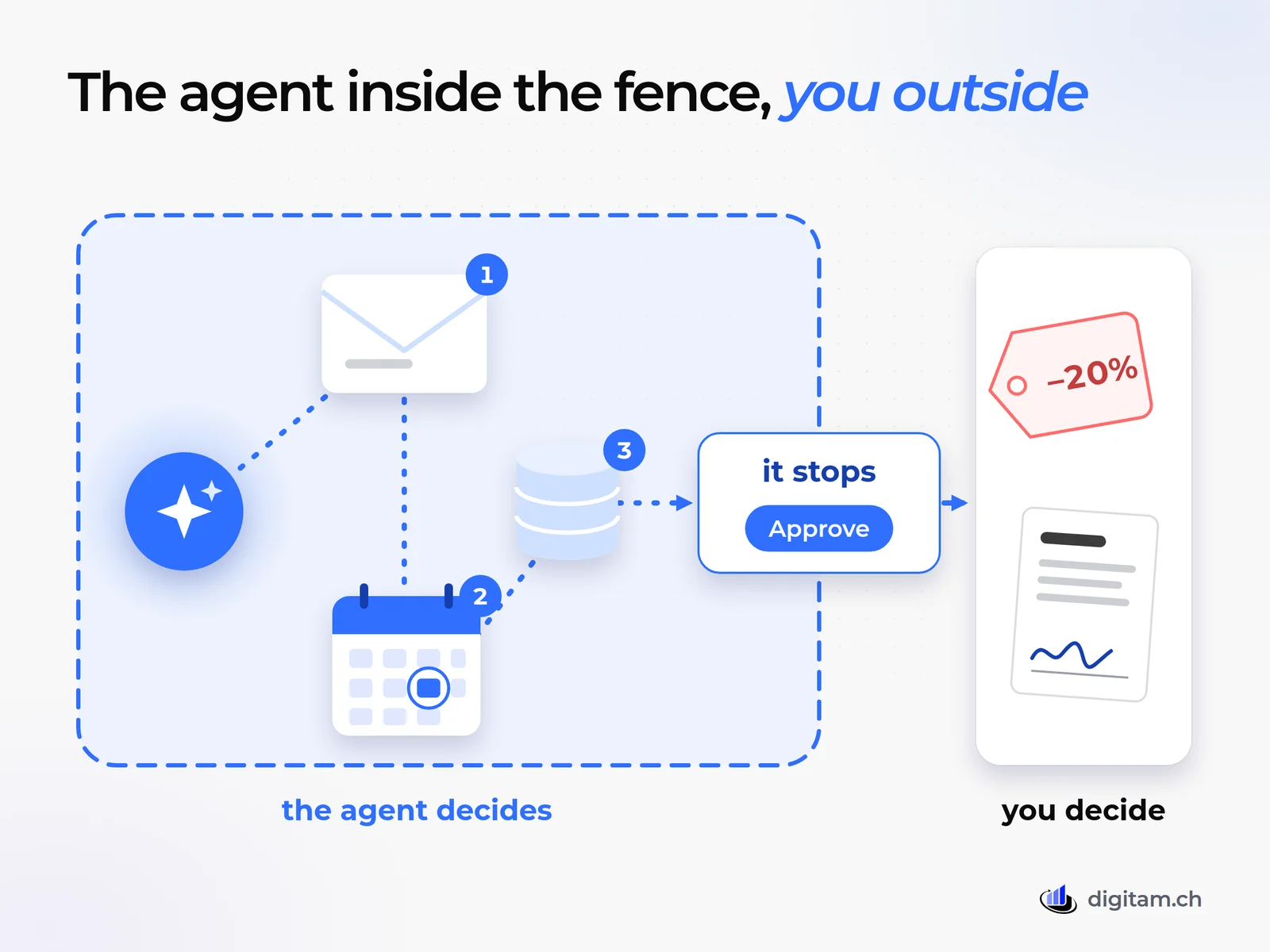
Watch the labels: plenty of products called "agents" are a chat tool with one extra button. And if a task is always identical, an agent is overkill; a simple automation will do, as we explain in AI automation for SMEs: where to start.
How far can it go on its own? What the tests say
Vendors show the demos that worked. Independent tests also count the failures, and they all point the same way: the longer the task, the more often the agent gets it wrong.
The research organisation METR timed how long experts take to complete a set of tasks, then measured which of them AI models could do. In March 2025, models almost always succeeded at tasks that take a person less than 4 minutes, and less than one time in ten at tasks over roughly 4 hours6. The length of task they could handle was doubling about every 7 months. They are improving fast, but the order stays the same: short tasks first.
At Carnegie Mellon University, researchers built TheAgentCompany, a simulated small software firm with 175 everyday employee tasks across programming, HR, project management, admin and finance5. In the September 2025 version, the best agent completed 30.3% of them on its own, taking 27.2 steps and about 4.2 dollars per task on average. The weakest results came in admin and finance, where many models finished no tasks at all. The authors say the models struggle to understand documents, to talk to colleagues and to use complex interfaces.
The third test is the closest to a small business. For about a month, Anthropic let an agent run the small shop in its San Francisco office: choosing products, setting prices, restocking, answering customers7. The agent was talked into handing out discount codes, gave stock away, sold items below cost and for a while told customers to pay into an account that didn't exist. When someone offered 100 dollars for six cans of a soft drink that cost 15 online, it said it would keep the request in mind. The authors' verdict: if they were moving into that business today, they would not hire it.
30.3%
of simulated office tasks completed on its own by the best agent, September 2025
TheAgentCompany4 minutes
below this length models almost always succeeded; above 4 hours, less than one time in ten
METRThe lesson for a small business is practical. Short tasks with a clear start and end, an agent handles well. Money and negotiations belong outside the fence.
What are Swiss companies already doing?
In Switzerland, agents arrived first in customer service. A barometer by Teleactis, Colombus Consulting and callnet.ch surveyed about 100 companies in all three language regions between June and September 2026: 36% already use an AI agent in customer service and another 41% are seriously considering it4. The sample is small and Teleactis sells customer service, so read it as a signal rather than a measurement. The most useful finding is how companies see the role of their people.
What Swiss companies expect from AI agents in customer service
- They will take over some tasks, under human supervision70 %
- They will be an extra tool for staff56 %
- They will replace staff on a large scale8 %
The same barometer names the main obstacle: not cost, but a lack of in-house skills (47%). And among companies with 50 to 250 employees, 55% have no project at all4.
Among SMEs the picture is more cautious. AXA's study with Sotomo of 336 SMEs in German- and French-speaking Switzerland, carried out in March 2026, found that 35% deliberately build AI into their processes, 39% are trying it out and 26% don't use it3. They use it mostly for translation (47%), correspondence (42%) and advertising copy (35%). In customer support the share is stuck at 17%. AXA puts this down to the "human in the loop" principle, with a person as the final check, and to the fear of made-up answers. Ticino was not in the sample.
Alone, as a draft, or by a person: how to split the work
Back to Carla. Her agent isn't smarter than others; it simply has clear rules about where to stop. For every task you want to hand to an agent, ask three questions.
- Does money leave the company, or is a decision made about a person? Discounts, payments, credit notes, a rejected applicant, a customer turned away. If yes, a person decides; the agent prepares the information.
- If it gets it wrong, can you undo it with one click? A moved appointment can be moved back. An email sent to a customer can't be recalled. Anything that can't be undone goes out as a draft.
- Is the rule written down anywhere? "Confirm the job if a team is free" is a rule. "We look after long-standing customers" is not: as long as it lives in the owner's head, the agent can't apply it.
If the answers are no, yes and yes, the agent can act alone, leaving a record of every action. In the morning, the result looks like this.
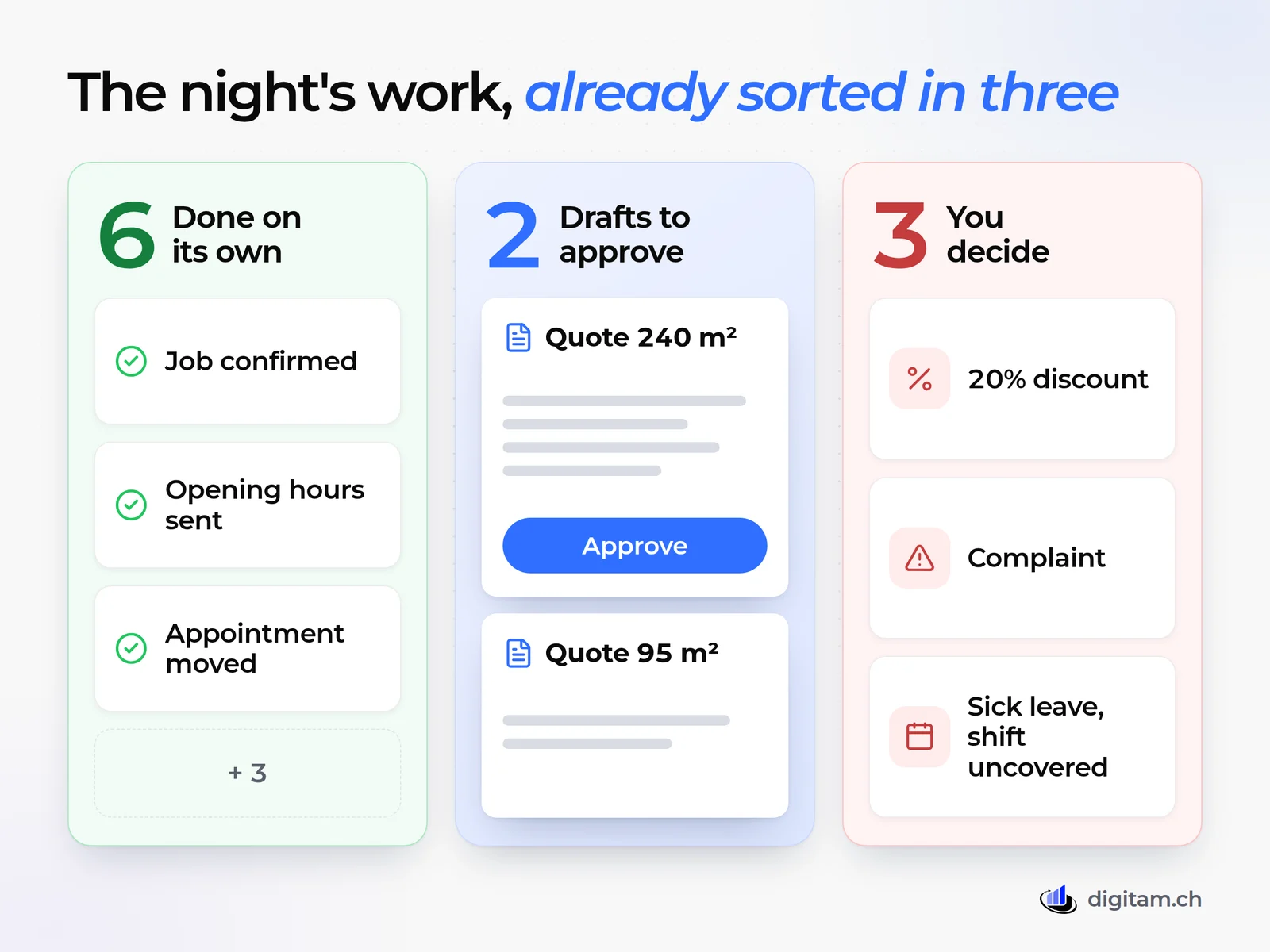
Apply the same three questions to other typical tasks in a Ticino SME and you get a split like this.
| Task | Alone | As a draft | A person decides |
|---|---|---|---|
| Customer orders | Confirms if item and price are on the list | Delivery on a non-standard date | Off-list discount, credit limit exceeded |
| Incoming email | Sorts and answers questions on hours and order status | First reply to a new customer | Complaint, cancellation |
| Supplier invoices | Reads amount and due date, matches them to the order | Accounting entry | Payment, price differences |
| Appointments | Offers and confirms free slots | A change that affects another customer | Emergency, unhappy customer |
| Job applications | Confirms receipt | Summary of the application | Who gets an interview |
The column that matters is the last one. An agent that doesn't know when to stop is worse than no agent, because it makes mistakes quietly. Ask for a one-line reason every time it stops, as in Carla's queue: that is how you will see whether the rules work.
What does Swiss law require?
Switzerland has no dedicated AI law. The Federal Act on Data Protection (FADP) applies instead, and the FDPIC considers it directly applicable to AI-based processing because it was written to be technology-neutral2. Four points matter for an agent.
Decisions taken by the machine alone. If a decision is based solely on automated processing and has legal effects or significant consequences for a person, Art. 21 FADP requires you to inform them. On request, they can give their view and demand that a natural person review the decision1. This doesn't apply if the decision is directly linked to concluding or performing a contract and the person's request is granted, or if they gave express consent. In practice, an agent that confirms an order is fine. One that rejects an applicant or turns down a customer is not.
People writing to the agent must know. According to the FDPIC, anyone interacting with an AI system has the right to know they are communicating with a machine2. A clear signature on replies is enough. The rules for phone and WhatsApp are in AI phone assistants and WhatsApp.
Your privacy notice. Art. 19 requires you to inform people properly when you collect their data, including the purpose and, where relevant, the recipients1. If an AI provider reads your customers' emails, your privacy notice must say so.
The provider reading your mail. If the agent runs on a provider's servers, that provider processes data on your behalf. Art. 9 requires a contract and for you to check that the provider can guarantee data security1. Anyone who intentionally outsources processing without meeting these conditions faces, on complaint, a fine of up to CHF 250,000 (Art. 61). The questions to ask your provider are in ChatGPT and the FADP.
This article is not legal advice: for your own case, ask your fiduciary or a lawyer.
What does it really cost, checking included?
The software price is the easy part. Take Microsoft's Copilot Studio, which publishes prices in francs: a pack of 25,000 credits costs CHF 162 a month8. Each AI-generated answer uses 2 credits, each agent action 5, each document page read 89. In Microsoft's own example, an agent that processes an order with 4 actions uses 20. At 800 cases a month that is 16,000 credits: one pack is enough, even if the agent also reads a one-page PDF per case (28 credits, 22,400 in total).
The bill can grow. If the agent uses a model that "reasons" at length, add 10 credits per 1,000 tokens. And when usage reaches 125% of the credits you bought, the agents are switched off until capacity is added9. Set a monthly limit for each agent from day one: Microsoft lets you do it from the admin centre.
Then there's the item missing from most quotes: the time of the person who checks. In 2024 the median wage in Ticino was CHF 5,708 gross a month for a full-time job10, with a contractual week of 41 hours 47 minutes11. That works out at about CHF 31.50 an hour before social charges (our calculation). Half an hour a day to approve drafts and look at exceptions, over 21 working days, is 10.5 hours: CHF 331 a month.
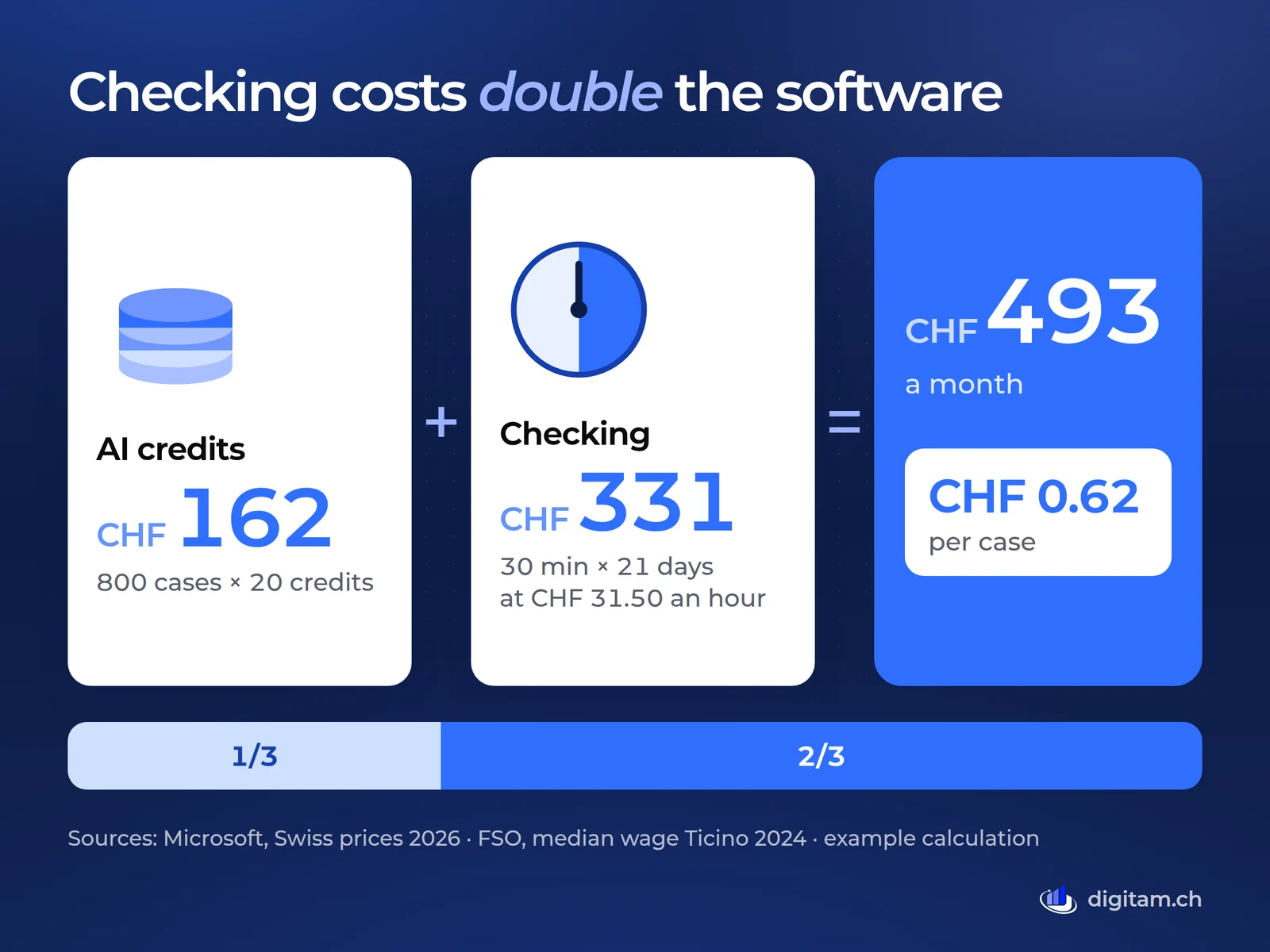
Checking costs twice as much as the software, and that's not a flaw: it's the price of the fence. To see whether it pays, compare the CHF 493 with the time those 800 cases take today. At 4 minutes each, that's more than 53 hours a month. But if the agent makes frequent mistakes and checking rises to two hours a day, most of the gain disappears. Set-up comes on top: connecting the agent to your software and writing the rules.
When an AI agent isn't worth it
- You only have a handful of cases a month: the set-up never pays for itself.
- The task is always identical: a fixed rule costs less and never improvises.
- The rules live in one person's head and change from customer to customer.
- A mistake can't be undone: a payment sent, a cancellation mailed.
- Customers choose you for the personal relationship and want to talk to you.
- Nobody has time to look at the exceptions: without checks, the agent fails quietly.
What to do from tomorrow
You don't need a big project. You need one task, measured before and after.
A first agent in six weeks, without leaps in the dark
- Pick one taskJust one, frequent and tedious: job confirmations, questions about opening hours, orders at list price.
- Count for two weeksHow many cases, how many minutes each, how many exceptions. Without these numbers you'll never know if the agent pays off.
- Write the fenceOne page: what it does alone, when it stops, whom it tells. Money and decisions about people stay outside.
- Run it in draft mode for a monthThe agent prepares, a person approves everything. Then let it act alone only where its drafts were almost always right.
Before signing with a provider, ask what the agent does without asking and how you change those limits, what it does when it isn't sure, whether there's a log of every action you can read, whether you can set a spending cap and where the data ends up. Then measure: according to the Swiss barometer, 46% of companies using AI agents don't measure their performance4. After the month in draft mode, count how many drafts went through without corrections.
If nobody in the company knows how to set the rules, the problem is skills before technology: see AI training for companies. If you'd rather build the agent with someone, with AI Automation we connect it to the software you already use, start in draft mode and write the fence page with you. You get a fixed price before signing, and if the numbers don't add up, we tell you straight away. To work out which task to start with, book a free 30-minute consultation.
Sources checked on 13 October 2026.
Frequently asked questions
Can an AI agent answer customers on behalf of my company?
Yes, but the person reading the answer must be able to tell that a machine wrote it: according to the FDPIC, anyone dealing with an AI system has the right to know. A clear signature such as “answer prepared by our AI assistant” is enough. For the first few weeks, have replies to new or unhappy customers go out as drafts that a person approves.
Do I need my customers' consent to use an AI agent?
Not as a general rule. You do have to inform them properly that their data is processed and, where relevant, who receives it (Art. 19 FADP): if an AI provider reads your email, your privacy notice must say so. Express consent matters mainly for decisions taken by the machine alone that have significant consequences for a person (Art. 21 FADP).
Can I use an AI agent to screen job applicants?
It can summarise applications and confirm that they arrived. If it rejects someone on its own, though, that is an automated decision with significant consequences: the person must be informed and can ask for a human to review it (Art. 21 FADP). The simplest set-up is for the agent to prepare the summary and for a person to decide who gets an interview.
Who is responsible if the agent gets it wrong?
Towards your customers, the mistake belongs to the company using the agent, just as with a software bug or an employee's error. That is why you need three things: a log of every action that someone reads each week, only reversible actions when the agent works alone, and a monthly spending cap. Payments, discounts and commitments to customers should stay outside its autonomous actions.
How is an AI agent different from the chat tool I already use?
With a chat tool you carry the work: you copy the text, ask, and paste the result where it belongs. An agent starts by itself when an email or order arrives, uses the software it is connected to and chooses the order of the steps. It saves more time, but precisely because it acts alone it needs written limits and someone who checks the exceptions.
How much does an AI agent cost a small business?
The software can be cheap: in Copilot Studio a pack of 25,000 credits costs CHF 162 a month and, at Microsoft's rates, covers about 1,250 simple cases like the order in their example (20 credits each). The bigger item is often the time of whoever approves drafts and exceptions: half an hour a day at the Ticino median wage is worth about CHF 331 a month. Set-up comes on top.
Sources
- Federal Act on Data Protection (FADP), SR 235.1. Art. 9 (processors), Art. 19 (duty to inform), Art. 21 (automated individual decisions), Art. 61 (fine of up to CHF 250,000). Italian version consulted.
- FDPIC: current data protection law is directly applicable to AI. Statement of 8 May 2025: the FADP is technology-neutral, people have the right to know they are talking to a machine, automated decisions can be reviewed by a human.
- AXA: SME Labour Market Study 2026, artificial intelligence. Press release of 15.9.2026. Sotomo survey of 336 SMEs in German- and French-speaking Switzerland, 11-18 March 2026.
- Baromètre IA dans la relation client en Suisse (Teleactis, Colombus Consulting, callnet.ch). Press release of 6.10.2026 on Allnews. About 100 companies in all three language regions, June to September 2026. Teleactis is itself a customer service provider.
- TheAgentCompany: Benchmarking LLM Agents on Consequential Real World Tasks. Carnegie Mellon University preprint, version of 10 September 2025: 175 tasks, best agent at 30.3%.
- METR: Measuring AI Ability to Complete Long Tasks. Study of 19 March 2025 with published method: tasks timed on human experts, manageable task length doubling about every 7 months.
- Anthropic: Project Vend. Report of 27 June 2025 on the agent that ran a small office shop for about a month.
- Microsoft: Copilot Studio pricing for Switzerland. Pack of 25,000 Copilot Credits at CHF 162 a month. Consulted on 13.10.2026.
- Microsoft Learn: Billing rates and management, Copilot Studio. Credits per answer, action and page read; order-processing example (20 credits); agents disabled at 125% of capacity; per-agent limits.
- FSO: median wage of CHF 7,024 gross in 2024. Press release of 25.11.2025: median wage in Ticino CHF 5,708 gross a month for a full-time job.
- FSO: over eight billion hours worked in 2024. Press release of 22.5.2025: contractual working week for full-time employees of 41 hours 47 minutes.
Written by Alessandro Scerpella. Sources checked on 21 October 2026. This article is not professional advice: if you spot a figure that doesn’t add up, write to us at info@digitam.ch.











 About Markets