 Digitam SAGL
Missed calls at a Swiss small business: what they cost and how to stop losing them
How to count the calls you miss, what they are really worth and who can answer for you: call forwarding, an answering service or an AI assistant, with Swiss prices.

33.8%
of people in Switzerland find talking to an AI on the phone appealing; written chat appeals to 61.9%
Comparis / Innofact, March 2026At a glance
- For one week, note every missed call: who it was, what time, whether you called back. Suppliers and regular clients try again; new numbers are the ones that matter.
- You work out the value with four numbers of your own: new numbers lost, share that becomes a job, margin per job, weeks worked. If the result is small, don't spend money fixing it.
- A telephone answering service in Switzerland starts at CHF 190 a month, but works Monday to Friday during office hours: evenings and weekends are not covered.
- On a Swisscom landline, forwarding on no answer is free, kicks in after 25 seconds and lets you keep your number.
- Only 33.8% of people in Switzerland find talking to an AI on the phone appealing: an assistant must say what it is, keep it short and hand emergencies to a person.
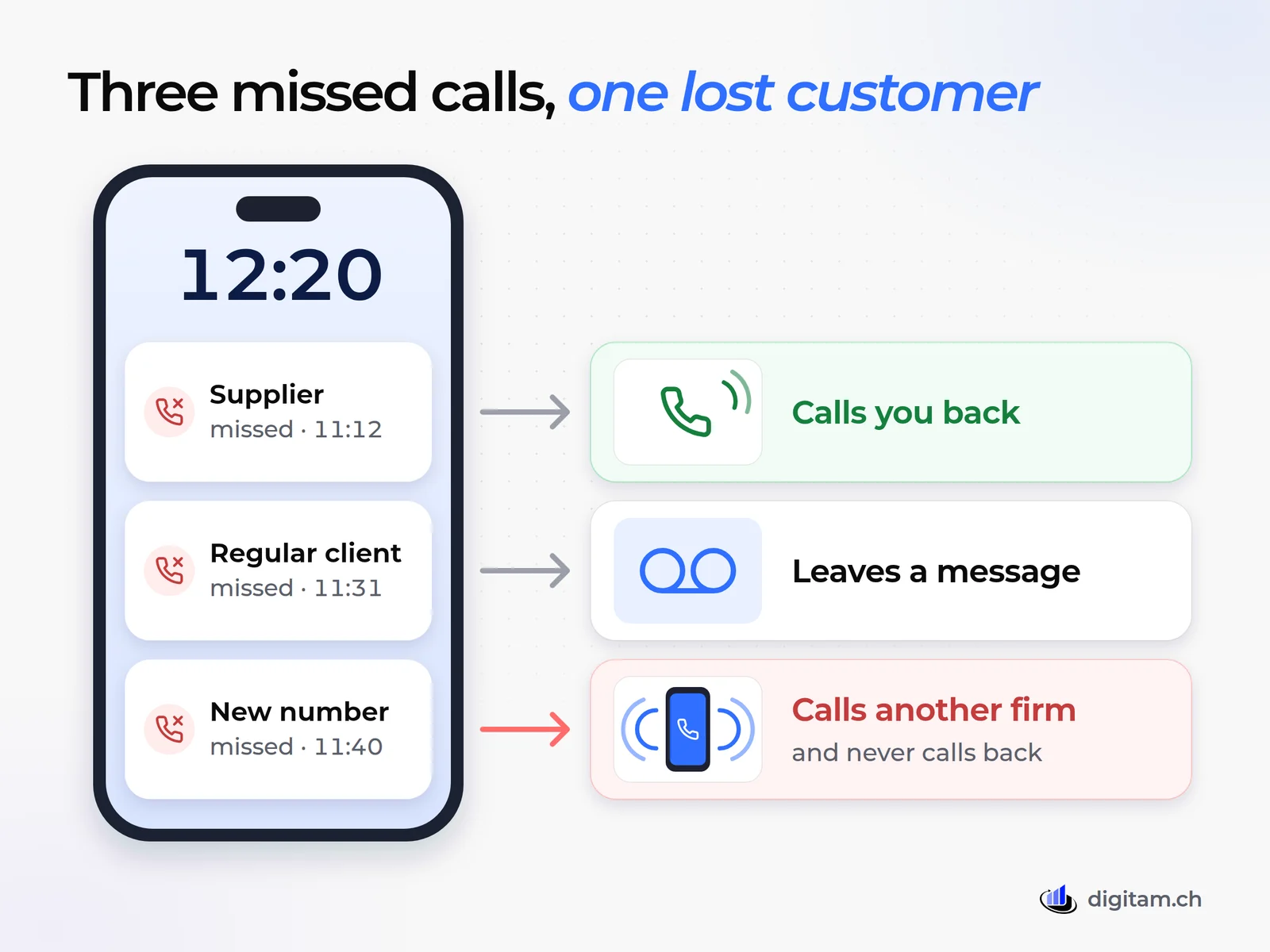
Tuesday, 11:40. Davide, a plumber with two employees in Mendrisio, is on his knees under a washbasin in Chiasso, hands wet. His phone vibrates in his jacket, hanging in the van. At 12:20, on his break, he finds three missed calls: his supplier, a long-standing client and a number he doesn't know. He calls the new number first. The manager of an apartment building answers: "Thanks, we've already found someone. There was water in the cellar."
The example is made up. The 11:40 call isn't: anyone who works with their hands knows it well. In Switzerland, almost 90% of companies have fewer than ten jobs7. In nearly all of them nobody is paid just to answer the phone: whoever is free picks up, when they are free.
This article doesn't start from technology but from the numbers. How many calls you miss, what they are worth, and which solution costs less than the damage: from free call forwarding to an answering service to an AI assistant.
How many calls do you really miss, and from whom?
Hardly anyone knows. You remember the call that cost you a job, not the twenty that didn't matter. For one week, keep count. Four columns on a sheet of paper or in a note on your phone are enough: time, who it was, did you call back, how did it end.
You already have the data:
- Your phone's call log shows missed calls with time and number. If you have a phone system, ask your provider for the report of unanswered calls.
- Your Google Business Profile, under Performance, counts Calls: how many times someone tapped the button to call you from your profile4. It doesn't tell you whether you answered, but it shows how many new people reach you that way. If it's a lot, your phone is your shop window: how to look after the profile is covered in our guide to local SEO in Switzerland.
At the end of the week, split the missed calls into three groups. Suppliers and colleagues call you back. Clients who know you try again or leave a message. New numbers are the group that matters: someone looking for a plumber usually has more than one name on the list, and if the first doesn't answer they try the second. It's what you would do too.
Also look at when you miss them. If missed calls cluster at lunchtime, after 17:30 or on Saturdays, the fix is different from the one for calls missed here and there during the day, when someone in the office could already pick up.
What is a missed call worth?
There is no single number that fits everyone, so be wary of anyone who gives you one without knowing your business. But the calculation takes a minute, with four numbers of your own:
- how many new numbers a week never call back (from your week's sheet);
- how many of those would have become a job: the share of your quotes that get accepted is a good estimate;
- how much margin an average job leaves you, meaning what's left after materials and hours, not turnover;
- how many weeks you work in a year.
Davide loses on average one new number a week that never calls back. One in two would have become a job, and a job leaves him CHF 600 of margin on average. He works 46 weeks a year.
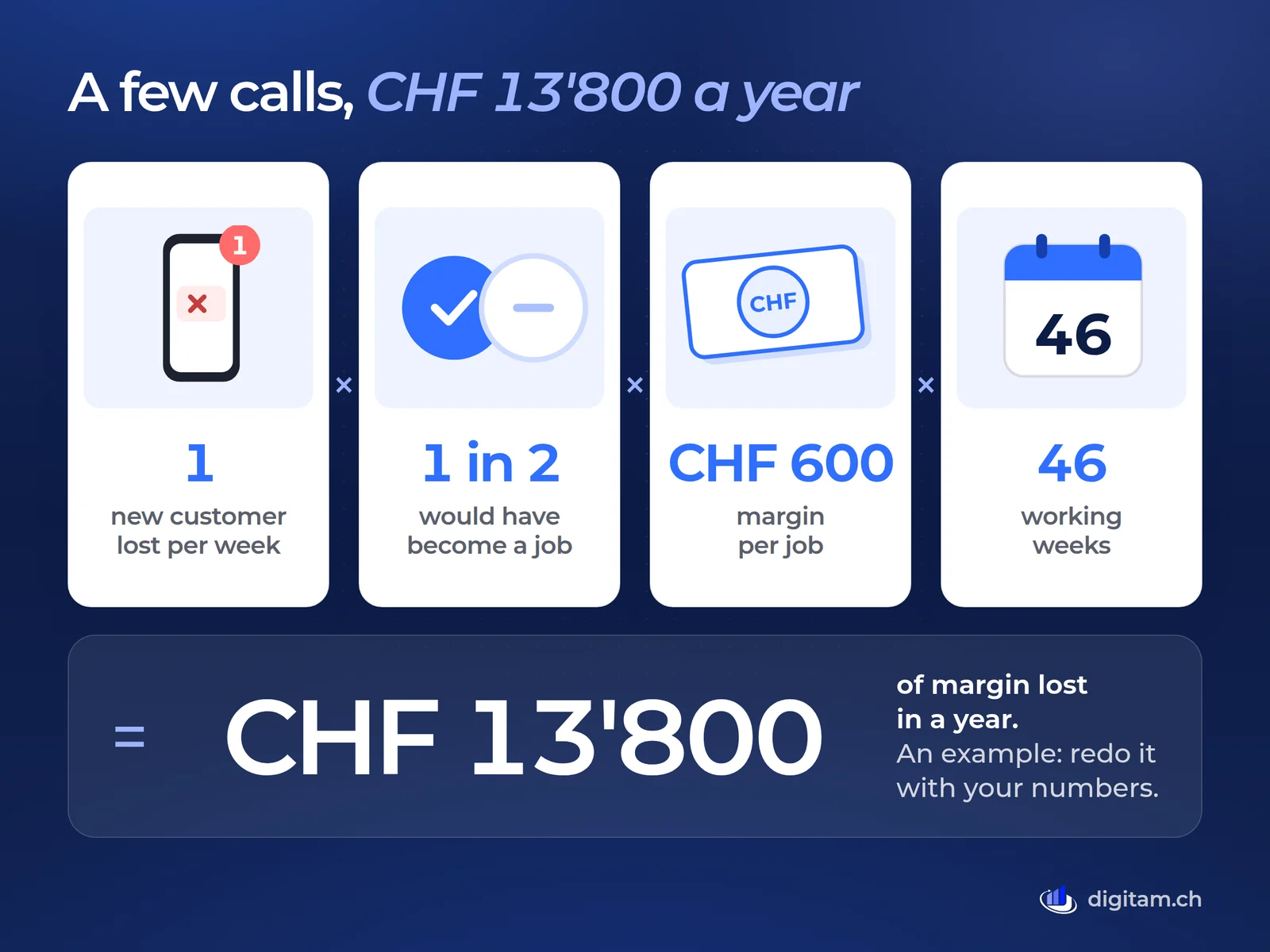
Two caveats. The estimate is conservative: it leaves out the clients that building manager would have sent your way by word of mouth. And it works the other way too: if your result is CHF 1'000 a year, don't spend CHF 300 a month fixing the problem. Rewrite your voicemail greeting and stop there.
Who can answer for you, and what does it cost?
Besides voicemail, which only records, there are four options.
A colleague or the office. Forwarding is free and the person answering knows the job. The catch: at lunchtime the colleague eats too, and whoever is on site has the same wet hands as Davide.
An external answering service. A person answers in your company's name, takes the message and sends it to you; some also manage your diary. Prices are public. Telefonservice Nobs charges CHF 270 a month with 50 calls included, or CHF 120 a month plus CHF 5 per call1. TopComm ranges from CHF 190 a month for 25 calls to CHF 380 for 150, plus CHF 3 for each extra call, excluding VAT2. Work it out per call: with 50 calls for CHF 270, each costs CHF 5.40; if only 25 come in, each costs twice as much, CHF 10.80, because the fee is the same.
One more person. In Ticino the 2026 minimum wage is CHF 20.00 to CHF 20.50 an hour6. Twenty hours a week at the minimum comes to about CHF 1'730 a month in wages alone, before social charges and holidays, and covers half the week.
An AI phone assistant. It answers at any hour, says straight away that it's an AI, books appointments in your diary, passes emergencies to a person and leaves you a written summary. With us there is a one-off cost to set it up for your business, then a monthly fee; whoever the provider, ask whether the fee includes call minutes or whether they are charged separately.
| Option | Cost | What it really does |
|---|---|---|
| Forwarding to a colleague | Free feature; you pay for the forwarded call if your plan doesn't include it | Someone who knows the job answers, if they're free |
| Answering service, flat rate | CHF 270 a month with 50 calls; diary CHF 100 a month extra | Takes the message in your name |
| Answering service, per call | CHF 120 a month plus CHF 5 per call | As above, worth it with few calls |
| Answering service, bundles | CHF 190 (25 calls) to CHF 380 (150) a month, excl. VAT | Takes the message, Italian included |
| One person, 20 hours a week | About CHF 1'730 a month at minimum wage, excl. charges | Everything, but only in their hours |
| AI phone assistant | Set-up plus monthly fee, on quotation | Answers, books appointments, passes emergencies, summarises |
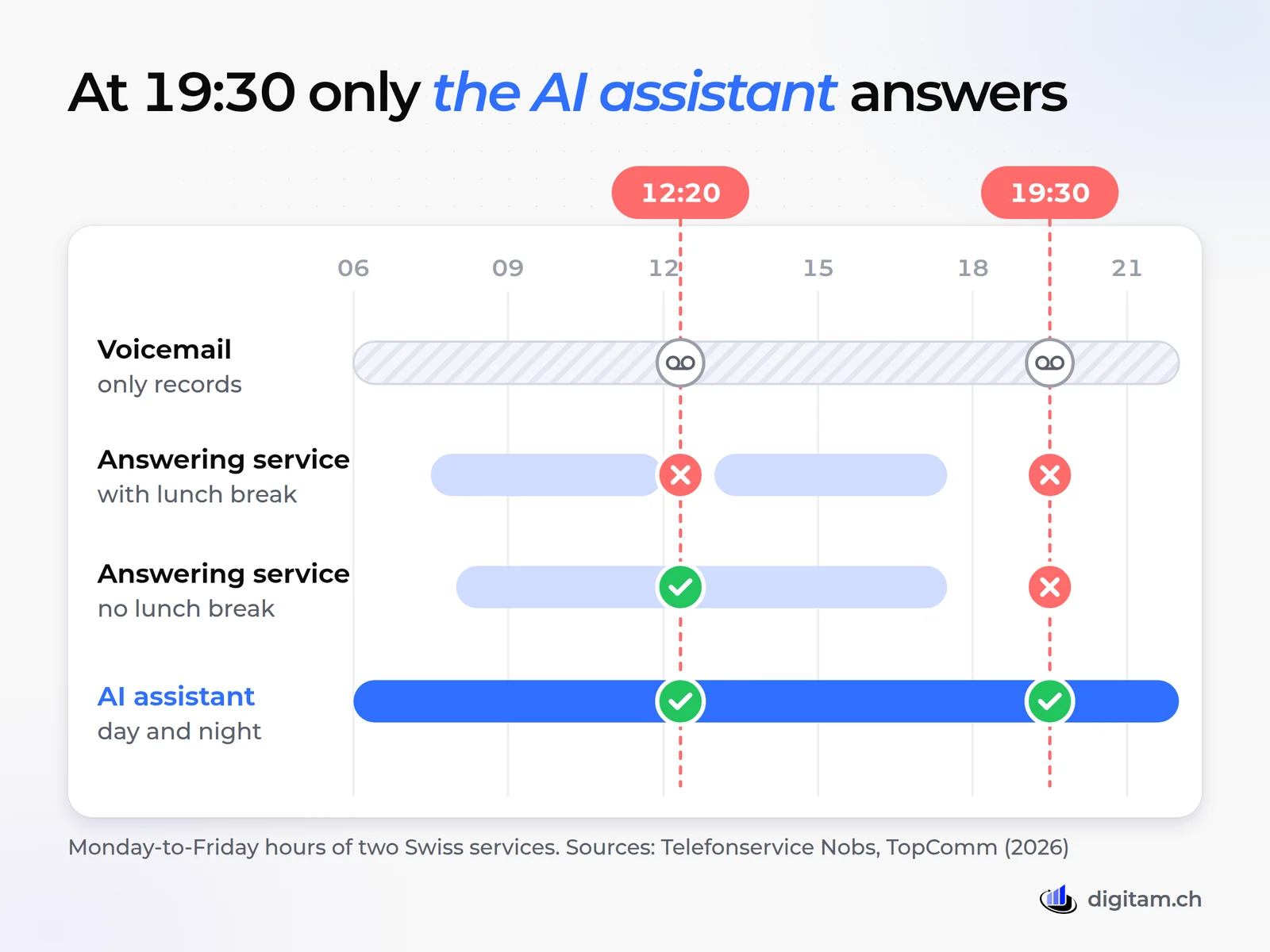
Price isn't the biggest difference, though. The difference is opening hours. Nobs answers from 07:30 to 12:00 and 13:00 to 17:301; TopComm Monday to Friday from 8:00 to 17:30, with no lunch break2. If your missed calls come in the evening or on Saturday, you are paying for hours when you don't need them.
How do you forward calls without changing your number?
Whichever option you pick, the number stays yours: on the website, on the van, in your Google profile. Only the place where the call ends up when you don't answer changes. With Swisscom, on a landline, it works like this3:
Forwarding calls on a Swisscom landline
- Choose where they goYour colleague's mobile, the answering service's number or the AI assistant's.
- No answerLift the handset, dial *61 and the destination number: the call is forwarded after 25 seconds without an answer.
- Busy or always67 forwards only when you're on the line, 21 forwards every call straight away.
- On a mobileForwarding is set in the phone's settings or in the Swisscom Cockpit.
- Test and switch offCall yourself from another phone and don't answer. To switch off: # plus the code plus #, for example #61#.
The forwarding features are free. You pay for the connection to the destination number if your plan doesn't include it, and roaming applies abroad3. If you're with another provider, look up "call forwarding" in its help pages: the logic is the same.
One detail makes a big difference: 25 seconds is a long time on the phone, and someone with water in the cellar may hang up sooner. Time how long you wait before hanging up yourself. If it's less, immediate forwarding to someone who always answers works better than forwarding on no answer.
What should an AI assistant do in the first thirty seconds?
First, an honest figure. In a representative Comparis survey of 1'035 people, written chat with an AI appeals to far more people than the phone5:
Talking to an AI: which channel people in Switzerland find appealing
- Written chat61.9 %
- Phone33.8 %
- Video with an avatar22.8 %
In the same survey, 62.9% said they tolerate a chatbot's mistakes less than a person's5. So a phone assistant shouldn't try to be charming or keep the caller on the line: it should save them time and make as few mistakes as possible. In practice, five rules:
- Say straight away that it's an AI. Anyone interacting with an AI system has the right to know whether they're talking to a machine8. What to say, what to record and where the data goes is covered in our rules for AI phone assistants and WhatsApp.
- Work out whether it's urgent. "There's water in my cellar" can't wait for the evening summary: the call goes straight to Davide or the colleague on call. You define what counts as urgent, in writing.
- Only book appointments where there's room. The assistant checks the real diary, not a list of slots written six months ago.
- Never quote prices it doesn't know. For a quote it collects what's needed: address, photos, measurements, urgency. What a quote should contain is explained in how to write a quote.
- Leave a summary. Who called, what they wanted, what was decided, what's still to do. Davide reads it at 12:20 instead of three missed calls.
When an AI assistant isn't needed
When it doesn't pay off
- You miss few calls and call everyone back within an hour: rewrite your voicemail greeting and leave it at that.
- Missed calls come in during the day, with the office open: the problem is who answers, not technology. Forwarding to whoever is in the office is enough.
- You work with a few regular clients who already message you on WhatsApp: reply there.
- Almost all calls are long consultations, as in a fiduciary office with long-standing clients: the AI can only take a message, and so can voicemail.
- You have no shared diary and no written rules on emergencies and hours: get organised first, then automate.
- You don't call back people who leave a message: no tool fixes that.
Even when it pays off, it has limits. An address said in a hurry from a noisy building site can be misheard: the assistant must repeat it and have it confirmed. And an angry customer wants a person, not a polite machine: the rule "complaint, put them through to me" should be written down on day one.
What to do from tomorrow
- From tomorrow, for one week, count. Four columns: time, who it was, did you call back, how did it end.
- On Friday, do the calculation with your four numbers. If the result is small, stop at step 3.
- Rewrite your voicemail greeting today. Say when you'll call back and offer an alternative: WhatsApp or the form on your website. It costs nothing.
- If you miss calls during the day, set up forwarding on no answer to whoever is in the office.
- If you miss them at lunchtime, in the evening and on Saturdays, and from new numbers, try an answering service or an AI assistant with your real calls before you sign.
If you get to step 5, that's what Digitam Voice does. It answers in Italian, and German, French and English can be added. It says straight away that it's an AI, books appointments in your diary, passes emergencies to the person you choose and leaves you a written summary. In most cases you keep your number. In the demo you make a real call; afterwards you get an offer with a set-up cost and a monthly fee, to put next to your Friday calculation.
Frequently asked questions
Can I keep my number if an AI assistant answers?
Yes, in most cases. You decide when it steps in: always, only outside office hours, or only when nobody picks up within a set time. Forwarding is set up together with your phone provider. For the first few days the cautious option works best, outside office hours only, so you can read the summaries before trusting it with the working day too.
Can an AI assistant answer on WhatsApp as well?
Yes, if the provider supports it. Digitam Voice, for example, answers the phone, WhatsApp Business and the website chat with the same information and rules, and transcribes voice messages. So someone who finds the line busy can write and still get an answer outside office hours. Meta's terms apply on WhatsApp, though: you will find them in our article on the 2026 rules.
Will an answering service pick up in Italian?
It depends on the service: many are based in German-speaking Switzerland. TopComm, for example, says it also handles calls in Italian. Before you sign, ask for a trial: have a friend call in Italian at the time you usually miss calls, and listen to how they answer and what message reaches you.
What do I have to tell customers about their data if an AI answers?
Besides saying it is an AI, according to the Federal Data Protection and Information Commissioner people must know whether the data they provide is used to improve the software or for other purposes. Ask the provider in writing where the conversations end up, who can read them and how long they are stored, and put that in the privacy notice on your website.
What happens if the assistant doesn't understand the caller?
A well-built assistant doesn't make things up: it passes the call to a person or notes name, number and reason, and you call back. In the trial before going live, have someone call in dialect, from a noisy street, with a tricky address: that is where you see whether the assistant asks them to repeat and confirms the details.
How many calls do I need to miss for an AI assistant to pay off?
There is no threshold that fits everyone. Compare two yearly figures: the margin you lose, worked out with the calculation in this article, and the cost of the assistant, meaning set-up plus twelve monthly fees. Add the time you spend calling people back today: that is work you can't invoice either.
Sources
- Telefonservice Nobs: subscriptions and prices. External telephone answering service (Bern/Zurich). Tariff A CHF 270 a month with 50 calls, Tariff B CHF 370 with 100, Tariff E CHF 120 plus CHF 5 per call; diary and appointments CHF 100 a month; hours 07:30-12:00 and 13:00-17:30; no set-up fee. VAT not stated.
- TopComm: Telefonservice Schweiz. Plans from CHF 190 (25 calls) to CHF 380 a month (150 calls), CHF 3 per extra call, excluding VAT and phone charges; Monday-Friday 8:00-17:30 with no lunch break; calls also handled in Italian; one-week plan CHF 125.
- Swisscom: set up call forwarding for landline and mobile. Landline codes: *21 immediately, *61 after 25 seconds without answer, *67 when busy; turn off with # code #. The features are free; you pay the connection to the forwarding number if it is not included in your plan; roaming applies abroad.
- Google: Business Profile performance. The Calls metric counts how many times a customer tapped the call button on the profile; found under Performance, on desktop or in the Google Maps app.
- Comparis: artificial intelligence survey 2026 (press release of 2 April 2026). Representative Innofact survey of 1,035 people in all regions, March 2026: written chat appealing to 61.9%, phone to 33.8%, video with an avatar to 22.8%; 62.9% are less tolerant of a chatbot's mistakes.
- Cc-Ti (Ticino Chamber of Commerce): new minimum wages from 1 January 2026. Ticino cantonal minimum wage 2026: lower threshold CHF 20.00 an hour, upper threshold CHF 20.50 (decree of 16 December 2025).
- FSO: slight growth in employment in 2024 (press release of 20 August 2026). Structural business statistics STATENT: units with fewer than ten jobs make up almost 90% of Swiss companies.
- FDPIC: data protection law applies directly to AI. Statement of 8 May 2025: people interacting with a language model have the right to know whether they are communicating with a machine.
Written by Alexandru Ciobanu. Sources checked on 13 October 2026.











 About Markets