 Digitam SAGL
AI quotes for Swiss tradespeople: from site visit to PDF, with NPK items
What to dictate on site, what never to ask of a photo, where the prices come from and what to check before the PDF goes to the client.

88.5%
of companies in Ticino have fewer than 10 employees (35,933 of 40,590 in 2024): whoever does the site visit usually writes the quote too
USTAT, Canton TicinoAt a glance
- The slow part isn't the maths: it's rebuilding in the evening what was obvious on site. One voice note per room, recorded straight away, fixes that.
- AI turns the note into lines from your price list and works out quantities from the measurements you said; anything it can't find stays open, outside the total.
- Photos record the state of the site but don't measure it: precise positions and counting are among the stated limits of image-reading models.
- With an NPK/CPN bill of quantities the client has already written the items: there, AI adds little.
- Photos and voice notes taken in a client's home are personal data: tell them, pick a provider that puts in writing where the data goes, delete what you no longer need.
Tuesday, 5:40 pm, Losone. Sandro has been laying tiles for twenty years and runs a firm with four employees. He walks out of a third-floor bathroom: the owner wants the bath out and a shower in, and has told him, politely, that she has asked two other firms for a quote as well. Sandro has measured with his laser, taken eleven photos and jotted four numbers on the back of a delivery note. At 9:30 pm, at the kitchen table, he opens his Word template. The wall measurements are there. The one for the niche under the window isn't, and the photos don't show it. Tomorrow morning he'll have to call the owner back, and by then she'll have two offers on the table.
Sandro is an example, but his evening is familiar to many tradespeople and small building firms in Ticino. This isn't about which software to buy (that's in Quoting software: Excel, business software or AI?) or about the rules of the Swiss Code of Obligations (see How to write a quote). It's about the stretch between the site visit and the PDF: what AI quotes can actually do, what you need to say on site, what never to ask of a photo and what to check before you hit Send.
Why does the quote always arrive late after a site visit?
Because in a small firm the person who measures is the person who writes, and during the day they're on site. In Ticino almost nine in ten companies have fewer than ten employees1. There's no estimating office pricing the job while the owner takes the measurements.
And there's a lot of made-to-measure work. In 2024, investment in conversion and renovation grew in Switzerland, while investment in new builds fell2. You can't price a renovation from a floor plan: you have to go and look, and every bathroom is different from the last.
35,933 of 40,590
companies in Ticino with fewer than 10 employees in 2024
USTAT+2.3%
investment in conversion and renovation in Switzerland in 2024, against −2.7% for new builds
FSO6 in 10
Swiss companies already using artificial intelligence
UBS and Intervista, 2026The time isn't lost in the maths, though. It's lost in translation. On site the information is complete: you see it, you touch it, you say it out loud to the client. Four hours later it's a few numbers on a scrap of paper with no context. Was that 2.10 the width of the bathroom or of the window? Does the wall behind the bath need stripping, or just a skim coat?
The UBS and Intervista survey of about 2,500 companies adds one detail: the more digital a sector is, the readier it is for AI3. On a building site information starts out spoken, and for years that held things back. Now it's the starting point: turning a voice note into text, and text into tidy lines, is exactly the kind of work where AI helps.
What happens, step by step, between the site visit and the PDF?
Back to Sandro, with a different method. At 5:45 pm he's in the van outside the house. Before driving off he sends three voice notes to the system that prepares his quotes: one for the bathroom, one for the stairs (third floor, no lift) and one for waste disposal. Then he drives.
While he's on the road, the AI quotes system does four things:
- Voice becomes text. The transcript is automatic and stays next to the draft.
- Text becomes lines. Each job he mentioned is matched to an item in the firm's price list, with unit and price.
- Measurements become quantities. The bathroom is 2.10 by 2.60 and the tiles go up to 2 metres: 9.40 m of perimeter times 2 m of height is 18.8 m²; minus the door (0.80 by 2 m, or 1.6 m²) that leaves 17.2 m² of wall. The floor is 5.5 m².
- What's missing stays open. The 90 by 120 shower tray isn't on the price list: the line is flagged and kept out of the total. The window niche wasn't measured: it becomes a question, not a number.
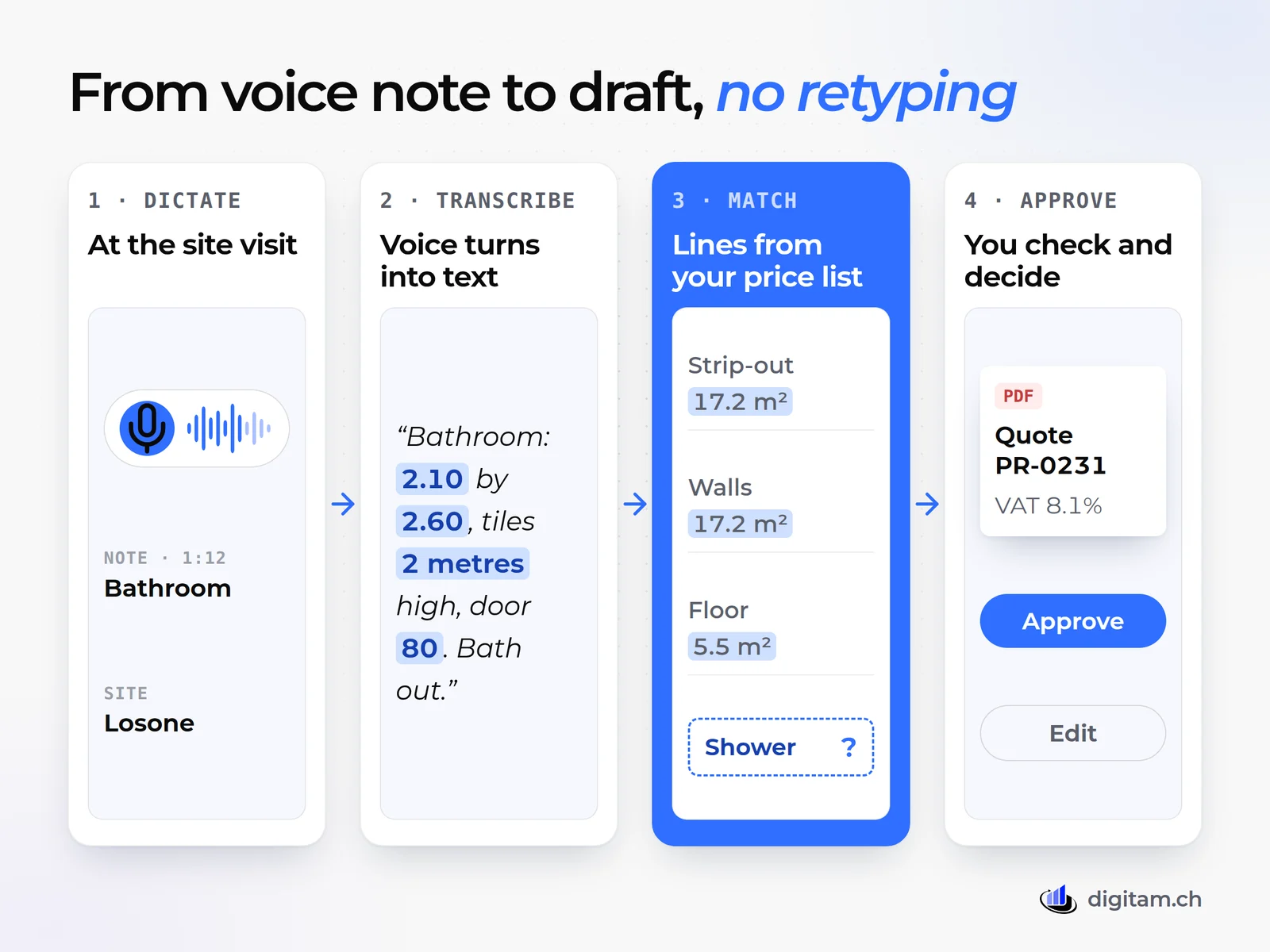
On Wednesday at 7:15 am Sandro opens the draft. He doesn't write it: he reads it. He adds the price of the shower tray, calls the owner for the niche measurement, rewords one description and approves. The PDF goes out with his logo, VAT at 8.1%8 and his own terms.
The "minutes" in the title apply to the draft, not to the check. The check is still yours and it needs your attention. What disappears is the late-evening work of retyping, hunting for prices in the old spreadsheet and fiddling with the layout.
What should you say in the voice note so the draft comes out right?
AI only uses what you tell it. If the height is missing from the note, the square metres are missing from the draft. That's why how you dictate matters more than which tool you use.
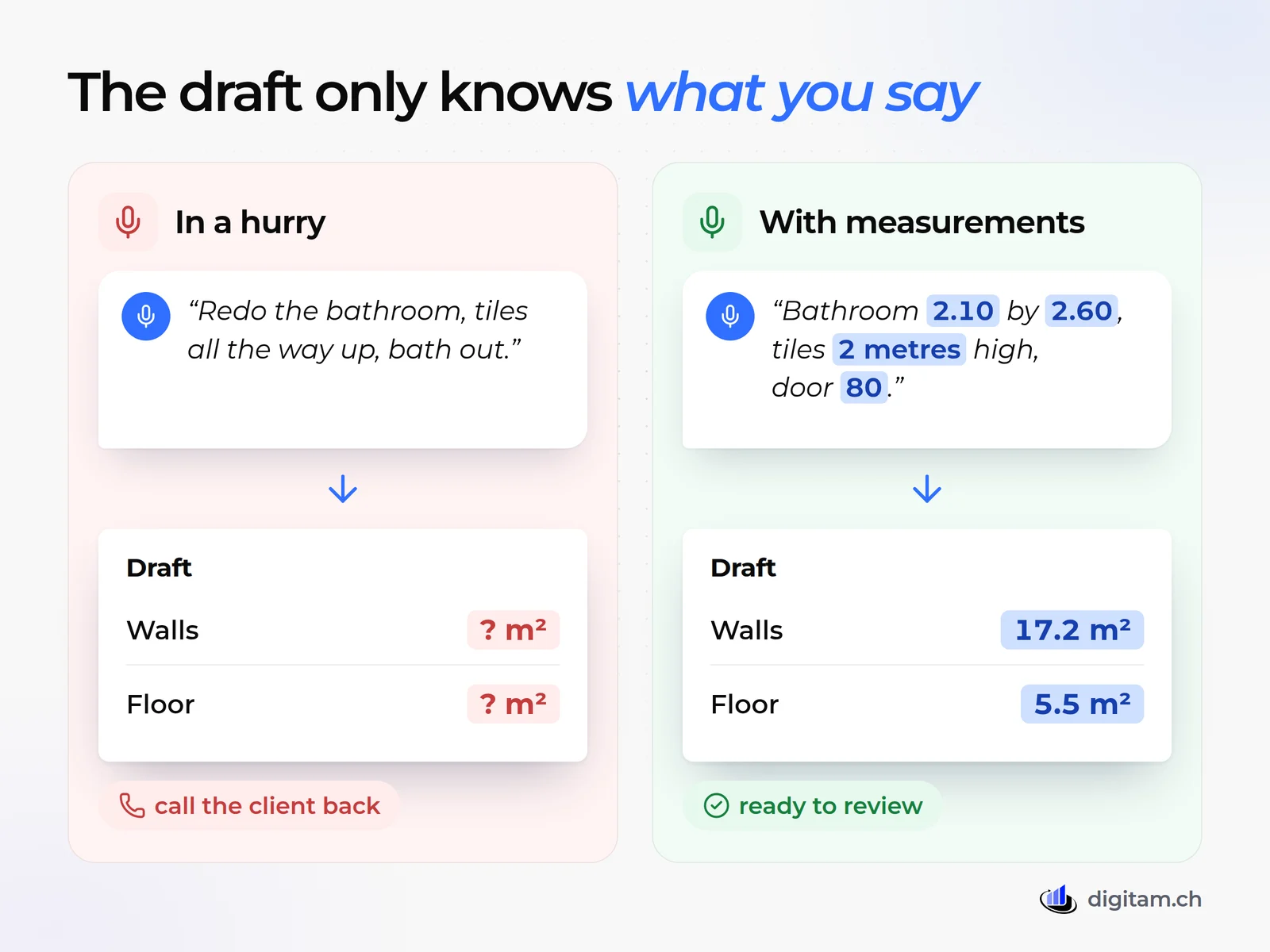
Six habits make most of the difference:
- One note per room, with the name of the room as the first word. A ten-minute note covering the whole house is hard to check, and a job mentioned twice can end up in the quote twice.
- Every measurement with its name and unit. "Width two metres ten" is clear; "two ten" on its own isn't.
- What's there now and what comes out: old tiles to strip, surfaces to skim, signs of damp.
- Access: which floor, whether there's a lift, where to park, where the skip goes. These are the lines people forget, and they cost money.
- What's excluded: "plumbing connections by the client", "painting not included".
- What you don't know: "window niche to be checked". Said like that, it becomes a question in the draft rather than an invented price.
Each trade also has its own typical blind spots.
| Trade | The measurements you need | What a photo won't tell you |
|---|---|---|
| Tiler | sides, tiling height, doors and windows to deduct | surfaces to skim, falls, the format the client chose |
| Painter | sides and height of rooms, ceilings, stairwells | chalky surfaces, stains to seal, furniture to move |
| Electrician | lights and sockets per room, length of chases | state of the distribution board, type of wall to chase |
| Plumber | distances to drains, floor, niche dimensions | age of the risers, stop valves, access to the plant room |
| Builder | lengths, heights, thicknesses, volumes to demolish | access for machinery, room for the skip, floors without a lift |
There are two things worth knowing about transcription, both stated in OpenAI's documentation for its own service. Rare words, such as product names and technical terms, can be suggested to the system, but they remain hints: you need to check that they don't make words appear that nobody said. And accuracy varies from language to language4. That's why a good draft shows you the transcript next to the lines: if a number looks wrong, you replay the voice note instead of calling the client.
Are photos useful? Yes, but not for measuring
It's the most common temptation: photograph the wall and ask for the square metres. OpenAI's documentation on its image-reading models rules this out on its own. Among the stated limitations: they struggle with tasks that need precise spatial localisation, they give approximate counts of objects, they struggle with panoramic and fisheye images, and they read neither the file name nor the metadata5.
On site, that means:
- no areas from a photo: a few centimetres out on each side, across a whole bathroom, changes the amount of material;
- no counting from a photo: sockets, broken tiles and light points are counted on site and said in the note;
- no panoramas to "show everything": that's exactly where the model struggles;
- you name the room: the model doesn't know which room a photo comes from or when you took it.
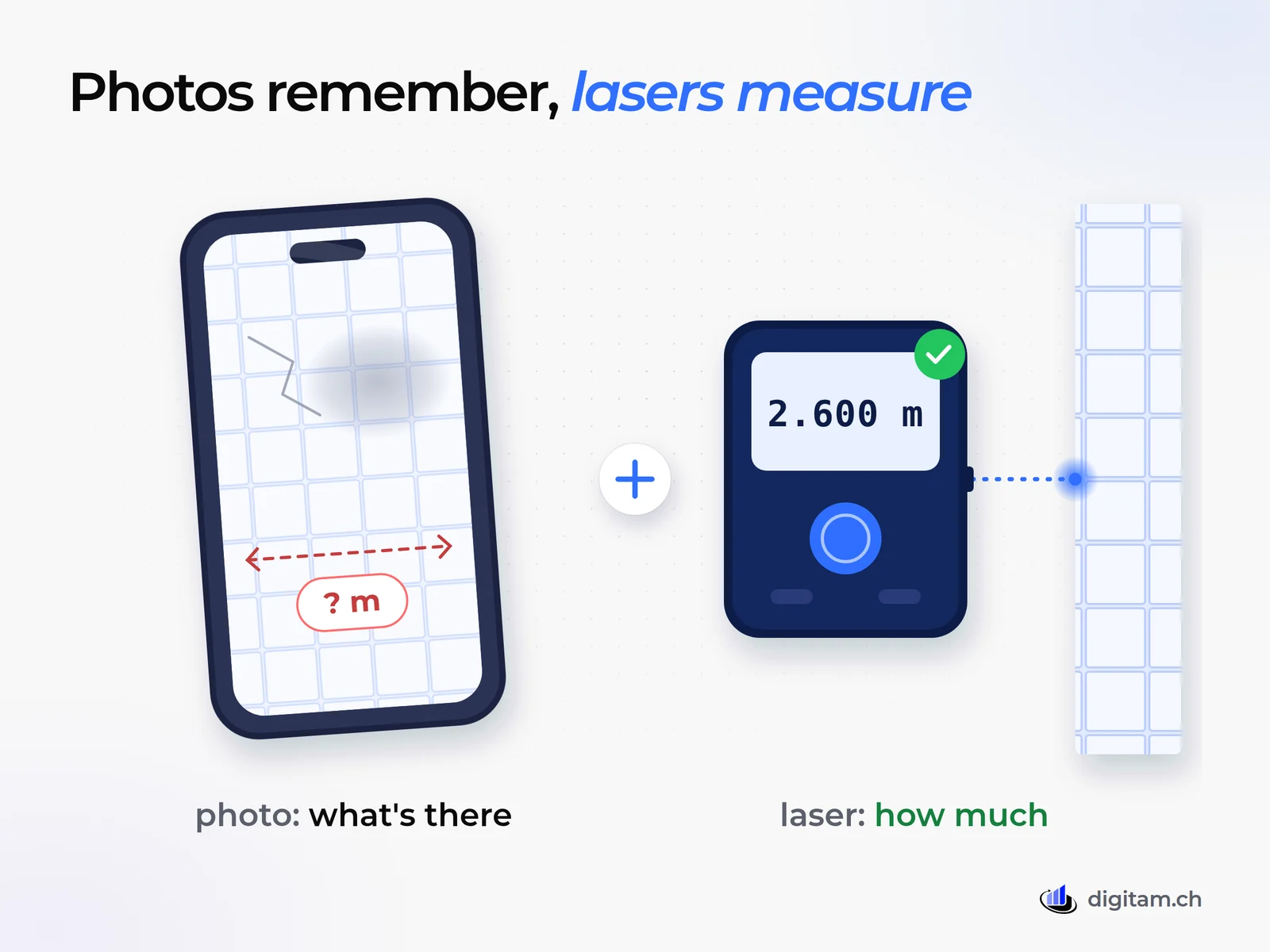
Photos are for everything else. They show the state of the surface, the type of taps, the distribution board, the way up the stairs. They help the AI write a more precise description, such as "existing tiling with blackened grout, crack on the window wall". And attached to the PDF, they show the client what your price is based on. One simple habit: photograph the laser display while it's resting against the wall. The measurement is still the one you took, but now the proof sits next to it.
Where does the AI get its prices, and what changes with an NPK/CPN bill of quantities?
Ask a general chatbot how much it costs to lay 17 m² of tiles and it will answer. That's exactly the problem: it doesn't know your prices, your suppliers or how long your team takes. A serious quoting system does the opposite: it looks for the item in your price list and, if it can't find it, says so. How to get a price list in order is covered step by step in Quoting software.
If you work on site, add the items that usually live in your head: day-work hours, the surcharge for upper floors without a lift, the minimum call-out, disposal at a flat rate. If they're written down, the AI suggests them when you mention them in a note. If they aren't, they end up among the open lines, every time.
A bill of quantities is a different story. When an architect or a public body sends out a tender, the items are already written, often using the CRB standard catalogue (NPK in German, CPN in Italian). It has about 200 chapters and over a million items in German, French and Italian. Working with it digitally requires CRB-certified software and a data-use licence; small firms can use the NPK-Editor to add their prices and send the list back in the standard CRBX format6. For electricians, EIT.swiss publishes its own CPN products with about 14,000 items, updated every year7.
| Private request after a site visit | NPK/CPN bill from an architect or public body | |
|---|---|---|
| Who writes the lines | you, by voice; the AI puts them in order | the client, with items already defined |
| Where prices come from | your price list | your own calculation, item by item |
| What you send back | your PDF, with logo and terms | the list in the required format, often CRBX |
| How much AI helps | along almost the whole way | little: the part it does best, writing the lines, the client has already done |
Finally, fixed terms aren't dictated: the standard VAT rate of 8.1%, in force since 1 January 20248, how long the offer is valid, payment terms. You write them once and the system applies them to every quote.
Photos and voice notes in a client's home: what does data protection require?
A site visit in someone's flat leaves far more than a wall on your phone: family photos on the shelf, post on the table, the name on the doorbell. With an address next to them, they're personal data.
The Federal Data Protection and Information Commissioner (FDPIC) repeated it on 8 May 2025: the Data Protection Act, in force since 1 September 2023, applies directly to processing with AI too, and anyone using it must be transparent about its purpose, how it works and where the data comes from9. The Act itself asks three things that matter to a tradesperson10:
- inform people that you're collecting their data: at least who you are and how to reach you, the purpose and, if you pass it on, to whom (Art. 19 FADP);
- check that the provider you hand the data to can guarantee its security (Art. 9(2) FADP);
- destroy or anonymise the data once it's no longer needed for the purpose (Art. 6(4) FADP).
In practice: tell the client ("I'll take a few photos for the quote, and that's all I'll use them for"), frame the job rather than the room, and choose a provider that puts in writing where voice notes and photos are stored, who can see them and whether they're used to train models. Set a simple rule for photos from quotes that weren't accepted too, for instance deleting them when the offer expires. It's no coincidence that in the UBS survey data protection and security are among the risks companies see in AI3. There's more in our article on ChatGPT and the FADP.
What should you check before the PDF goes out?
A well-made draft is quick to check, but you always check it. Five points, in this order:
- The biggest quantity. Redo the sum for the item that weighs most. If that one adds up, the others usually do too.
- The open lines. No item without a price should stay hidden: either complete it or remove it and list it under exclusions.
- The exclusions. Disposal, scaffolding, work by other trades: whatever isn't written down, the client assumes is included.
- The type of price. A fixed price and an estimate bind you in different ways: the difference is explained in our guide to quotes.
- The transcript alongside. If a number looks odd, replay the voice note before you approve.
If the same mistake comes up twice, the problem is further upstream: in the way you dictate, or in a badly written price-list item. Fix it there, once.
When AI quotes aren't worth it
- Few quotes, all different. If you write two or three a month, a good Word template and half an hour of quiet will do.
- No price list. Without written prices the AI has nowhere to take them from: price list first, automation second.
- Prices that come from a technical calculation. A system that needs sizing or work that needs a structural check: AI can write the description, not do the engineering.
- Tenders on an NPK/CPN bill. The client has already written the lines and the price goes into the required format.
- Nobody to review. A draft sent without a check is worse than a quote written late.
What to do from tomorrow
Four moves before you buy anything
- Dictate at your next site visitOne note per room, straight away, in the van. Even if you then write the quote the usual way.
- Reread the transcriptNote what you were missing to finish the quote without calling the client: that's your list of things to say.
- Write down your site itemsDay work, upper floors without a lift, disposal, minimum call-out: with name, unit and price.
- Test on three real visitsWhether it's software or a service, judge it on your own notes, not on the demo example.
If the test shows the problem is worth an evening a week, that's the job we built Digitam Quote for. It starts from WhatsApp voice notes, emails, photos or PDFs; requests that come in by phone can be picked up by the AI phone assistant. It uses only your catalogue and your prices, leaves what's missing for you to complete and sends nothing without your approval. The PDF goes out with your design and your terms. The cost is a set-up fee plus a monthly fee, which we agree after a demo. To try it on one of your real site visits, book a demo and bring the messiest voice note of the week.
Sources checked on 13 October 2026.
Frequently asked questions
Can I use ChatGPT to write a construction quote?
For clear descriptions and terms, yes. For prices, no: a general chatbot doesn't know your price list, and if you ask what a job costs it gives you a plausible-sounding estimate. If you use one, paste in the items and prices yourself, check every figure and leave out client data you don't need, such as names, addresses or photos of the flat.
Is a quote drafted with AI as valid as one written by hand?
Yes. The client receives an offer from your company, with your name and your terms: the fact that software prepared the draft changes nothing. That's exactly why no PDF should go out before you have read and approved it. For the difference between a fixed price and an estimate, and how long an offer binds you, see our guide on how to write a quote.
Does it work if I speak dialect on site, or mix Italian and German?
It depends on the system, so test it. OpenAI's documentation says transcription accuracy varies by language. Before you rely on it, record five real notes the way you would in the van and compare the transcript with the audio. Trade terms and product names can be given to the system in advance.
Do I need to install an app on the site phone?
Not necessarily. Some systems work on channels you already use: a WhatsApp voice message, an email with photos, a PDF. What matters more is that the note goes in right after the visit, and that the draft shows the transcript next to the lines so you can check it.
Where do I start if my prices are still in my head?
With the price list. Take your last ten or twenty accepted quotes, mark the items that keep coming back and write down a name, unit and price for each, plus the site items you usually forget: day-work hours, upper floors without a lift, disposal. Without that file no tool can suggest the right prices, and in the meantime you can already practise dictating notes.
Sources
- Ustat – Industry and services: key figures 2024. Ticino statistics office: 40,590 companies in 2024, of which 35,933 with fewer than 10 employees (in Italian).
- FSO – Decline in construction investment in 2024 (press release, 17.07.2025). Federal Statistical Office, provisional results: conversion and renovation +2.3%, new builds −2.7% (in German).
- UBS Outlook Switzerland: AI in Swiss companies (19.05.2026). UBS and Intervista survey of about 2,500 companies: 6 in 10 use AI; data protection and security among the main risks (in German).
- OpenAI – Speech to text (API documentation). Files up to 25 MB, keywords as hints to be checked, accuracy that varies by language.
- OpenAI – Images and vision: Limitations (API documentation). Stated limits: precise spatial localisation, approximate counts, panoramic and fisheye images, no reading of file names or metadata.
- CRB – Normpositionen-Katalog NPK. About 200 chapters and over a million items in German, French and Italian; certified software, licence, NPK-Editor and CRBX format (in German).
- EIT.swiss – CPN for electrical installers. About 14,000 work items with reference values, updated every year (in Italian).
- Federal Tax Administration – VAT rates. Standard rate 8.1% since 1 January 2024 (in Italian).
- FDPIC – Current data protection law is directly applicable to AI (8.5.2025). The FADP, in force since 1 September 2023, also applies to AI: transparency about purpose, functioning and data sources (in Italian).
- Federal Act on Data Protection (FADP, SR 235.1). Art. 6(4) (destroy data no longer needed), Art. 9 (processors), Art. 19 (duty to inform) (in Italian).
Written by Aramis Moggi. Sources checked on 25 October 2026. This article is not professional advice: if you spot a figure that doesn’t add up, write to us at info@digitam.ch.











 About Markets