 Digitam SAGL
Quoting software: Excel, business software or AI?
The software lays out the PDF in seconds. The slow work comes first: reading the request and finding the right prices.

5,708CHF
median gross monthly salary in Ticino in 2024: every hour spent on quotes costs at least CHF 31.50
Federal Statistical Office (FSO), 2025At a glance
- Quoting software speeds up the layout. Reading the request, picking the line items and chasing missing measurements are still your job.
- At the Ticino median salary (CHF 5,708 a month, FSO), 30 hours of quotes a month cost about CHF 950 in gross pay alone.
- In Switzerland, invoicing software with a quotes module starts at CHF 0 (AbaNinja) or CHF 35-39 a month (bexio, Cantia).
- An AI that drafts the quote from the request pays off with many requests in mixed formats and a tidy price list, and it must never make up a price.
Monday, 6:50 pm, Bioggio. Davide runs a seven-person plumbing firm and gets back to the office after the last job of the day. Nine quote requests are waiting in his inbox. A property manager has sent a PDF: new mixer taps in twelve flats. A woman in Agno writes on WhatsApp that her water heater is leaking, with a 42-second voice note and a photo. An architect wants a price for two bathrooms, "specification attached". The price list is a three-sheet Excel file from 2025, and the template is a Word file only Davide knows how to format. He gets two done before dinner.
He has seen an ad for quoting software at a few francs a month. His question is simple: will it fix the problem, or just move the same work into another window?
Davide is an example, but his evening is a familiar one for tradespeople and small firms across Ticino. The answer depends on where your time goes. This article covers what quoting software does and doesn't do, what it costs in Switzerland, what your current time costs, and when an AI that starts from the request makes sense. If you want to know what to put in a quote and how it binds you under the Swiss Code of Obligations, read our guide to writing a quote.
What quoting software does, and what it doesn't
In its most common form, quoting software is a module inside an invoicing app. You keep customers and items there, pick the lines, and the software works out totals and VAT (the Swiss standard rate has been 8.1% since 1 January 20246). Then it produces a PDF with your logo. When the customer accepts, you turn it into an invoice without retyping: bexio, for example, describes converting an accepted offer into an order or invoice "with one click", using templates with your own logo, fonts and colours and text blocks in several languages8.
That's a real step up from Word: no wrong totals, no duplicate quote numbers, no "template_final_2.docx". But look at Davide's evening again. The software only comes in once he already knows what to write. Before that, there are three jobs no quotes module does for him:
- reading the request: the property manager's PDF, the voice note, the photo, and working out what is actually needed;
- finding the prices: which item on the list, which variant, whether the 2025 price still holds;
- chasing what's missing: the measurement, the floor, the access, who takes away the old water heater.
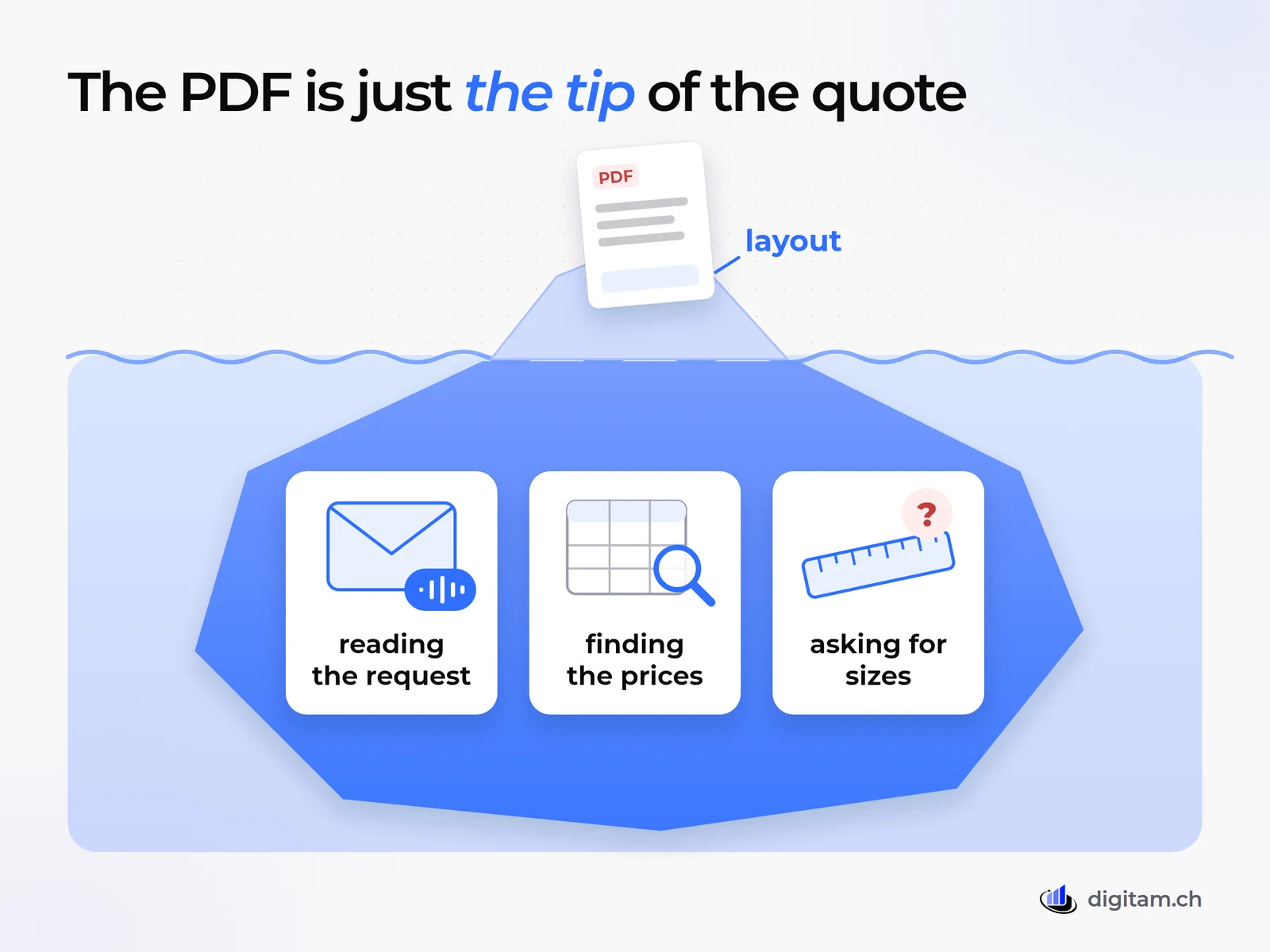
That's why people buy a tool, use it for a few weeks and drift back to Word: the time it saves is the layout time, which was already the short part.
What a hand-written quote costs you today
Before you compare subscriptions, work out what the work you want to shorten actually costs. It takes three lines.
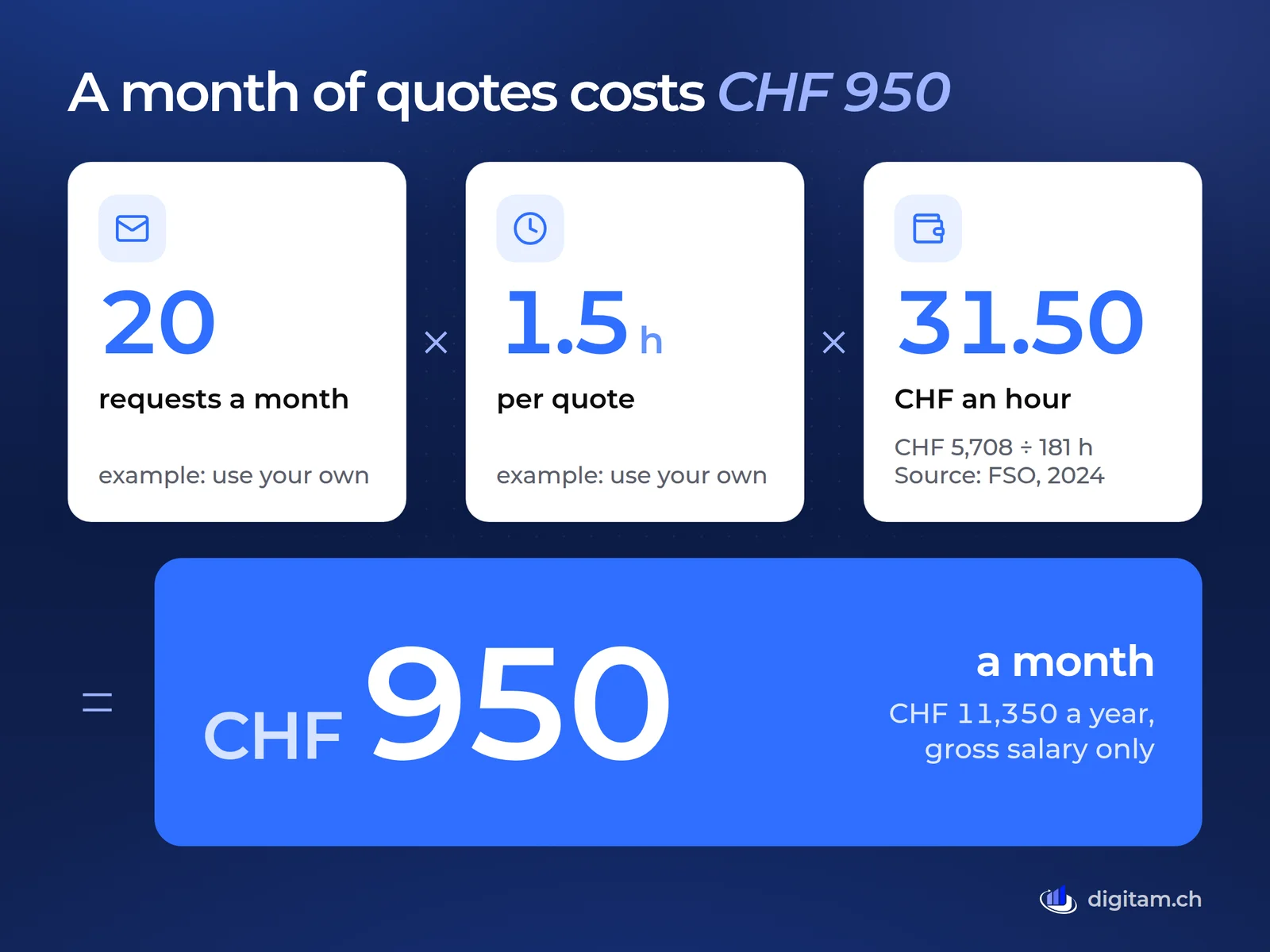
The median gross salary in Ticino in 2024 was CHF 5,708 a month for a full-time job, against CHF 7,024 for Switzerland as a whole1. A full-time employee's contractual working week is 41 hours 47 minutes2, or about 181 hours a month. That comes to roughly CHF 31.50 an hour in gross pay alone, before social charges, office and computer.
Now plug in your own figures. In the example, that's 20 requests a month at an hour and a half each, covering reading, looking up prices, questions to the customer and writing: 30 hours a month, or about CHF 950 a month and CHF 11,350 a year in salary alone.
Three things the sum leaves out, and they usually make it worse:
- quotes are often written by the owner or the lead technician, in the evening. In Ticino the top 10% of salaries are above CHF 10,012 a month1: if you write the quotes yourself, your hour is worth more than 31.50;
- not every quote turns into a job, and the time spent on the ones you lose doesn't come back;
- while you're writing, you're not on site, not on the phone and not with your team.
The sum has one purpose: to tell you whether the problem is worth CHF 30 a month or CHF 1,000. In the first case, a quotes module is enough. In the second, it's worth looking below the waterline too.
Three routes, with Swiss prices
Search for quoting software in Italian and you mostly find Italian products, built for the euro, Italian VAT and Italy's e-invoicing system. You need francs, Swiss VAT and, once the quote becomes an invoice, a QR-bill (see our article on QR-bills and eBill). For a Ticino SME there are three realistic routes.
| Excel and Word | Invoicing software with quotes | AI that starts from the request | |
|---|---|---|---|
| Examples | the files you already have | AbaNinja, bexio, Cantia (construction) | Digitam Quote or custom solutions |
| To get started | CHF 0 | CHF 0 to CHF 39 a month | set-up + monthly fee, on quotation |
| Who reads the request | you | you | the AI, then you check |
| Who picks the lines | you, copying | you, from the catalogue | the AI from your price list, you correct |
| When it pays off | few quotes, all different | many quotes with recurring items | many requests in mixed formats |
Excel and Word. They cost nothing and you know how to use them. The problem isn't the tool: every quote starts as a copy of the last one, old prices included. It works as long as quotes are few and one person writes them.
Invoicing software with a quotes module. Switzerland has several low-cost options. AbaNinja has a free plan for one user and up to 1,000 documents a year, quotes and QR-bills included; paid plans cost CHF 21 and CHF 49 a month9. bexio starts at CHF 35 a month billed annually (CHF 45 billed monthly) for one user, excluding VAT; the five-user package is CHF 697. Cantia, built for tradespeople and construction firms, starts at CHF 39 a month with a service catalogue, bills of quantities and quote signing, and has a 14-day trial10. What you gain here is order: one catalogue, one template, and invoices without retyping. Some trade-specific tools are also starting to prepare the offer from the catalogue for you to check before sending, as Cantia says on its own page10.
AI that starts from the request. This is the route that works below the waterline: it reads the email, the voice note or the PDF, picks items from your price list and leaves you a draft to check. It costs more and needs more preparation; more on that two sections down.
The routes aren't mutually exclusive. You can keep your invoicing software for invoices and accounts and add AI only for the stretch between request and draft. For choosing business software as a whole, see our guide on custom vs off-the-shelf business software.
The price list: no software can save you without it
Whether you pick a quotes module or an AI, the tool works with what you give it. If prices are scattered across a 2025 spreadsheet, three old quotes and the owner's memory, the software will just copy the mess faster. The price list is the first job, and it's worth doing even if you never buy anything.
- Start from quotes you've sent. Take the last 20 or 30 and mark the items that keep coming back. Those are the core of the list; one-offs stay out.
- One item, one name. "300 l water heater", not three variants spelt three ways. Each item has a unit (piece, metre, hour, lump sum) and a price.
- A date on every price. So you know which ones to check when a supplier raises prices.
- Variants become rules. "Surcharge for floors without a lift", "discount from 10 pieces": written once, not remembered every time.
- Standard terms in fixed text. Exclusions, timing, payment and how long the offer is valid shouldn't be retyped for every quote.
- One owner. One person updates the prices and everyone else uses them. A price list nobody owns quietly goes stale.
A good test: could a colleague write a standard quote without asking you anything? If not, the price list is still in your head, and no software can read it there.
When an AI that drafts the quote makes sense
According to the AXA study reported on the Swiss federal SME portal, 34% of Swiss SMEs had built AI into their work in 2025, up from 22% the year before3. They mainly use it to translate and to write.
What Swiss SMEs use AI for (2025)
- Translation52 %
- Correspondence47 %
- Automating work steps34 %
- Data analysis32 %
- Targeted advertising24 %
- Customer relations20 %
Writing an email with a chatbot is easy. A quote isn't: the chatbot doesn't know your prices and, if you ask, it may make them up. An AI built for quotes does something else: it works on real requests, with your price list, and stops where it doesn't know.
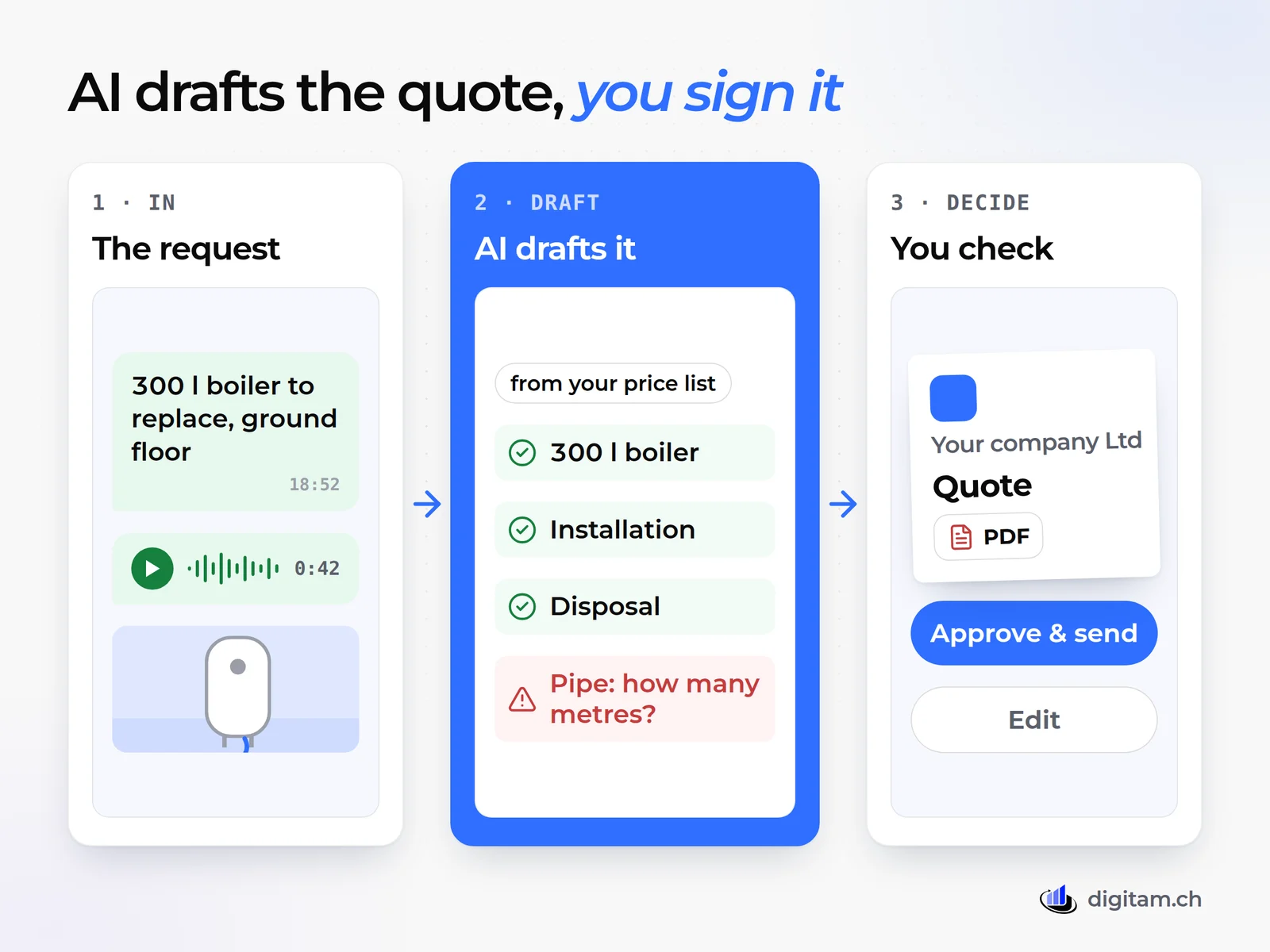
Four rules separate a serious tool from an experiment:
- it takes prices only from your price list and, if an item isn't there, flags it instead of inventing it;
- if a detail is missing, such as the pipe length or the floor, it says so and leaves the draft open;
- no quote goes out until a person approves it;
- you can change any line, and there's a record of who changed what.
It pays off when requests are many and arrive in different shapes: emails with attachments, voice notes, photos, phone calls. That's the part a quotes module never touches. With a tidy price list, your time per quote shifts from writing to checking.
Requests also contain personal data: names, addresses, photos of people's homes. The FDPIC points out that the Data Protection Act, in force since 1 September 2023, applies directly to AI-based processing and requires transparency about purpose, functioning and data sources4. If you hand the work to a provider, art. 9 FADP requires you to make sure they can guarantee data security5. The same AXA study found that only 34% of SMEs have clear rules on what data may be entered into AI tools, and just 23% of those with fewer than ten employees3. Before you sign, get it in writing: where the data is stored, who can see it and whether it's used to train models. More in our article on ChatGPT and the FADP.
This is also how Digitam Quote works, the service we built for this part of the job. Requests come in by email, WhatsApp, PDF, photo, or from calls handled by the AI phone assistant. The draft uses your catalogue and your branding, and goes out only when you approve it. Pricing is a set-up fee plus a monthly fee, which we agree after a demo on one of your real requests.
When it isn't worth it
When quoting software, or AI, isn't the answer
- You send a few quotes a month and each one is different: a good Word template will do.
- Every price comes from a site visit and a bespoke calculation: AI can write descriptions and terms, but the number stays yours.
- You have no price list and no time to build one: price list first, then any software.
- Your invoicing software already has a quotes module: use it properly before adding anything else.
- Requests already arrive structured, from a web form with the right fields: the gain from AI is small.
There's also a limit no software fixes: if the quote is stuck because a supplier hasn't sent you the material price yet, writing isn't the bottleneck. That needs a phone call, not software.
What to do from tomorrow
Four steps before you buy any software
- CountFor one month, note how many requests come in, through which channel, and how long each one takes.
- Do the sumHours a month times your hourly cost: now you know what the problem is worth and what it makes sense to spend.
- Sort the price listThe recurring items, with name, unit, price and last-updated date.
- Test on real requestsSoftware or AI, test it on three requests from last month, not on the demo example.
If the sum says the problem is worth a few francs a month, pick the simplest quotes module and move on. If it's worth hundreds and requests arrive in every shape imaginable, see how Digitam Quote handles one of yours: book a demo and bring the messiest request of the month.
Sources checked on 13 October 2026.
Frequently asked questions
Is there free quoting software in Switzerland?
Yes. AbaNinja's Starter plan costs CHF 0 and includes quotes and QR-bills, for one user and up to 1,000 documents a year (quotes, invoices and delivery notes all count). For a sole trader with a handful of quotes that can be enough. If two or three people work on the same records, you will need a paid plan.
Can I use quoting software made for Italy or Germany?
For laying out a PDF, yes. But many foreign tools are built around the euro, foreign VAT and their own e-invoicing systems. In Switzerland you need amounts in francs, Swiss VAT (8.1% standard rate) and, once the quote becomes an invoice, a QR-bill. If the tool can't handle those, you'll retype everything in your invoicing software and lose the benefit.
Will quoting software stop pricing mistakes?
Only if the price list inside it is current. The software repeats whatever price it finds in the catalogue: if it's last year's, it repeats it without hesitation. That's why every price needs an owner and a last-updated date, whatever tool you choose.
Can AI write a quote and send it to the customer on its own?
It shouldn't. An accepted quote commits you to a price, so a person has the final say. A serious tool drafts the quote from your price list, flags missing details and waits for your approval before anything is sent.
Do I need to change my business software to use AI for quotes?
No. The AI works on the stretch between the customer's request and the draft; the approved quote can then go into the invoicing or business software you already use. Before you start, ask the provider how the data gets across, so nobody has to retype it.
Sources
- FSO – Median salary in 2024: CHF 7,024 gross (25.11.2025, Italian). Median gross full-time salary 2024: Switzerland CHF 7,024, Ticino CHF 5,708; in Ticino the top 10% earn more than CHF 10,012.
- FSO – Over eight billion hours worked in 2024 (22.05.2025, Italian). Contractual working week of full-time employees in 2024: 41 hours 47 minutes.
- Swiss SME Portal (SECO) – KI in Schweizer KMU auf dem Vormarsch (05.11.2025, German). AXA study: SMEs that have integrated AI rose from 22% to 34% between 2024 and 2025; main uses; only 34% have rules on what data may be entered (23% below ten employees).
- FDPIC – Current data protection law is directly applicable to AI (08.05.2025). The FADP, in force since 1 September 2023, applies directly to AI-based processing; transparency on purpose, functioning and data sources.
- Federal Act on Data Protection (FADP, SR 235.1), art. 9. Processing by a processor: the controller must ensure the processor can guarantee data security.
- Swiss Federal Tax Administration – Swiss VAT rates. Standard rate 8.1% since 1 January 2024.
- bexio – Packages and prices. Basic CHF 35 a month billed annually (CHF 45 monthly), 1 user; Optima CHF 69, 5 users; prices excluding VAT.
- bexio – Order processing: from offer to invoice. Accepted offer converted into an order or invoice with one click; templates with your logo, fonts, colours and text in several languages.
- Swiss21 – AbaNinja pricing (Italian). Starter CHF 0 (1 user, 1,000 documents a year, quotes and QR-bills included), Basic CHF 21, Pro CHF 49 a month.
- Cantia – Software for tradespeople and construction SMEs (Italian). From CHF 39 a month, service catalogue, bills of quantities, quote and signature, 14-day trial, data hosted in Zurich.
Written by Alessandro Scerpella. Sources checked on 13 October 2026. This article is not professional advice: if you spot a figure that doesn’t add up, write to us at info@digitam.ch.











 About Markets