 Digitam SAGL
Year-end stocktake in Ticino and Switzerland: who must count, and how to do it
What the Swiss Code of Obligations asks for, what the goods left on your shelves are worth, why the software and the shelf almost never agree, and how to reach 31 December without sheets to retype.

59.5%
of the items checked at seven European retailers had a different quantity on the shelf than in the system
ECR Retail Loss, 2020At a glance
- Companies limited by shares (SA/AG), limited liability companies (Sagl/GmbH) and cooperatives always keep full accounts; sole traders and partnerships only from CHF 500'000 in turnover (art. 957 CO).
- The law asks for stock to be documented «by an inventory or in another way» (art. 958c CO): a full count on 31.12 works, and so does cycle counting during the year.
- Stock goes on the balance sheet at cost at most, and lower if you can only sell it for less today (arts. 960a and 960c CO).
- In a study of seven European retailers, 59.5 % of items had a different quantity on the shelf than in the system, and a few items caused most of the gap in francs.
- The stock reserve the tax office tolerates rests on a complete list: ask your fiduciary how Ticino applies it today.
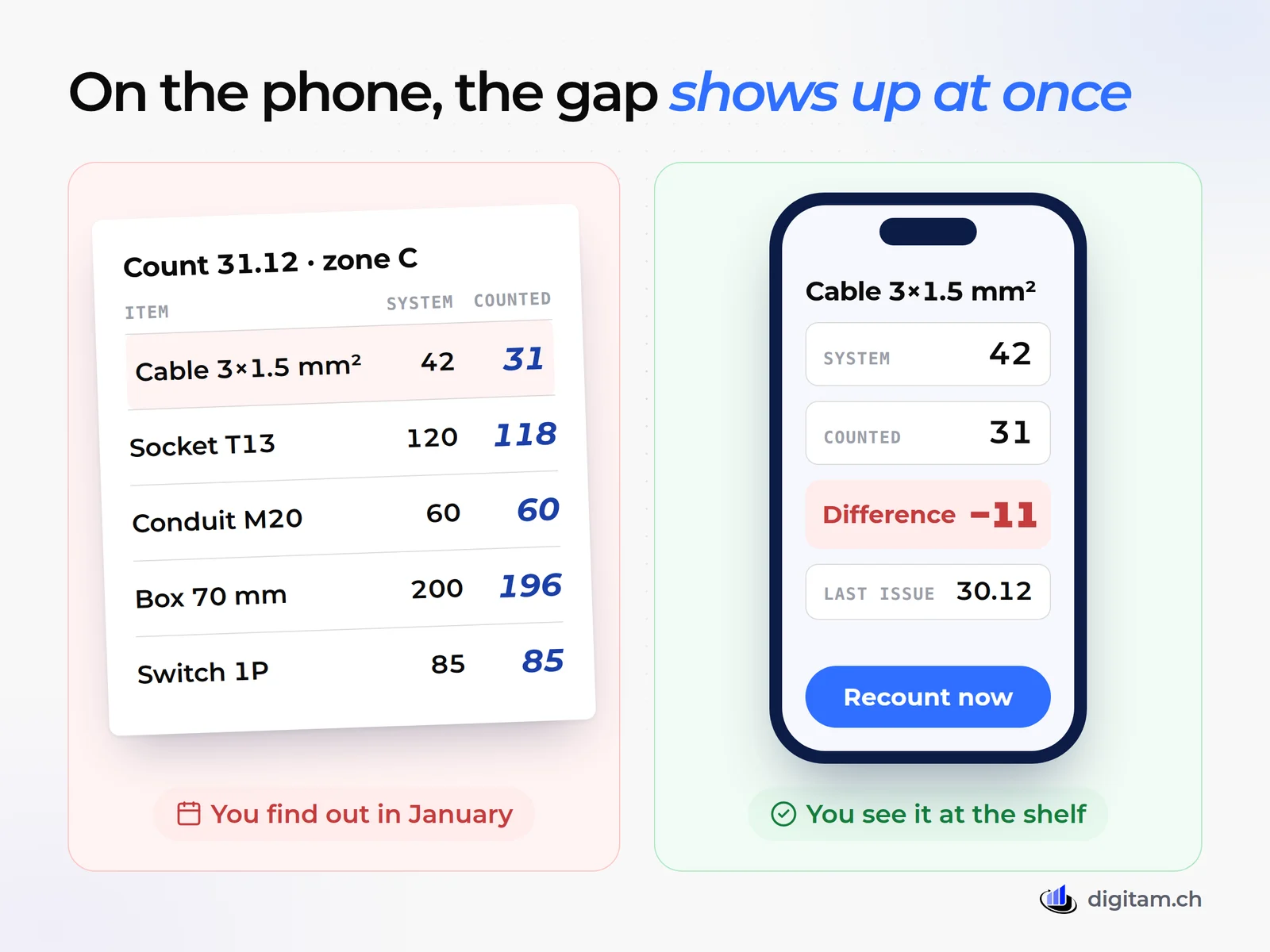
Wednesday 31 December 2025, 14:10, in a warehouse in Manno, near Lugano. Luca sells electrical supplies to installers around Lugano. He has six employees and closed the counter at noon for the year-end stocktake. Three people walk the shelves with sheets printed from Excel and a pen. At 17:30 the first problem turns up: the software says 42 rolls of 3×1.5 mm² cable, the shelf has 31. Nobody knows whether they are really missing or whether someone loaded them into a van for a building site without writing it down.
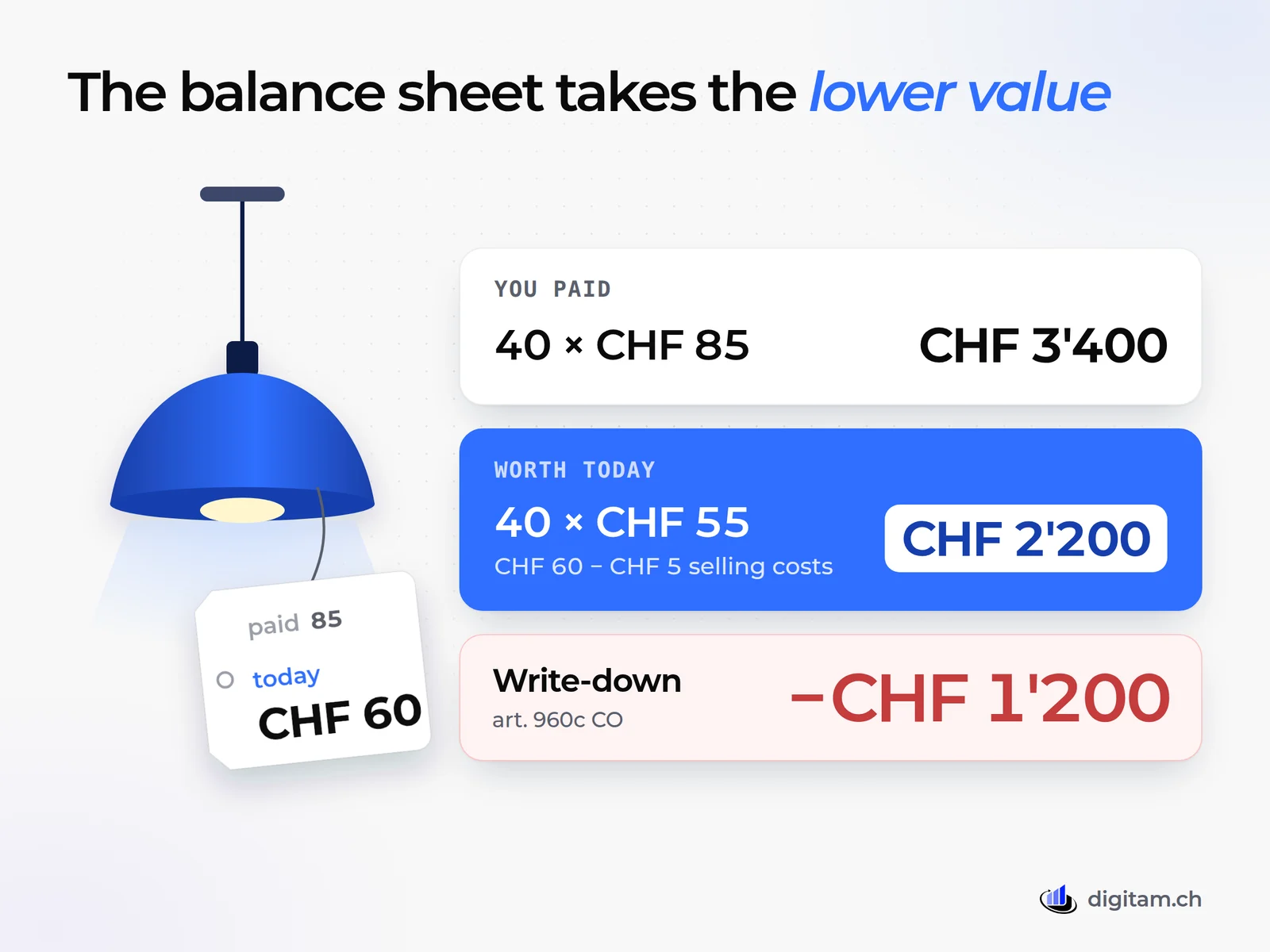
In January the fiduciary retypes every line from the sheets by hand. In March she asks the question nobody expected: «You paid CHF 85 for these lamps and you sell them for 60. Do we put them on the balance sheet at 85?»
The story is made up, but anyone with a warehouse in Ticino will recognise it. 31.12.2026 is a Thursday, eight weeks away. Here is what Swiss law actually asks for, how to put a value on your stock, why the software's numbers almost never match the shelf, and how to count without losing two days. And when new software is not the answer.
Who has to do a year-end stocktake in Switzerland?
The Code of Obligations is clear. Legal entities, meaning companies limited by shares (SA/AG), limited liability companies (Sagl/GmbH) and cooperatives, always keep full accounts and present financial statements, whatever their turnover. The same applies to sole traders and partnerships with at least CHF 500'000 in turnover in the last financial year (art. 957 para. 1 CO)1.
Below that threshold, simplified accounts are enough: income, expenditure and «accounts of assets» (art. 957 para. 2 CO). The goods on your shelves are assets, and the principles of proper accounting still apply «by analogy» (para. 3). In plain words: even a small shop has to know what is in its storeroom, just with fewer formalities.
Then comes the sentence that matters most, in art. 958c para. 2: the position of each balance sheet item «is documented by an inventory or in another way»1. The law does not say «count everything on 31 December». It says: you must be able to prove the figure you put on the balance sheet. A full count at year end is the usual way. Cycle counting during the year, with software that records every receipt and every issue, is another way, to be agreed with your fiduciary and, if you have one, your auditor.
Two dates to note. The annual report, which includes the financial statements, must be prepared within six months of the end of the financial year (art. 958 para. 3 CO). And count lists are accounting records: they are kept for ten years from the end of the financial year, electronically if you like, as long as they stay readable and match the transactions (art. 958f CO)1.
| Who | Accounts | Stock |
|---|---|---|
| SA/AG, Sagl/GmbH, cooperative | full, always | year-end inventory or equivalent proof |
| Sole trader or partnership from CHF 500'000 | full | as above |
| Sole trader or partnership below CHF 500'000 | simplified | list with quantities and value among assets |
| Firm without goods (architects, consultants) | depends on legal form | no shelves, but unbilled work is valued |
What is the stock you counted worth?
Counting is half of a year-end stocktake. The other half is putting a price on every line, and that is where the fiduciary's questions come in.
The starting rule: an asset never goes on the balance sheet above its purchase or production cost (art. 960a CO). If you paid CHF 85, it is not worth CHF 90 just because the supplier's list price went up. Then there is art. 960c: if at the closing date the selling price, minus the costs still needed to sell, is lower than cost, the stock goes in at the lower value1. By «stock» the law means raw materials, work in progress, finished goods and merchandise.
Back to Luca's lamps: 40 pieces bought for CHF 85, which now sell for CHF 60 with CHF 5 of selling costs each. On the balance sheet they are not worth CHF 3'400 but CHF 2'200. The difference, CHF 1'200, is a write-down that comes off the year's profit.
Two useful details. Similar items can be valued in groups rather than one by one, if that is the usual practice (art. 960 para. 1 CO). And where there are «concrete indications» that an asset is overvalued, the values must be checked and adjusted if needed (art. 960 para. 3 CO). Goods untouched for two years, discontinued models, damaged packaging: those are concrete indications. Better to flag them during the count, with a note next to the line, than to discover them in March.
The stock reserve: what the tax office accepts, and what it wants in return
On top of the mandatory write-down for goods worth less, you can go lower still, out of prudence. Commercial law allows it: art. 960a para. 4 CO permits additional write-downs to secure the long-term prosperity of the business1. The tax office, however, only accepts them within limits.
Canton Thurgau has put its practice in writing. It is not Ticino, but it shows how the tax authorities think. After the write-downs required by commercial law, a further reduction of up to one third of the value is allowed as a rule, the so-called «Warendrittel». The condition is an inventory that is complete by quantity, with purchase costs or market value, and the one-third limit is checked every year. It does not apply to construction work in progress or to services3.
In Ticino, the Tax Division's index card allows provisions for the risk of losses on current assets, «especially on goods». The limits come from federal guidelines and cantonal practice. Anything beyond them has to be justified, and provisions that are no longer justified go back into taxable profit (art. 72 para. 2 LT, art. 63 para. 2 DBG)2. Which percentage the tax office accepts in your case today: ask your fiduciary before 31.12, not after.
The practical point is a single one: a stock reserve rests on a list. A spoken «it'll be about CHF 80'000» is not enough, neither for the tax office nor for the bank.
Why do the software and the shelf almost never agree?
The 42 rolls that turn into 31 are not bad luck. A three-year project by the ECR Retail Loss research group, with seven large retailers in four European countries and about 100 stores, compared what was on the shelves with what was in the systems. On average, 59.54 % of the items checked had a different quantity4. And not always fewer: in 27.46 % of cases there was more stock than recorded.
59.5 %
of items had a different quantity on the shelf than in the system
ECR Retail Loss, 202027.5 %
of items had more stock than recorded, not less
ECR Retail Loss, 20206 %
more sales on average in the stores where stock records were corrected
ECR Retail Loss, 2020A large retail chain is not a wholesaler in Manno, but the causes of the gaps are the same here. Goods taken for a building site and never booked out. A return put back on the shelf without being recorded. A delivery booked in from the order instead of the delivery note. The wrong unit, with a 100-metre roll recorded as 100 pieces. The same item under two codes.
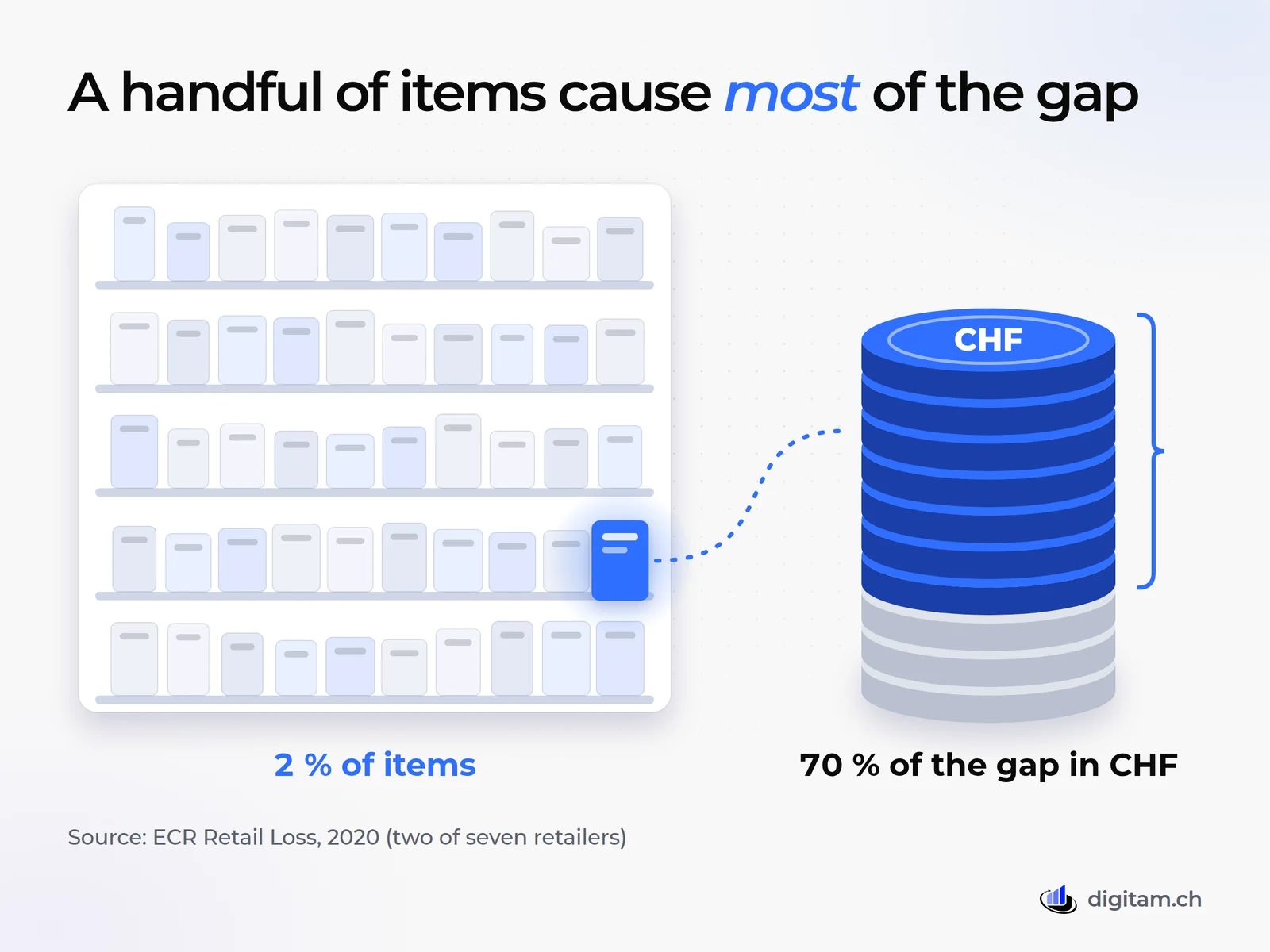
The most useful finding for anyone who has to count is another one. At two of the seven retailers, about 2 % of items caused 70 % of the discrepancies in value4. You don't need to count everything with the same care: you need to find those few items and count them well, more often.
That is the idea behind cycle counting: during the year you count zones or groups of items in turn, and the most valuable or fastest-moving ones come round more often. Off-the-shelf software supports it too. In Odoo, for example, each location can have a count frequency in days, the system shows the recorded quantity next to the counted one and works out the difference by itself; for the full count it proposes 31 December5.
How do you count in one day, without sheets to retype?
Whether you do a full count or cycle counts, the method is the same. The tips in software vendors' guides work: count in pairs, one counts and one records, always in the same direction along the shelf, with damaged goods kept apart6. What they leave out are the steps before and after, and that is where the hours go.
The 31.12 stocktake in six steps
- Before the 31stBook every delivery note received and every issue for building sites. From the afternoon of the 30th, no movement without a slip or a message.
- ZonesSplit the warehouse into labelled zones. Each pair has its own zones and nobody counts the same one twice.
- CountOne counts, the other records. Best with a phone that reads the barcode and writes straight into the software: nothing to retype in January.
- DifferencesSort the differences by value in francs and recount only those above a threshold agreed beforehand, starting with the largest.
- Doubtful stockUnmoved for over a year, damaged, discontinued: on a separate list, with a photo. You need it for the valuation with your fiduciary.
- ClosingFinal list with the date and the signature of whoever counted, saved as a PDF and kept for ten years.
The difference between paper and phone shows when a line doesn't match. On paper you find out in January, when the fiduciary compares the figures. With the count in the software you see it at the shelf, while you can still recount or ask the storekeeper whether the rolls are in the van.
Where does AI-powered business software help, and where doesn't it?
Artificial intelligence doesn't count rolls of cable: someone still has to go to the shelf. But it can take work away during the year, exactly where the gaps start.
- Delivery notes. The AI reads the supplier's delivery note as a PDF or photo, recognises codes and quantities and prepares the goods-in entry. The storekeeper checks the goods and confirms. It is the same logic as AI invoice processing, applied to goods.
- Issues for building sites. The installer writes on WhatsApp «took 3 rolls of 3×1.5 cable for the Viganello site» and the software prepares the issue against the job, for approval.
- Minimum stock. When an item drops below its threshold, the software drafts a reorder to the supplier. No order goes out without confirmation.
- The list for your fiduciary. At year end, items with no movement for twelve months already come out in a list with their value at cost. How much to write down is for you and your fiduciary to decide.
If you already use bexio, Odoo or another system, it is often enough to connect these steps to what you have. If your stock lives in Excel and three different sheets, first read custom or off-the-shelf business software: there are four routes, and one is to change nothing. With AI Business Software Digitam covers the two in between: adding AI to the software you use, or building new software one module at a time. Either way, the AI prepares and a person approves, as we also explain in AI agents in business.
When new software isn't worth it
- You have few items, high in value and slow-moving: an hour's manual count with a signed list is enough.
- You are a sole trader below CHF 500'000 with little stock: keep a tidy list with values at cost and stop there.
- Your software already has a stock module nobody uses: get people using it first, then think about the rest.
- Nobody books out goods for building sites: no software and no AI can fix a missing habit. Start with the rule, not the tool.
- You work on projects without a real warehouse, like an architecture firm: the issue is unbilled work, not shelves.
What to do from tomorrow, before 31.12.2026
- This week, call your fiduciary and ask four things: the count date, the valuation method, the stock reserve and the format of the list they want.
- By the end of November, clean up your item master data: duplicates, units of measure, codes that no longer exist.
- In December, do a first count of the 20 or 30 most valuable items. If the numbers match there, the 31st becomes a formality.
- On 30 December, book every delivery note and stop movements without a slip.
- On 31 December, count by zone and in pairs, with a phone if your software allows it.
- In January, recount only the large differences, sign the list and file it for ten years.
- After closing, look at where the differences came from. If the answer is «delivery notes and building sites», that is where AI-powered software takes work away, all year and not just on the 31st. If you want to look at it with your real sheets, book a free 30-minute consultation, at your premises if you are in Ticino.
Frequently asked questions
Can I count the stock a few days before 31 December?
The law asks for balance sheet items to be documented at the closing date (art. 958c CO), but it does not fix the day you count. You can count a few days before or after, as long as delivery notes, invoices and issues let you reconstruct every movement up to 31.12. Agree the date with your fiduciary and, if your company has one, with the auditor, and write it on the count list.
I run a sole proprietorship with less than CHF 500'000 in turnover: do I need a stocktake?
You don't have to keep full accounts: income, expenditure and assets are enough (art. 957 para. 2 CO). But goods are part of your assets, and the principles of proper accounting apply by analogy (para. 3). In practice you still need a list with quantities and value at cost, just with fewer formalities.
How long do I have to keep the count lists?
Ten years from the end of the financial year, like other accounting records (art. 958f CO). Electronic copies are fine as long as they stay readable and match the transactions. A signed PDF of the final list, filed with the year-end closing, is the simplest option.
Can I put all stock on the balance sheet at purchase price?
Purchase price is the ceiling, not the rule (art. 960a CO). If at year end the price you can sell at, minus the costs of selling, is lower, the stock goes in at that lower value (art. 960c CO). Similar items can be valued in groups (art. 960 para. 1 CO).
Can AI do the stocktake for me?
No. Someone still has to go to the shelf and count. AI helps before and after: it reads delivery notes and prepares the goods-in entries, turns messages from building sites into stock issues to approve, sorts the differences by value and prepares the list of slow-moving items for your fiduciary. A person confirms every movement.
Do I need new software for cycle counting?
Not necessarily. Many off-the-shelf systems already support cycle counts: in Odoo, for example, you set a count frequency for each location. The weak point is rarely the software but the goods in and out that nobody records. Fix that and cycle counting works with the system you already have.
Sources
- Swiss Code of Obligations (SR 220), arts. 957, 958, 958c, 958f, 960, 960a, 960c (Italian text). Duty to keep accounts and the CHF 500'000 threshold, six-month deadline, proof of balance sheet items «by an inventory or in another way», ten-year retention, stock valuation rules.
- Canton Ticino Tax Division, legal entities tax index: Accantonamenti – principi generali. Provisions allowed for the risk of losses on current assets, especially goods; limits set by federal guidelines and cantonal practice; unjustified provisions added back to taxable profit (art. 72 LT, art. 63 DBG). Published 10.03.2020.
- Canton Thurgau, Steuerpraxis StP 43 Nr. 2: Bewertung Geschäftsvermögen. An example of cantonal practice on the «Warendrittel»: a further reduction of up to one third as a rule, only with an inventory complete by quantity, checked every year; not for construction work in progress or services.
- ECR Retail Loss (Rekik, Syntetos, Glock): Measuring the Sales Impact of Improving Inventory Records, 2020. Three-year project with seven large retailers in four European countries and about 100 stores: 59.54 % of items with wrong stock records, 27.46 % with more stock than recorded, at two retailers 2 % of items caused 70 % of the value discrepancies.
- Odoo 18 Documentation: Count products (Physical Inventory). Example of off-the-shelf software: on-hand quantity, counted quantity and calculated difference, count frequency in days, scheduled date defaulting to 31 December.
- bexio: Inventario, l'inventario spiegato in modo semplice. Guide by a Swiss software vendor: inventory methods and practical counting tips (in pairs, in the same direction, damaged goods kept apart).
Written by Alexandru Ciobanu. Sources checked on 3 November 2026.











 About Markets