 Digitam SAGL
On-call duty over Christmas in Ticino: who answers the phone?
The Swiss rules on on-call duty, the costs in francs, and a way to make the on-call phone ring only when it really matters.

7days
of on-call duty at most in four weeks for one employee, followed by two weeks off call (Art. 14 ArGV 1)
SECOAt a glance
- A business closed from 24.12.2026 to 6.1.2027 is shut for 14 days: 4 public holidays, 3 weekend days and 7 working days.
- An employee may be on call for at most 7 days in 4 weeks, so covering the holidays takes two people, unless the small-business exception applies.
- On-call duty at night, on Sundays and on public holidays needs a permit, unless the business is exempt under Ordinance 2.
- In the building services trade, on-call duty is paid CHF 180 a week, plus call-outs with a 100% supplement on public holidays.
- An AI assistant answers every call and puts through to the on-call technician only the ones your rules define as urgent.
Sunday 27 December 2026, 21:40, a kitchen in Giubiasco. Luca, a fitter at a heating firm near Bellinzona with eight staff, has the on-call phone next to his plate. It rings for the fourth time since dinner started: a customer wants to know when the technician will come to service her boiler. Before that there was a quote for a new bathroom, a man from Zurich asking in German whether the water at his rustico in Valle Maggia had been shut off, and a wrong number. At 23:10 the real call comes in: a house in Sementina with no heating and a newborn baby. Luca grabs his jacket and leaves. Out of five calls, one needed him.
Luca and the firm are made up. The problem isn't. Between Christmas and Epiphany many Ticino businesses close, but customers keep calling, and some of them call about a real breakdown. Before 24 December it's worth answering three questions: who can be on call and for how many days, what it costs, and how to make sure the on-call phone only rings when it matters.
How many days is a business really closed over the holidays?
Ticino has 15 official public holidays2. Four fall over the festive period: Christmas Day (25.12), St Stephen's Day (26.12), New Year's Day (1.1) and Epiphany (6.1). The Immaculate Conception on 8 December is a holiday too, but it isn't treated like a Sunday3.
This year's calendar works out like this. If you close on Thursday 24 December and reopen on Thursday 7 January, the business is shut for 14 days. Four are public holidays, three are ordinary Saturdays or Sundays (St Stephen's Day falls on a Saturday) and seven are working days, when customers expect someone to pick up.
The four festive holidays carry extra weight. The cantonal law implementing the Employment Act treats all of them like Sundays3, so for businesses covered by the federal Employment Act the Sunday-work rules apply2. Someone who goes out on a job on Christmas Day isn't working on just any day, neither in law nor under most contracts.
How many days can an employee be on call?
The rule is in Article 14 of Ordinance 1 to the Employment Act (ArGV 1), and SECO explains it plainly1. On-call duty is planned over four weeks, and an employee may do at most seven days of it, consecutive or not. Then they must be left alone.
In the two weeks following their last on-call duty, the employee may no longer be called.
Apply that to the holidays: 14 calendar days, seven at most per person. You need at least two people. Whoever covers the first week, 24 to 30 December, is off call until 13 January. Whoever covers New Year and Epiphany, 31 December to 6 January, can't be called until 20 January. For a firm with only two fitters, that means nobody can be put on call from 7 to 13 January, and only one of them until 20 January.
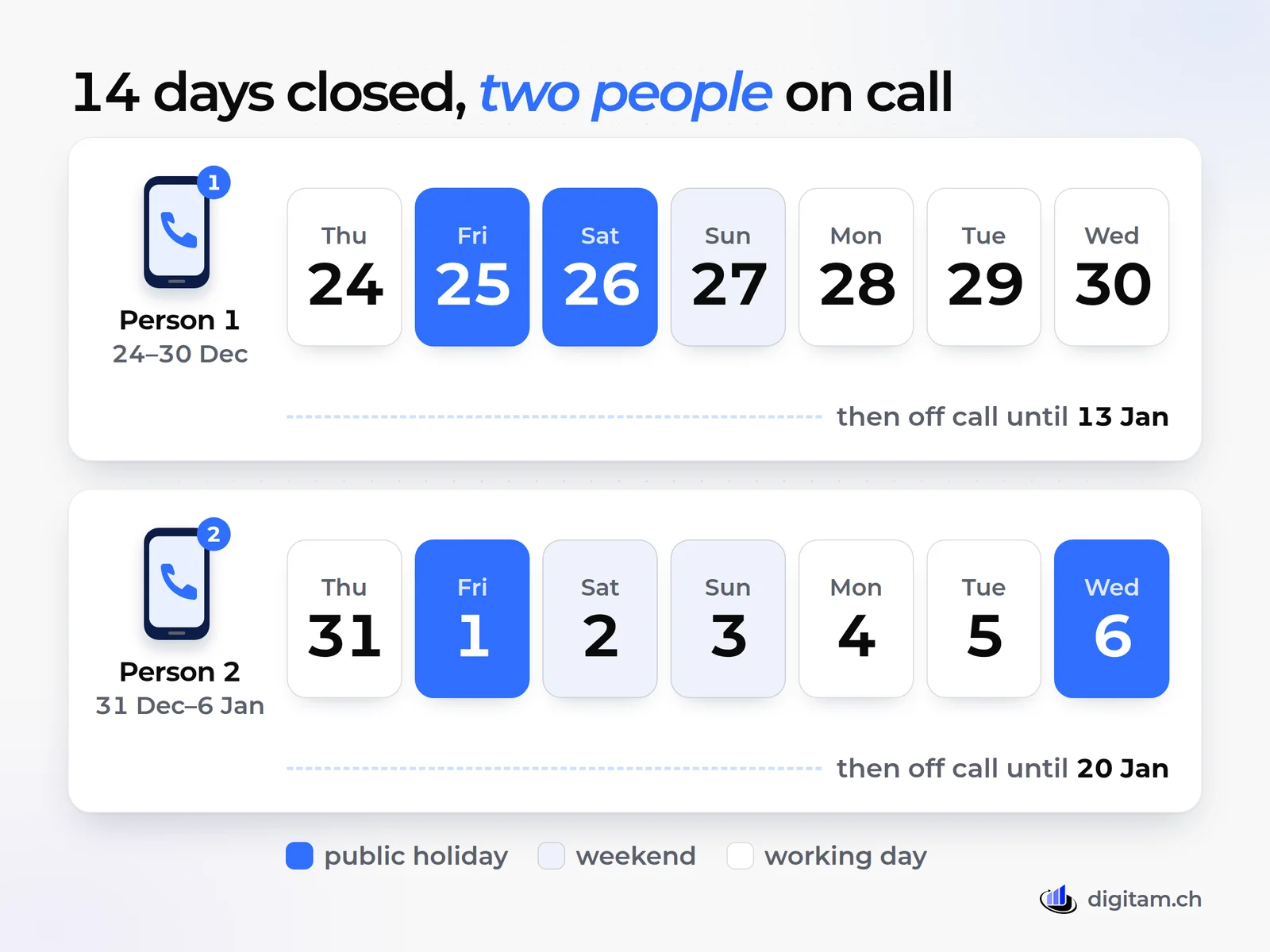
Small businesses have an exception1. On-call duty can go up to 14 days in four weeks if two conditions are both met: because of its size and structure the business doesn't have enough staff, and the employee is called out no more than five times a month on average over the calendar year. Then one person can cover the whole holiday period. But it's their holiday too: agree it in November, don't announce it on 23 December.
The same SECO page covers the other points an employer needs to know1:
- If the employee is on call from home, only call-outs and travel count as working time. The 23:10 job and the drive to Sementina count; the evening spent with the phone in his pocket doesn't.
- Call-outs may interrupt the 11 hours of daily rest. But if the employee doesn't get at least four consecutive hours of rest, a full 11 hours are due again.
- For on-call duty at night, on Sundays and on public holidays the employer must apply for a permit, unless the business belongs to a category exempted by Ordinance 2. If you're not sure whether yours is, ask the cantonal labour inspectorate or your trade association before drawing up the rota.
- Pregnant women and breastfeeding mothers may not be put on call. Employees with family responsibilities, if the schedule changes for business reasons, only take it on with their explicit consent.
What does it cost to keep someone on call over the holidays?
The Employment Act doesn't set an amount. According to SECO, standby time must be compensated, though not necessarily at the normal wage: the figure can come from the contract or a collective agreement, or be included in the salary already1.
In the building services trade (heating, plumbing, ventilation) the figure is written down. The national collective agreement is generally binding from 1.1.2026 to 31.12.2029 throughout Switzerland except Geneva, Vaud and Valais, so it applies in Ticino. Article 43.4 sets a flat rate of CHF 180 a week, Monday to Sunday, for employees on call who don't have to stay on the premises. Work on Sundays and public holidays carries a 100% supplement, occasional night work between 23:00 and 6:00 a 50% one4.
For Luca's firm, the two weeks come to CHF 360 in flat rates before the first call-out. Every hour worked on Christmas Day or New Year's Day then costs double. If your trade has no collective agreement with a figure, put one in the contract or in your internal rules: leaving it vague is the surest way to argue about it in January.
On-call duty isn't the only way to cover the phone. The alternatives cost different amounts and, above all, do different things when someone calls with a breakdown:
| Option | Indicative cost | With an urgent call |
|---|---|---|
| Voicemail | CHF 0 | The message is heard on 7 January |
| Outsourced answering service | e.g. CHF 105 a week, excl. VAT | Takes a message; ask whether nights and holidays are covered |
| Employee on call | CHF 180 a week per person (building services agreement), plus call-outs | Answers everything, including what could wait |
| AI phone assistant | setup fee plus monthly fee, on quotation | Recognises the emergency using your rules and puts it through |
The answering-service price is the one Twinline publishes for a week of holiday cover, with stated hours of Monday to Friday, 8.00 to 17.306. Before you sign, ask in writing whether anyone actually picks up on 25 and 26 December, 1 January and 6 January.
Is a good voicemail message enough?
For many businesses, yes. An architecture practice or a fiduciary office closed for two weeks rarely has real emergencies: a clear message and an inbox checked twice a week are enough. The message needs to say four things, in this order: who the caller has reached, until when you're closed, when you reopen and what to do if it's urgent.
A ready-made message
- "Hello, you've reached [company name]. We're closed for the holidays from 24 December to 6 January and back on Thursday 7 January at 7.30. For an urgent breakdown, please call [on-call number]. For anything else, leave your name, number and reason for calling, and we'll call you back from 7 January."
- Record it in Italian too and, if you have customers from north of the Alps, in German: "Grüezi, Sie sind bei [Name der Firma]. Über die Feiertage sind wir vom 24. Dezember bis 6. Januar geschlossen und ab Donnerstag, 7. Januar, um 7.30 Uhr wieder da. Bei einem dringenden Defekt rufen Sie bitte [Pikettnummer] an. Für alles andere hinterlassen Sie Namen, Nummer und Anliegen: Wir rufen ab dem 7. Januar zurück."
The opening scene shows the limit. If the message gives out the on-call number, people will call it for the bathroom quote and the boiler service too: voicemail can't tell the difference. If it doesn't, the customer with the cold house calls another firm. And on 7 January someone spends the first morning of the year listening to messages and calling back.
Two cheap things help either way. Update your holiday opening hours on your website and Google profile, so that someone looking for a heating engineer on 28 December sees straight away that you're closed and what to do (how to look after the profile is covered in Local SEO in Switzerland). And set up an email auto-reply with the same dates and number. If you want to forward calls without changing your number, the providers' codes are explained in Missed calls at a Swiss small business.
How does an AI assistant make the on-call phone ring only for emergencies?
An AI phone assistant answers the business number at any hour and does what you would do if you had the time: it listens, asks two or three questions and decides based on the rules you've given it. It doesn't repair boilers and it doesn't replace on-call duty. It takes away the calls that can wait.
With an assistant, Luca's Sunday would have gone like this:
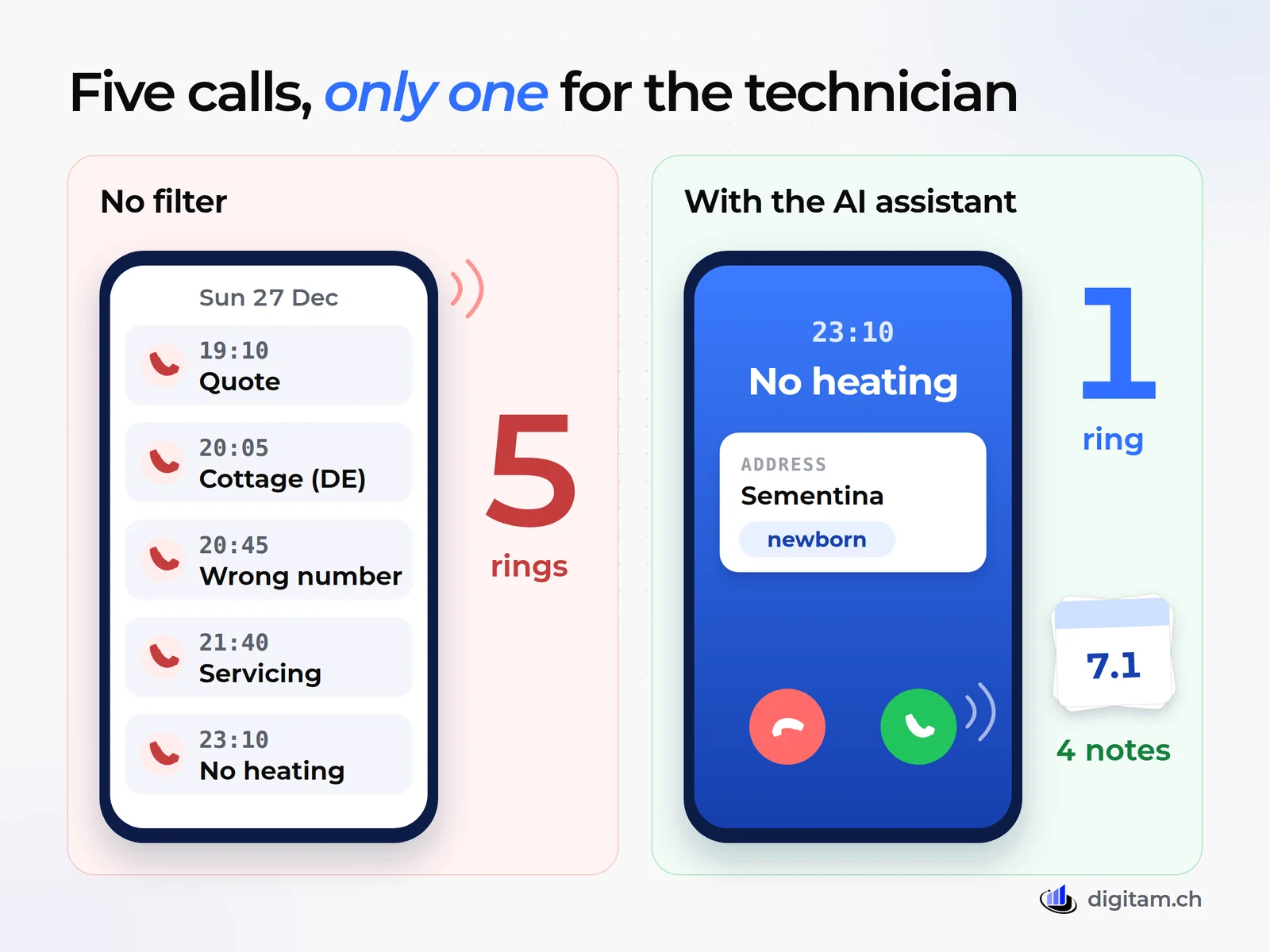
The man from Zurich gets his answer in German and his question goes into a note. The boiler service and the quote become callbacks scheduled from 7 January. The wrong number ends on its own. At 23:10 the assistant recognises a house with no heating and a newborn, takes down the address and number, and puts the call through to Luca, who picks up already knowing where to go.
The part that matters most is the rules, and you write them before the holidays. One page is enough, plus a clear idea of what, in your trade, can't wait until 7 January. For a heating firm, for example, a house with no heating or a water leak goes straight to the on-call technician. A smell of gas doesn't even wait for the technician: the assistant tells the caller to get out of the house and call the emergency services. Quotes, servicing and invoices become a note for reopening day.
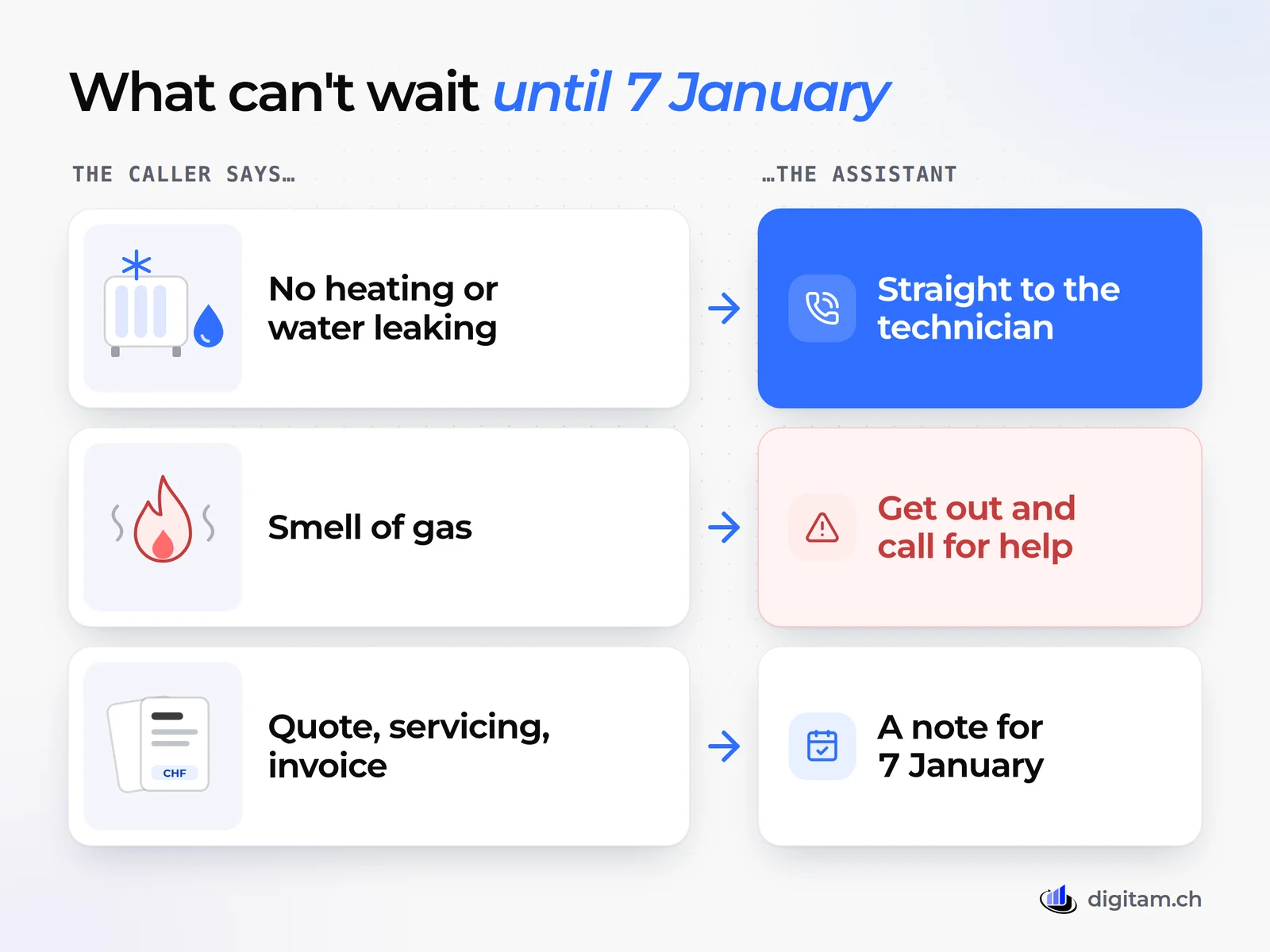
One point is non-negotiable. People talking to an AI system have the right to know they're dealing with a machine, and whether the data they give is used for other purposes: the Federal Data Protection and Information Commissioner (FDPIC) says so explicitly5. So the assistant introduces itself as a virtual assistant in its first sentence. What to record, for how long and what to put on your website is covered in AI phone assistants and WhatsApp: the 2026 rules.
When an AI assistant for the holidays isn't worth it
- If last year, between Christmas and Epiphany, the phone rang only a few times and none of the calls was an emergency: voicemail is enough.
- If there's nobody who can go out. The assistant recognises the emergency, but with no technician to put it through to it has to tell the customer clearly, and they'll call another firm.
- If emergencies in your trade always need a technical judgement on the phone. Then the assistant only speeds up the handover, and the saving is small.
- If you want to switch it on just before 24 December. Rules, tests on real calls and connecting your number take time: better to start in January and use it every evening and weekend of the year.
What to do before 24 December
Before you close for the holidays
- Count last year's callsOpen the call log of your phone system or mobile for 24 December to 6 January: how many, at what time, how many were real emergencies.
- Decide who is on callTwo people for 14 days, seven each. If you're considering the 14-day exception, check both conditions and ask for consent.
- Check the permitOn-call duty at night, on Sundays and on holidays: check with the labour inspectorate whether your business is exempt.
- Put the pay in writingThe collective agreement's flat rate or the amount you've agreed, in black and white, with the holiday supplements.
- Record the message and update your hoursVoicemail in Italian and German, website, Google profile and email auto-reply, all with the same dates.
- Write the emergency rulesOne page: what counts as urgent, who to put it through to, what to tell everyone else.
If the count in the first step shows that most calls could have waited, that's the job of Digitam Voice. It answers on your business number, says straight away that it's a virtual assistant, speaks Italian and, if you need it, German, French and English. It puts emergencies through to whoever is on call according to the rules you set, and leaves you a written summary of every call: who called, what they wanted, what was agreed, what's still to do. The cost depends on what it has to do: after a no-obligation demo you get a written quote with the setup fee and the monthly fee. And if it's too late for these holidays, it's still useful every evening and weekend of 2027.
Frequently asked questions
Does on-call duty from home count as working time?
Only partly. If the employee waits at home, only actual call-outs and the necessary travel count as working time. If they have to stay on the premises, the whole on-call period is working time and a full daily rest is due afterwards. SECO explains this in its guidance on Art. 15 ArGV 1.
Do I have to pay for on-call duty if nobody calls?
Yes. The Employment Act does not set an amount, but according to the Federal Supreme Court case law cited by SECO, time spent on standby must be compensated, though not necessarily at the full wage. The amount can come from the employment contract or a collective agreement, or be included in the salary. In the building services trade the collective agreement sets a flat rate of CHF 180 a week.
Does 8 December count as a Sunday in Ticino?
No. The Immaculate Conception is an official public holiday in Ticino, but the cantonal law implementing the Employment Act does not treat it like a Sunday, so the federal Sunday-work rules do not apply. Christmas, St Stephen's Day, New Year's Day and Epiphany, on the other hand, are treated like Sundays.
Can an employee refuse on-call duty over the holidays?
Pregnant women and breastfeeding mothers may not be put on call. Employees with family responsibilities can only be put on call, when the schedule changes for business reasons, if they explicitly agree and there is no reasonable alternative. For everyone else, the employment contract, internal rules or the trade's collective agreement decide.
Can the AI assistant tell a customer how to shut off a valve?
It can only pass on instructions you have written for it, and with a technical fault it is better not to improvise. The safest rule is for it to recognise the emergency, take down the address and number, and put the call straight through to the on-call technician, who decides what the customer should do.
Can I keep my business number?
In most cases, yes: calls are forwarded from your number to the assistant, and the setup is done together with your phone provider. Customers keep calling the number they already know.
Sources
- SECO – Servizio di picchetto (on-call duty). Arts. 14 and 15 ArGV 1: seven days in four weeks, the 14-day exception, working time, rest, permits for nights, Sundays and holidays, pay.
- Canton of Ticino, UIL – Giorni festivi in Ticino. The 15 official public holidays in 2026 and 2027, and when the Sunday-work rules apply.
- Ticino law collection – LALL (RL 843.100), Art. 6. Holidays treated like Sundays (including Christmas, St Stephen's Day, New Year's Day, Epiphany) and those that are not (including 8 December).
- Collective agreement for the Swiss building services trade (gavservice.ch). Art. 43.4: on-call flat rate of CHF 180 a week; Art. 43: 100% supplement on Sundays and holidays, 50% for occasional night work; generally binding 2026-2029.
- FDPIC – Current data protection law is directly applicable to AI. People talking to an AI system have the right to know it is a machine and what their data is used for (update of 8 May 2025).
- Twinline – Telefonauftragsdienst. Example price for an outsourced answering service: CHF 105 a week excluding VAT; stated hours Monday to Friday 8.00-17.30.
Written by Aramis Moggi. Sources checked on 24 November 2026. This article is not professional advice: if you spot a figure that doesn’t add up, write to us at info@digitam.ch.











 About Markets