 Digitam SAGL
Restaurants and hotels on ChatGPT in Ticino: what guests asking in German find
One in five people in Switzerland already plans trips with AI, and they ask in their own language. Where ChatGPT gets its names, why an Italian-only website starts behind, and what to fix this winter before you reopen.

21%
of people in Switzerland already use AI to plan a trip; among under-45s it's 29 %
YouGov Schweiz, January 2026At a glance
- People who use AI for holidays mostly ask what to do once they're there (66 %): that's where the table or the room gets decided.
- When the question is in German, two in three sources ChatGPT cites are German-language pages: an Italian-only website starts behind.
- Menu, prices and season dates belong in text, on your website and in your Google listing, not just in a photo.
- In winter, mark the listing “temporarily closed” and reopen it on the very day you reopen.
- Nobody can guarantee you a spot in the answers: check with a set of test questions in three languages, before and after.
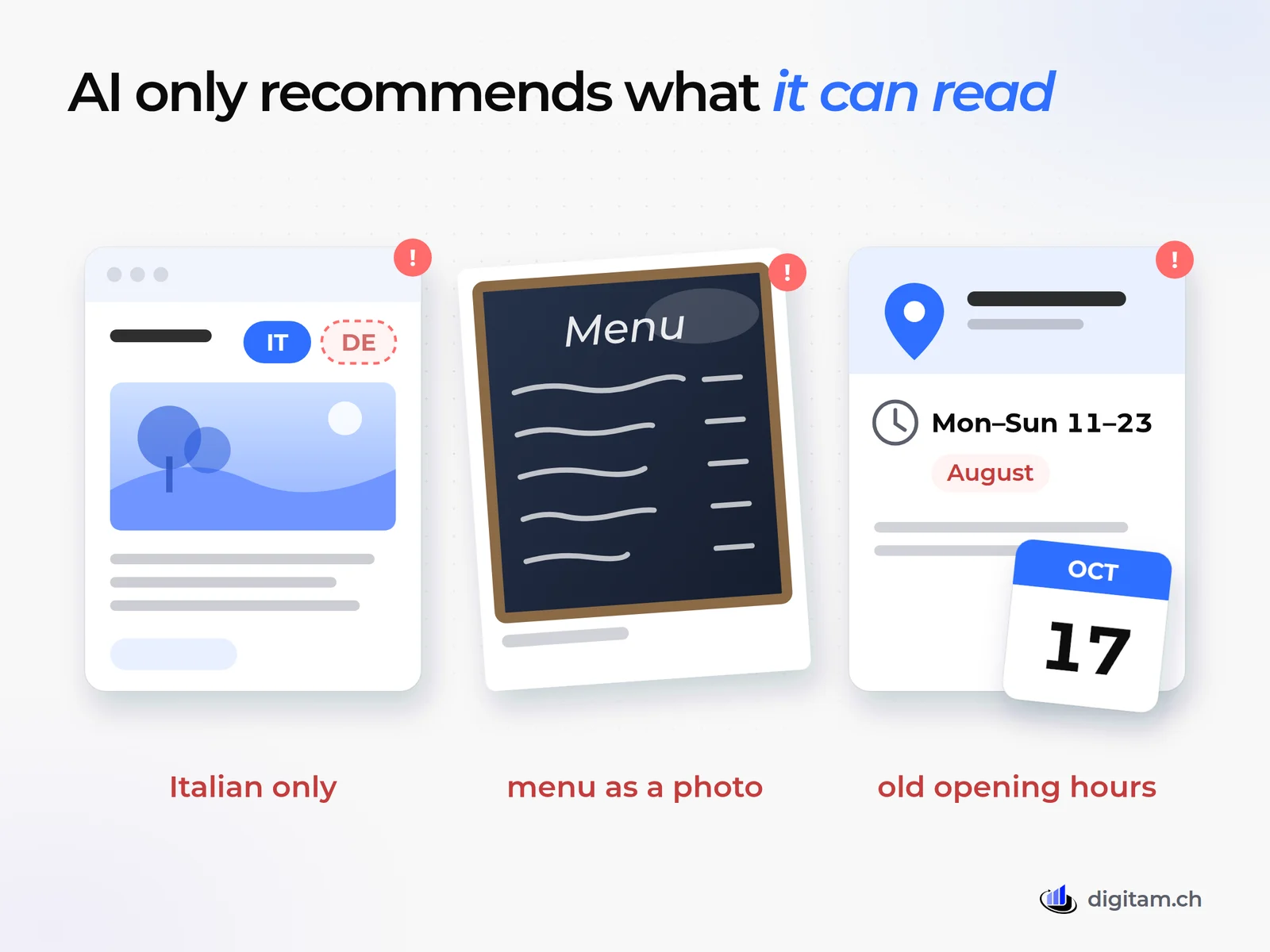
Saturday 17 October, half past twelve, a car park in the Maggia Valley. A couple from Winterthur types into ChatGPT, in German: «Grotto in der Nähe mit Terrasse, heute offen, nicht zu touristisch» (a grotto nearby with a terrace, open today, not too touristy). Three names come back. The grotto five hundred metres away, open, with two free tables under the chestnut trees, isn't one of them. Its website is in Italian only, the menu is a photo of the chalkboard and its Google listing still shows the August opening hours.
The scene is made up. The three causes are real, and each one takes ten minutes to check. This article explains where an AI assistant gets its names when a visitor asks for something «nearby», why the language of the question matters so much, and what to prepare this winter, before you reopen.
How many visitors ask an AI where to eat and stay?
In January 2026 YouGov surveyed 1,239 people in Switzerland aged 15 to 79. 21 % already use ChatGPT, Gemini or Copilot to plan a trip or look for ideas; among under-45s it's 29 %1. Of those, 88 % use ChatGPT. And 66 % ask it for things to do once they're there, more than for destinations (45 %) or routes (43 %)1. 71 % say they'll use it more.
For anyone running a restaurant or hotel, that means AI comes in once the holiday is already booked. It's when people choose where to have lunch, what to see, where to spend the second night. In other words, the moment your table or your room is won or lost.
And who are your guests? In 2025 Ticino's hotels recorded 2.51 million overnight stays, plus 1.95 million in holiday homes, campsites and hostels. Six in ten hotel nights were booked by guests living in Switzerland, one in ten by guests from Germany2.
Hotel nights in Ticino by guests' country of residence, 2025
- Switzerland60.3 %
- Germany10.0 %
- Italy6.2 %
- United States4.3 %
- Netherlands2.0 %
Ustat counts country of residence, not the language people speak. But anyone working at a hotel reception in Locarno or a restaurant on the Lugano lakefront knows how much German they hear at the counter. Many of the questions ChatGPT gets about your village aren't in Italian.
Where does ChatGPT get names when the question is «nearby»?
When people look for restaurants and hotels on ChatGPT, the question is almost always about a specific place. In that case ChatGPT doesn't answer from memory: it searches the web, using a crawler called OAI-SearchBot. If your website blocks it, OpenAI says, your pages won't appear in its search answers9. For AI Overviews and AI Mode, Google uses pages it has already indexed and can show with a snippet. No special files or tricks are needed4.
In the same guide, Google asks for two things that are decisive for a restaurant or hotel: important content written as text, and an up-to-date Business Profile4.
We've already explained how an AI assistant picks names and how to keep your listings on Google, local.ch and search.ch in order. Here a simpler rule applies: AI can only recommend what it can read. In the opening scene the grotto is invisible for three separate reasons, and none of them has anything to do with the food.
Why does the language of the question matter?
In early 2026 Temso analysed more than 7 million sources cited by four AI assistants in answer to commercial questions in seven languages across 12 countries. When the question was in German, 66.0 % of the sources ChatGPT cited were in German. For Google's AI Overviews, it was 89.8 %3.
Share of German-language sources when the question is in German
- Google AI Overviews89.8 %
- Microsoft Copilot75.9 %
- ChatGPT66.0 %
- Grok49.3 %
Two caveats. Temso sells tools for measuring AI visibility, and its questions were of the «best software for…» kind, not «grotto open today». A separate study published in August 2026, not yet peer-reviewed, reaches a similar conclusion for ChatGPT: the language of the question, more than the country it's asked from, decides whether local suppliers appear in the answer at all11.
What this means for a business in Ticino: when the couple from Winterthur asks in German, the answer is built mostly from German-language pages. Your grotto can still show up through its Google listing or a portal. But it starts behind the place next door that has a clear page in German.
What a German page that Google recognises looks like5:
- it has its own URL, for example /de/, rather than one page that switches language by itself;
- it's in one language only, text and navigation included: Google works out the language from the visible text, not from the code;
- it doesn't redirect visitors to another language based on where they're browsing from, and it links clearly to the other versions;
- it translates the actual content, not just the menus and footer.
If your website needs rebuilding anyway, we've set out the costs in francs in how much a website costs in Switzerland.
A menu in a photo, August hours in October: what does AI misread?
A photographed chalkboard looks great on social media. But for a restaurant the important content is the menu itself: dishes, prices, days. If it only exists inside a photo, the assistant has to work it out from an image. Google says it plainly: important content should be available as text4.
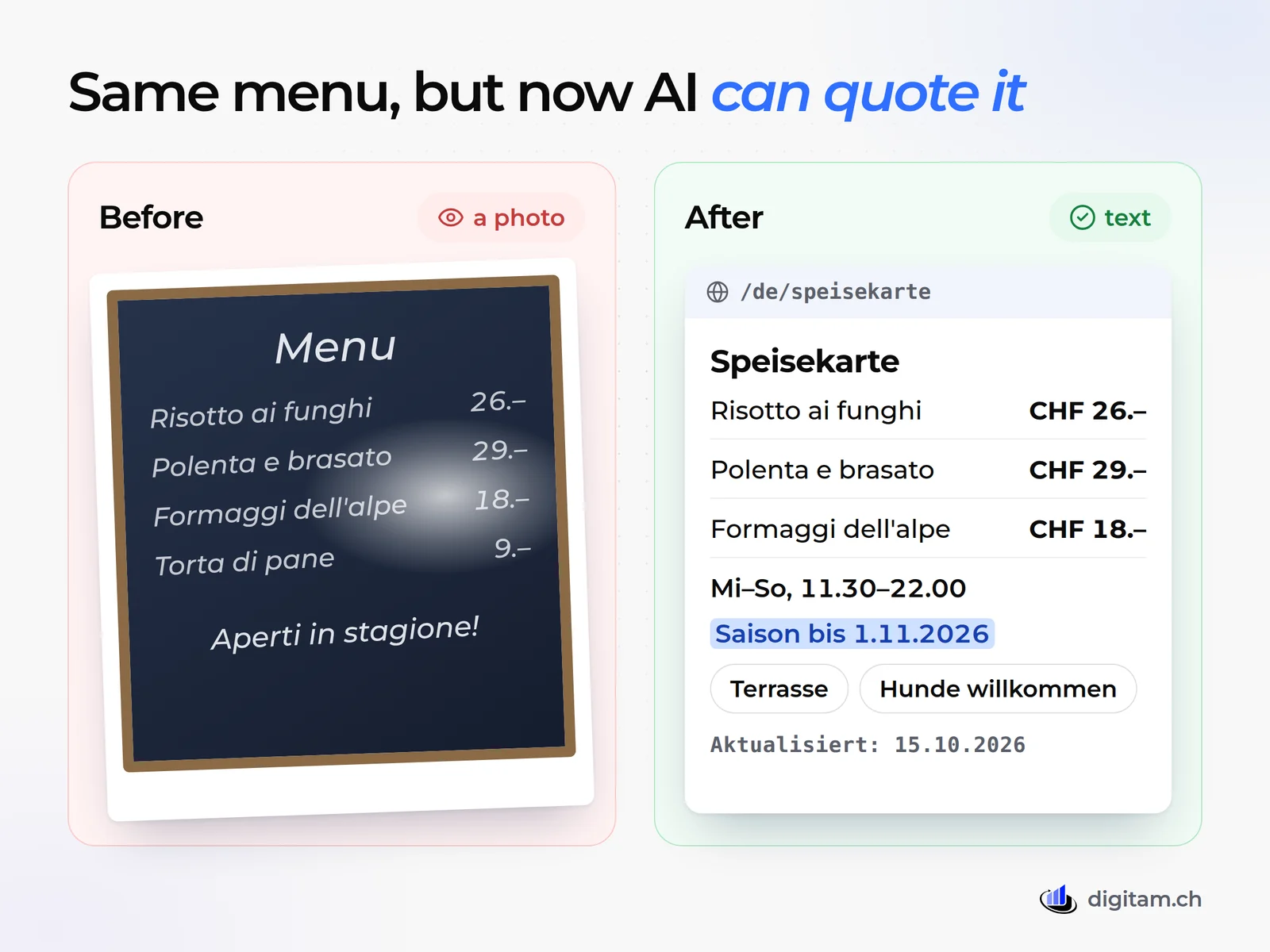
What to put on your «Speisekarte» page, and on its Italian and English twins:
- dishes with prices in francs, at least the ones that don't change;
- opening days and hours, with the end of the season written out in full;
- the things visitors actually ask about: terrace, dogs, parking, wheelchair access, vegetarian dishes, whether to book;
- how to get there from the nearest bus stop or car park.
In your Google listing, food businesses can add the menu item by item, with descriptions and prices. Changes can take 24–48 hours to show on Maps and in Search8. There's also an experimental feature that turns a photo of the menu into text: handy, but check every price8.
Then there's the season. Many grottos, mountain restaurants and hotels in Ticino close in winter, and this is where answers easily go wrong: the sources don't all update at the same time. Google distinguishes two cases67:
- short closures, such as a long weekend or a public holiday, up to 6 days in a row: use special hours, which expire by themselves;
- long closures, more than 7 days or the off-season: mark the business as temporarily closed, never as permanently closed.
Google warns that for broad searches a temporarily closed business can rank after open ones6. In winter, that's fine. But on the day you reopen, remove the status straight away, not at the end of April when someone remembers.
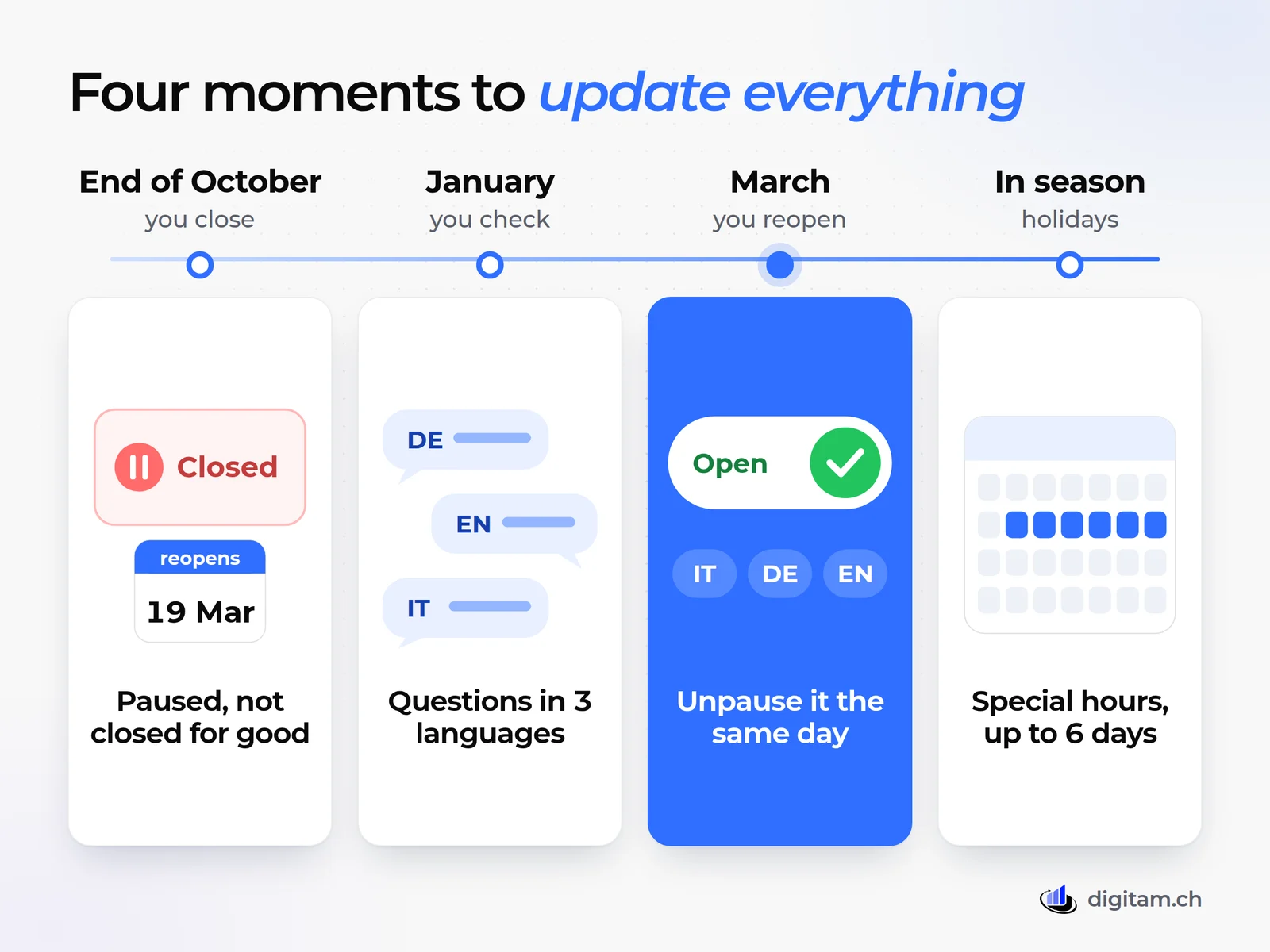
Write the season with dates on your website, in every language. «Geöffnet vom 19. März bis 1. November» says far more than «open in season». And put the date of the last update next to your opening hours: guests trust it more, and anything reading the page can see it's current.
And for a hotel, what changes with Booking?
Hotels have one more step. The distribution study by HotellerieSuisse and HES-SO Valais-Wallis, covering 171 Swiss hotels, found that direct bookings (phone, email, form or the booking engine on the hotel's website) remain the main channel at 58.5 %. Bookings made on the hotel's own website have risen from around 7.5 % in 2015 to 20.9 %. Among real-time online bookings, Booking.com has more than 70 % and Expedia around 15 %10.
What does that have to do with AI? If your website doesn't say in German and English whether there's parking, whether dogs are allowed, how far the lake is and from what date you're open, the assistant will find that information elsewhere, on a booking portal for example. And the link in the answer will point there. A clear page on your own website takes nothing away from Booking: it gives the AI one more source that leads to your name, and gives guests a way to book without a middleman.
A twelve-room guesthouse in Brissago doesn't need a project for this: a «Zimmer & Preise» page in German, one in English, and the same opening dates everywhere will do.
When isn't it worth the effort?
When it isn't worth it, or not yet
- Your place lives on village regulars you know by name: look after your Google listing and stop there.
- Your hotel sells almost all its rooms to groups, tour operators or companies on contract: AI answers barely affect your occupancy.
- Nobody has time to keep hours and menus up to date: a little correct information in one language beats a lot of outdated information in three.
- You want a guarantee: answers change even between two identical questions, and nobody can promise you a fixed spot11.
There's an honest limit too: the studies on source language are recent and based on commercial questions, not restaurants. They point in a direction; they're not a figure to put in your budget. And even with everything in order, an assistant can still get an opening time wrong. That's why it matters that all your sources say the same thing.
What to do this winter, before you reopen
Five things to do before the 2027 season
- Check your websiteAsk whoever runs it whether OAI-SearchBot is blocked in the robots.txt file or by the service that protects the site.
- Sort out your Google listing«Temporarily closed» for the winter break, menu item by item, recent photos, reopening date.
- Write a real page in GermanMenu with prices, season with dates, terrace, dogs, parking. Then the same in English.
- Use the same dates everywhereWebsite, Google, portals, tourist office: same opening, same closing.
- Run the test questionsThe questions in the table, three times each, in January and again after you reopen.
| Language | Restaurant or grotto | Hotel |
|---|---|---|
| German | «Grotto bei Locarno mit Terrasse, heute offen» | «Hotel in Lugano mit Parkplatz, Hunde erlaubt» |
| English | «Best risotto in Ascona, open on Monday» | «Family hotel on Lake Maggiore with a pool» |
| Italian | «Ristorante nel Mendrisiotto per una cena di lavoro» | «Albergo a Bellinzona vicino alla stazione» |
| French | «Restaurant tessinois typique près de Lugano» | «Hôtel calme dans le Val Verzasca» |
Swap in your own village, dishes and facilities. Note how many answers you appear in, in which language and with what details. If you're there in Italian but never in German, you know where to start. If the AI quotes you with the wrong hours, you know which source to fix.
If you'd rather do it with someone, Digitam's AI Visibility starts right here: thirty free minutes in which we run five real questions from your sector together. Then, only if it's worth it, an analysis of your website, listings and reviews, work on pages, data and portals, and a monthly report. We don't promise a fixed spot in the answers, and if it isn't worth it in your case, we'll tell you. For a multilingual website, see Websites. And if your real problem is the phone ringing in the middle of service, we covered that in phone bookings at a restaurant.
The season is prepared in winter. Write to us before March.
Frequently asked questions
Can I pay to get my restaurant into ChatGPT's answers?
No. Answers can't be bought: the assistant picks names from the pages and listings it finds. Advertising, where it exists, is kept separate from the answer. Be wary of anyone selling “first place on ChatGPT”: even two identical questions can return a different list.
Is it enough to run my website through a machine translator?
As a starting point, yes. As the finished result, no. Google wants one page per language, each with its own URL, and warns against translating only the menus and footer while the rest stays in Italian. Have a native speaker check at least the menu, opening hours and directions: a badly translated dish stands out, including to an AI that has to quote it.
Is a PDF menu on my website good enough?
Keep it for people who want to print it. But put the same dishes and prices on a text page as well, in your guests' languages, and in the menu editor of your Google listing. Google asks for important content to be available as text, and for a restaurant the menu is the most important content there is.
Should I close my Google listing in winter?
Never mark it as permanently closed. For the off-season or closures longer than 7 days, Google offers “Temporarily closed”; for long weekends and holidays of up to 6 days, special hours are enough. On the day you reopen, remove the closed status straight away: for broad searches, temporarily closed businesses can rank after open ones.
ChatGPT says I'm open, but I'm closed. What can I do?
You can't edit the answer directly: fix the sources. Make sure your website, Google listing and portals all say the same thing, with dates written out in full, and check that your website doesn't block OAI-SearchBot. Then ask the same question again a few days later, in several languages, and note what has changed.
Sources
- YouGov Schweiz – Jeder fünfte Schweizer nutzt AI zur Reiseplanung (03.02.2026). Online survey, 14–20 January 2026, 1,239 people aged 15–79, weighted by age, gender and language region: 21 % use AI for travel, 88 % of them ChatGPT, 66 % for activities (in German).
- Ustat, Canton of Ticino – Tourism: key figures 2025. 2.51 million hotel nights and 1.95 million in other accommodation; shares by guests' country of residence (FSO/HESTA data, in Italian).
- Temso AI – Lost in Translation: How AI Models Handle Local-Language Sources (updated 20.04.2026). 7,058,891 citations from about 350,000 answers, 7 languages, 12 countries, early 2026; commercial prompts. Study by a company that sells measurement tools.
- Google Search Central – AI features and your website. Requirements for AI Overviews and AI Mode: indexed and snippet-eligible page, important content in text form, up-to-date Business Profile.
- Google Search Central – Managing multi-regional and multilingual sites. Separate URLs per language, language detected from visible text, no automatic redirects based on IP.
- Google Business Profile Help – Mark your business as closed. “Temporarily closed” for closures longer than 7 days or for the off-season; for broad searches it can rank after open businesses.
- Google Business Profile Help – Opening hours and special hours. Special hours for holidays and events, for closures of up to 6 days in a row.
- Google Business Profile Help – About the menu editor. Menu items with descriptions and prices for food businesses; changes can take 24–48 hours to show; creating a menu from a photo is experimental.
- OpenAI – Overview of OpenAI Crawlers. OAI-SearchBot brings websites into ChatGPT search answers; if it's blocked, the site doesn't appear. GPTBot (training) is controlled separately.
- htr hotel revue – Sichtbarkeit wird zur neuen Währung im Hotelvertrieb (19.05.2026). HotellerieSuisse and HES-SO Valais-Wallis distribution study of 171 Swiss hotels: 58.5 % direct bookings, Booking.com over 70 % of real-time online bookings (in German).
- Żatuchin, D. – The Language of the Question Selects the Market (arXiv:2608.30052, 30.08.2026). Preprint, not peer-reviewed, 234 runs on ChatGPT from 4 countries in 6 languages: query language decides whether local suppliers appear; the top pick changes between identical runs.
Written by Alessandro Scerpella. Sources checked on 3 November 2026.











 About Markets