 Digitam SAGL
Wrong information on ChatGPT: how a Swiss business in Ticino fixes it
AI has no profile of your business that you can edit: it repeats whatever it finds online. How to find the page behind the mistake and what to fix, in order, with the tools that exist in Switzerland.

45%
of more than 3,000 answers from ChatGPT, Copilot, Gemini and Perplexity about the news had at least one significant issue
EBU/BBC, October 2025At a glance
- ChatGPT and Google keep no editable profile of your business: each answer is built from the pages they find, old ones included.
- Errors come in three kinds (outdated fact, namesake, filled-in gap), and each one is fixed in a different place.
- The right order: your website first, then Google Business Profile and local.ch, then the commercial register and third-party pages.
- Google may publish a suggested edit on its own if your website seems to confirm it, so an outdated site does double damage.
- Swiss data protection law covers only individuals: for a company you work on the sources, for the owner or the doctor there is a right to rectification.
Monday 2 November, 7:35, an industrial estate in Cadempino, just outside Lugano: a customer waits outside an empty workshop with her winter tyres in the boot.
The night before, she had asked ChatGPT for a garage near home that opens early. The answer was precise: «Via Cantonale 21, Cadempino, opens at 7:30». The trouble is, the garage moved to Lamone in 2024. The owner, let's call him Davide, updated his website and his Google listing on moving day. When the customer finally calls him at 7:50, she is already annoyed. And she isn't the first.
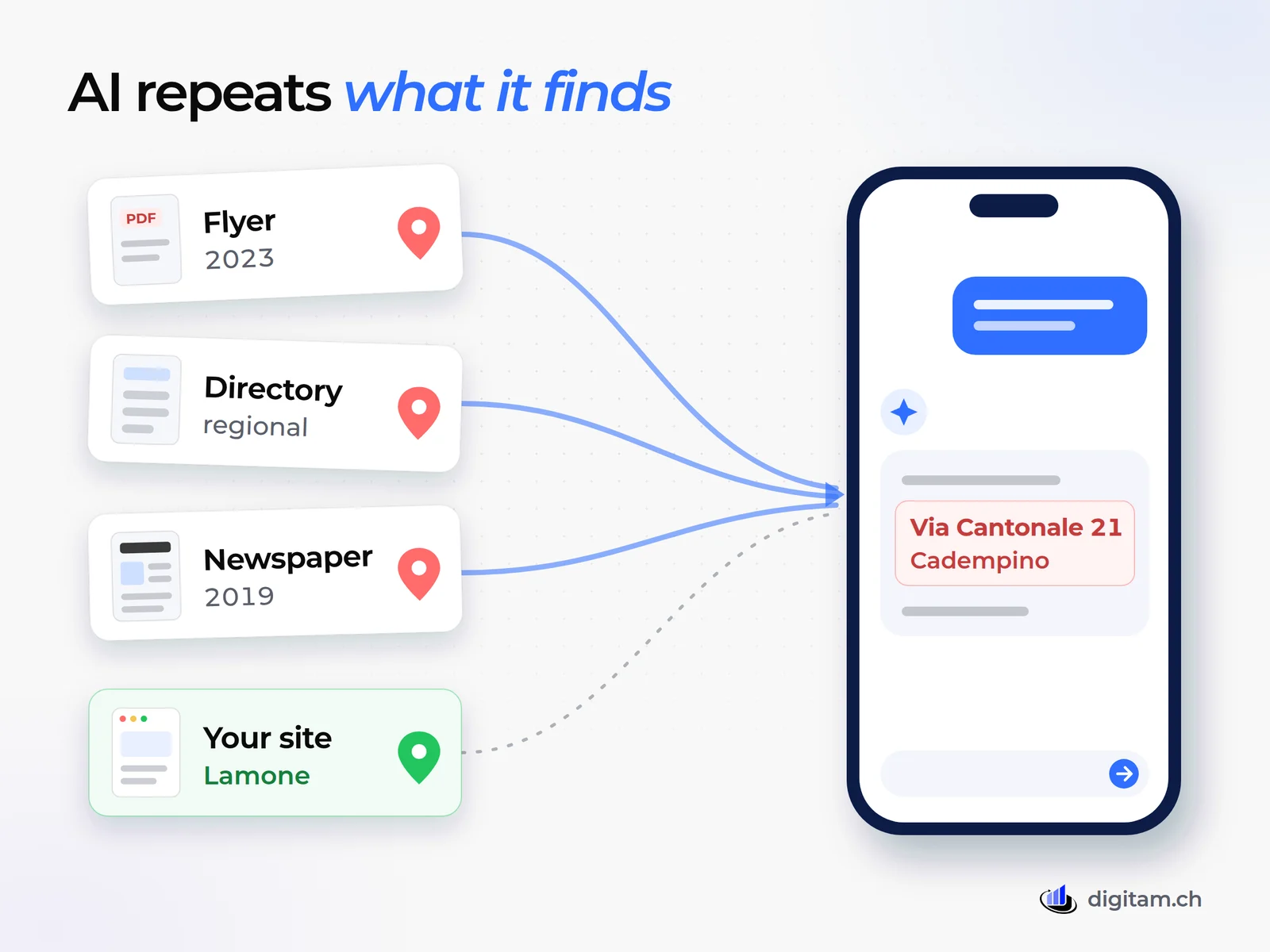
The scene is made up; the mechanism is not. The AI didn't invent the address. It repeated what it could still find online: a 2023 PDF flyer left on the server, an entry on a regional directory nobody touched, a local newspaper piece about the opening. This article explains where wrong information on ChatGPT and in Google's AI answers comes from, how to find the page behind it and what to fix, in order, with the tools available in Switzerland.
Where does ChatGPT get information about your business?
An AI assistant has no profile of your business that you can update. It has two ways of knowing anything about you.
The first is memory: what the model read during training. OpenAI collects content that may be used to train its models with a crawler called GPTBot4. That memory stops at a certain date. If you moved after it, the model doesn't know.
The second is live web search, done by a different crawler, OAI-SearchBot. OpenAI states that a site blocking it won't appear in ChatGPT search answers, at most as a plain link4. For a local business this is the route that matters: anyone asking for «a garage open early near Cadempino» triggers a search. We explain both routes in detail in how to get found on ChatGPT.
Google works in a similar way. AI Overviews and AI Mode rely on the normal Search index, with no extra technical requirements, and can run several related searches on their own to build an answer5. In plain terms: the AI also reads the directory, the forgotten PDF and the 2019 article, not just your website. If three pages say «Cadempino» and one says «Lamone», there's no guarantee the right one wins.
How common is the problem?
The problem grows with the number of people who ask an AI instead of searching, and in Switzerland that number is high. According to a representative Innofact survey for Comparis, carried out in March 2026 among 1,035 people, 76.1% of adults use chatbots such as ChatGPT, Gemini or Perplexity1. Among those who know them, 41.6% use them instead of a Google or Bing search1.
Adults in Switzerland using AI chatbots
- 202449.7 %
- 202562.4 %
- 202676.1 %
The Federal Statistical Office measures more cautiously, but the direction is the same: in spring 2025, 43% of the population aged 15 to 88 had used a generative AI app, and 36% of users do so every day or almost every day2.
How often does AI get it wrong? For local businesses, nobody has measured it with a sound method. The most solid figure comes from news. In a study coordinated by the European Broadcasting Union and led by the BBC, with 22 public broadcasters from 18 countries (Switzerland was represented by SRF), 45% of more than 3,000 answers from ChatGPT, Copilot, Gemini and Perplexity had at least one significant issue. 20% contained major accuracy issues, including made-up details and outdated information3.
News isn't your opening hours, but the type of error is the same. Google says so itself: AI answers may contain mistakes, and important information should be checked in more than one place6. Your 7:35 customer didn't, and none of your customers will double-check what time you open.
Outdated, namesake or invented: which error do you have?
Before fixing anything you need to know what to fix. Twenty minutes will do.
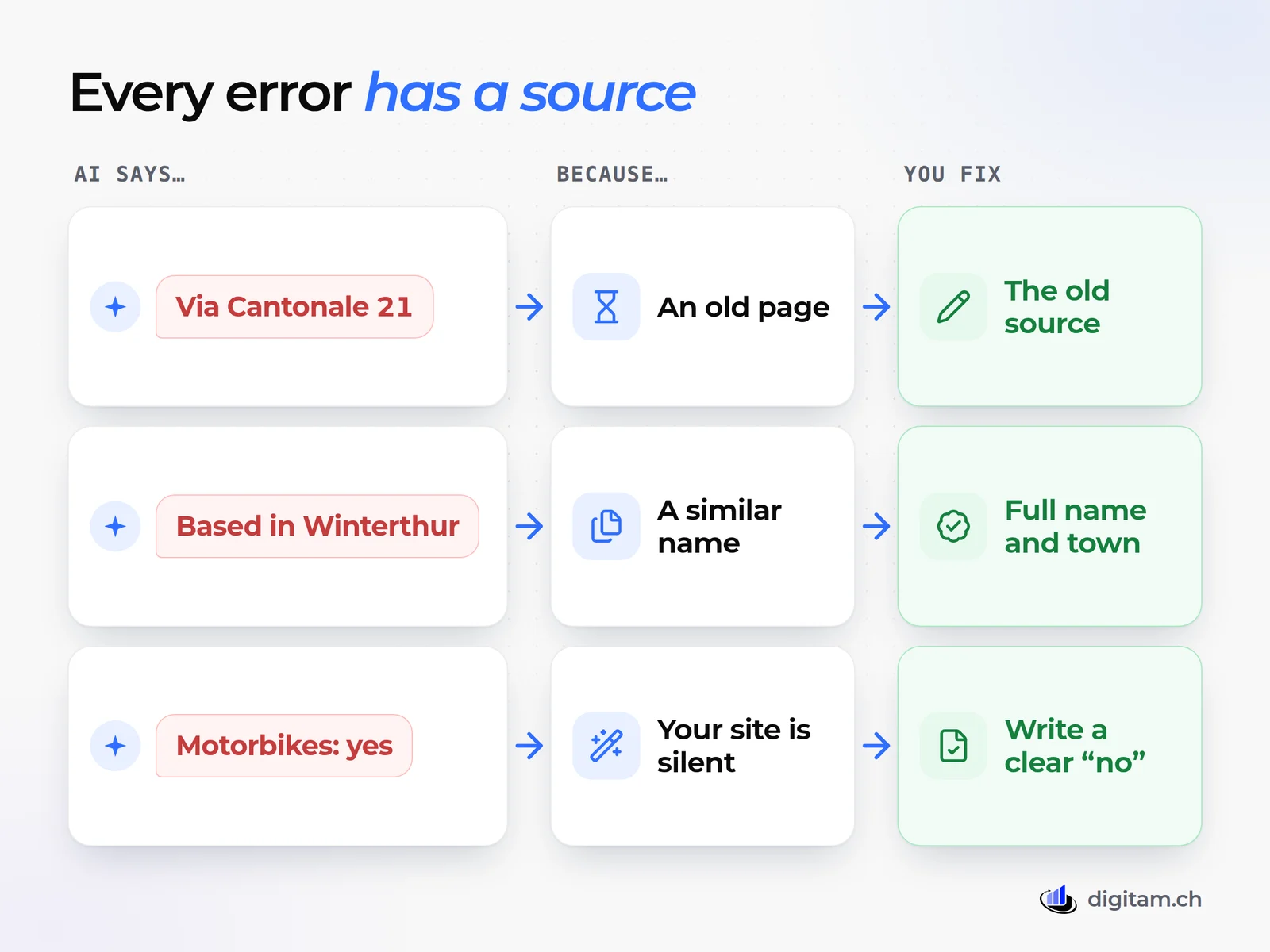
Write ten questions the way a customer would: «garage in Lamone that does inspections», «opening hours on Saturday» with your name, «do they also do motorbikes?». Half with your company name, half without. Ask them in ChatGPT, Gemini and Google Search, and paste every answer into a document with the date. When you find a mistake, ask the assistant: «where did you get this information?». It often points to the page. If it doesn't, search Google for the wrong phrase in quotation marks together with your name: «Via Cantonale 21» plus the garage's name leads straight to the 2023 flyer.
Errors almost always fall into three kinds. The outdated fact (address, opening hours, phone number or price from a few years ago) is the most common after a move or a name change. The namesake comes with generic names: a company in Winterthur with a name similar to yours, and the AI blends the two. The filled-in gap is the sneakiest: your website doesn't say whether you service motorbikes, so the AI says yes because plenty of garages do. It didn't read anything wrong. It guessed.
Which sources should you fix, and in what order?
First the ones you control, then the ones others copy, and finally third-party pages.
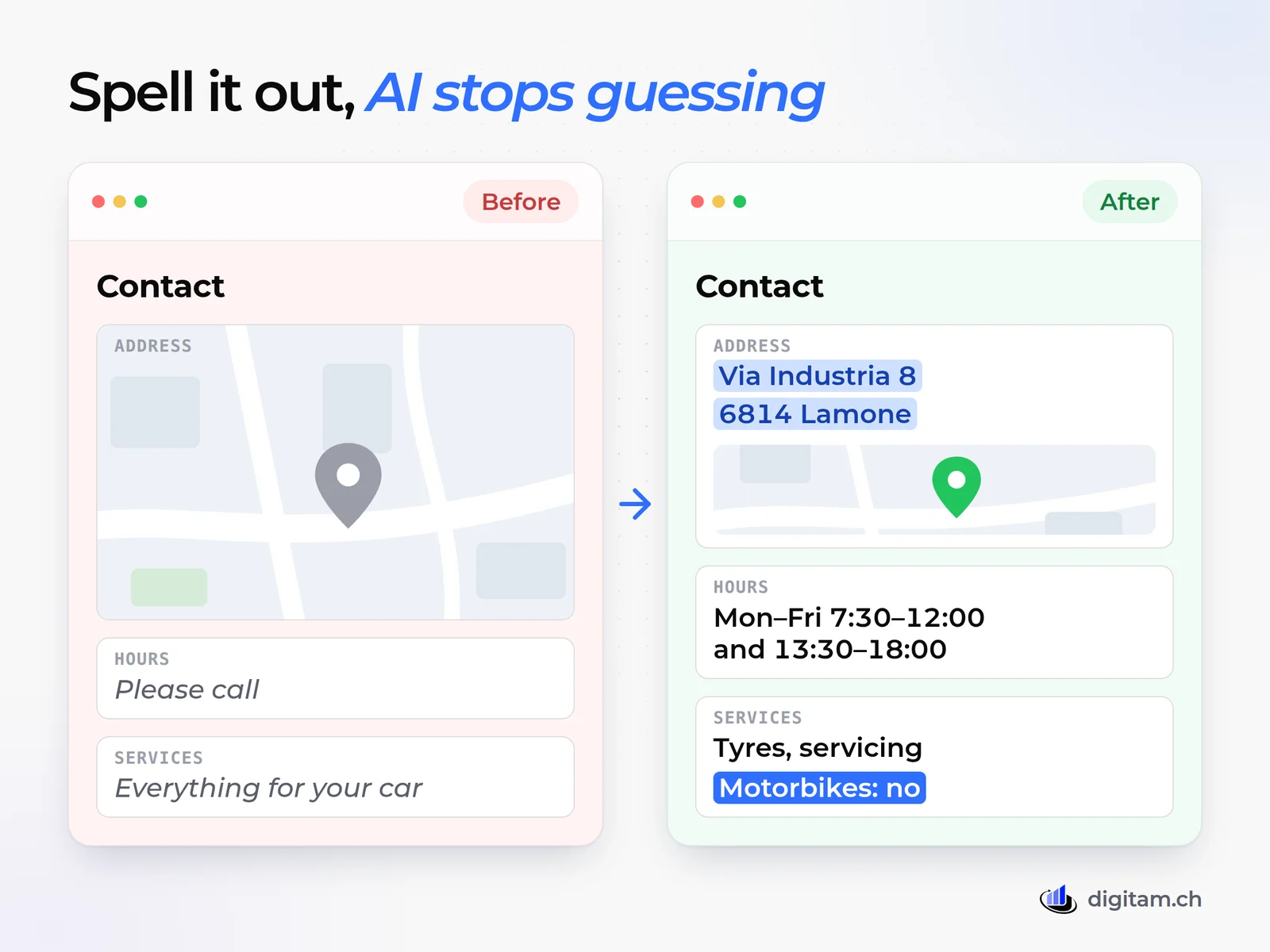
1. Your website. Write the address as text on the contact page, not just inside a map or an image. Opening hours day by day. Your full company name with the town. Add a line for what you don't do: «Motorbikes: no» closes the gap the AI would otherwise fill on its own. Then remove or update old PDFs: to a search engine, a 2023 flyer is a page like any other. And have someone check your robots.txt file: if it blocks OAI-SearchBot, ChatGPT can't see your updated website but keeps seeing the old directory4.
2. Your Google Business Profile. Updating it once isn't enough. Google also edits it on its own, using reports from users and licensed data; in the editor, fields changed by Google show up in blue7. When Google notifies you of a suggested edit, you have 4 days to accept or reject it. If you don't respond, Google can publish it if other public information confirms it, for example the business's website7. That's why an outdated website does double damage: it feeds the old fact to the AI and confirms it to Google. Everything else about the profile is in local SEO in Switzerland.
3. local.ch and search.ch. The free business listing from localsearch appears on local.ch, search.ch and localcities.ch. You edit it via «Create/modify listing», with your phone number and an account8. Five minutes, and that's three directories fewer with the old address.
4. The commercial register. If you moved, the commercial register office must be notified. A move to another municipality falls under art. 123 of the Commercial Register Ordinance; changing the business address within the same municipality costs CHF 30, and since autumn 2024 it can be done online via EasyGov9. This is your company's official record: if it still shows the old address, anyone who copies it will be wrong too.
5. Other people's pages. Directories, trade associations, newspapers: send a short email with the correct details and a link to your contact page. If the owner fixes the page but Google still shows the old text, there is a public tool called «Refresh outdated content». It only works for pages you don't own that have already been changed or removed, and an approval lasts 180 days10.
How long until the AI notices?
There's no set date. Google itself says a new crawl can take anywhere from several days to several months; for your own pages you can request one in Search Console5. ChatGPT search sees the new version when its crawler comes back. The model's memory only changes with a new model, and nobody tells you when. So the goal isn't to «delete» the old fact, but to make sure search finds far more correct sources than wrong ones.
Feedback buttons help a little and cost nothing. Under every Google AI Overview there's a thumbs down, then «Report a problem», with a box to explain6. ChatGPT also has a thumbs down under each answer. Use them, giving the right details and a link, but don't expect that to be enough: they are reports, not corrections.
The real test is asking the same ten questions again after two weeks and after two months, in the same document. If correct answers go from two out of ten to eight out of ten, the work on the sources is paying off.
What if the error is about a person?
Switzerland has a rule here that few business owners know about. Since 1 September 2023, the revised Data Protection Act only covers data about individuals, no longer data about legal entities12. The Act applies to the processing of personal data «concerning natural persons» (art. 2 FADP)11. So for your SA or Sagl (AG or GmbH north of the Alps), Swiss data protection law gives you no right to rectification: you're back to working on the sources.
It's different if the error concerns you as a person: the doctor credited with a specialisation they don't have, the owner of a sole proprietorship that carries her name, the architect mixed up with a namesake. That is personal data. Anyone processing it must make sure it is accurate (art. 6 para. 5 FADP), and the person concerned can demand that inaccurate data be corrected (art. 32 para. 1 FADP)11.
In practice: look in the provider's privacy policy for the channel for personal data requests. Attach dated screenshots, the question you asked and the correct information with proof, for example a commercial register extract or your professional registration. Don't expect a quick reply. And if the AI attributes serious false facts to you or your company, that's a matter for a lawyer, not a form. If your worry is the other way round, meaning what your staff type into ChatGPT, we covered that in ChatGPT and the FADP.
When it's not worth chasing
- The error only shows up for questions no customer asks, such as your company's history in the 1990s.
- You work with a few regular customers who call you by name: an outdated fact on ChatGPT costs you nothing.
- Someone sells you a «correction inside ChatGPT» or a guaranteed right answer: that control panel doesn't exist, the work happens at the sources.
- You're tempted to bury the old fact under fake pages or invented reviews: you pollute the sources instead of cleaning them, and if anyone notices you lose exactly the trust you were trying to win back.
What to do starting tomorrow
You can do the first round yourself, in three half-days, without spending anything.
Your first check, in one week
- Tuesday morningWrite the ten questions, ask them in ChatGPT, Gemini and Google, and save the answers with the date.
- Tuesday afternoonFor each error, find the page behind it and note whether it's yours, Google's, a directory's or a third party's.
- WednesdayFix the contact page, services and old PDFs; ask whoever runs your website to check robots.txt.
- ThursdayCheck the blue fields in your Google profile and your local.ch listing; if you moved, check the commercial register.
- Two weeks laterAsk the same ten questions again and compare.
If the wrong answers persist, or you don't have time to chase directories and crawlers, that's the work we do with AI Visibility: we start with a free 30-minute session where we ask five real customer questions together and look at what the AI answers. Then, only if it makes sense, we fix your website, profiles and sources and send you a report showing how many answers mention you and whether they're correct. We don't promise a guaranteed answer, because nobody can; and if it isn't worth it in your case, we'll tell you. To get started, just write to us.
Frequently asked questions
Can I ask OpenAI or Google to correct my company's details?
There is no form to edit a company's “profile” inside ChatGPT or Google's AI Overviews, because no such profile exists: the answer is rebuilt every time from the pages the system finds. You can flag a wrong answer with the thumbs down, but that is a signal, not a correction. The real fix happens at the sources: your website, Google Business Profile, local.ch, the commercial register and third-party pages.
Should I block AI crawlers in robots.txt to avoid mistakes?
Usually not: it makes things worse. If you block OAI-SearchBot, ChatGPT search stops reading your up-to-date website but keeps reading the old directories and PDFs. If you don't want your content used for training, you can block GPTBot only and leave OAI-SearchBot open: they are two separate rules.
Do I need an llms.txt file or special structured data so AI reads my site correctly?
Not for Google: its documentation says AI Overviews and AI Mode need no special AI files and no particular schema.org markup. The basics matter: indexable pages, real text instead of images, and structured data that matches what visitors see on the page.
An agency guarantees ChatGPT will say the right things about us. Can I trust that?
Be careful. Nobody has access to the models to edit their answers, and answers change even between two identical questions. Serious work tells you which sources it fixes, how it measures the result (for example, how many answers out of ten are correct) and accepts that the outcome isn't guaranteed.
How often should I check what AI says about my business?
After a correction, ask the same questions again after two weeks and after two months. After that, a check every three months is enough, plus one right after any major change: a move, a new number, new opening hours, a service added or dropped.
Sources
- Comparis: Bereits drei Viertel der Bevölkerung nutzen KI-Helfer wie ChatGPT & Co. (press release, 2 April 2026). Representative Innofact survey, March 2026, 1,035 people: 76.1% use AI chatbots (49.7% in 2024, 62.4% in 2025); 41.6% of those who know them use them instead of Google or Bing.
- Federal Statistical Office: Switzerland is embracing AI but increasingly exposed to disinformation (5 December 2025). Spring 2025: 43% of the population aged 15-88 had used generative AI; 36% of users use it daily or almost daily.
- EBU: Largest study of its kind shows AI assistants misrepresent news content 45% of the time (22 October 2025). 22 public broadcasters in 18 countries, including SRF; over 3,000 answers assessed; 45% with at least one significant issue, 20% with major accuracy issues including outdated information.
- OpenAI: Overview of OpenAI Crawlers. OAI-SearchBot for ChatGPT search, GPTBot for training; a site that blocks OAI-SearchBot will not appear in ChatGPT search answers.
- Google Search Central: AI features and your website. AI Overviews and AI Mode: no additional technical requirements beyond Search, query fan-out, recrawling can take from several days to several months.
- Google: About AI Overviews. Google warns that AI answers may contain mistakes; feedback via thumbs down and “Report a problem”; Switzerland is among the countries where AI Overviews are available.
- Google: About Google updates to your Business Profile. Google updates profiles using user reports and licensed data; fields changed by Google shown in blue; 4 days to accept or reject, after which an edit can go live if other public sources confirm it.
- localsearch: Your listing on local.ch, search.ch and localcities.ch. Free business listing published on all three platforms; edited via “Create/modify listing” with your phone number and an account.
- SME Portal (SECO): Changing a company's registered office or address. Changes of registered office must be notified to the commercial register (art. 123 CRO); CHF 30 to change the business address; online via EasyGov since autumn 2024.
- Google Search Console: Refresh outdated content. Public tool for third-party pages that have already been changed or removed; approval lasts 180 days.
- Fedlex: Federal Act on Data Protection (FADP, SR 235.1). Art. 1 and 2: protects natural persons; art. 6 para. 5: accuracy of data; art. 32 para. 1: right to rectification. In force since 1 September 2023.
- SME Portal (SECO): New Data Protection Act (nFADP). Since 1 September 2023 only data of natural persons is covered, no longer that of legal entities.
Written by Alexandru Ciobanu. Sources checked on 20 November 2026. This article is not professional advice: if you spot a figure that doesn’t add up, write to us at info@digitam.ch.










 About Markets