 Digitam SAGL
Google AI Overviews in Switzerland: why your site gets fewer clicks
Since 31 August 2026, Search Console shows which of your pages appear in Google's AI summaries. How to read it, which drops are the AI's fault and which aren't, and what to rewrite.

33%
of searches with an AI Overview end in a click on an organic result; without one it's 57% (Germany, February 2026)
SISTRIXAt a glance
- Google AI Overviews have been live in Switzerland since 26 March 2025, in Italian too; AI Mode since 8 October 2025.
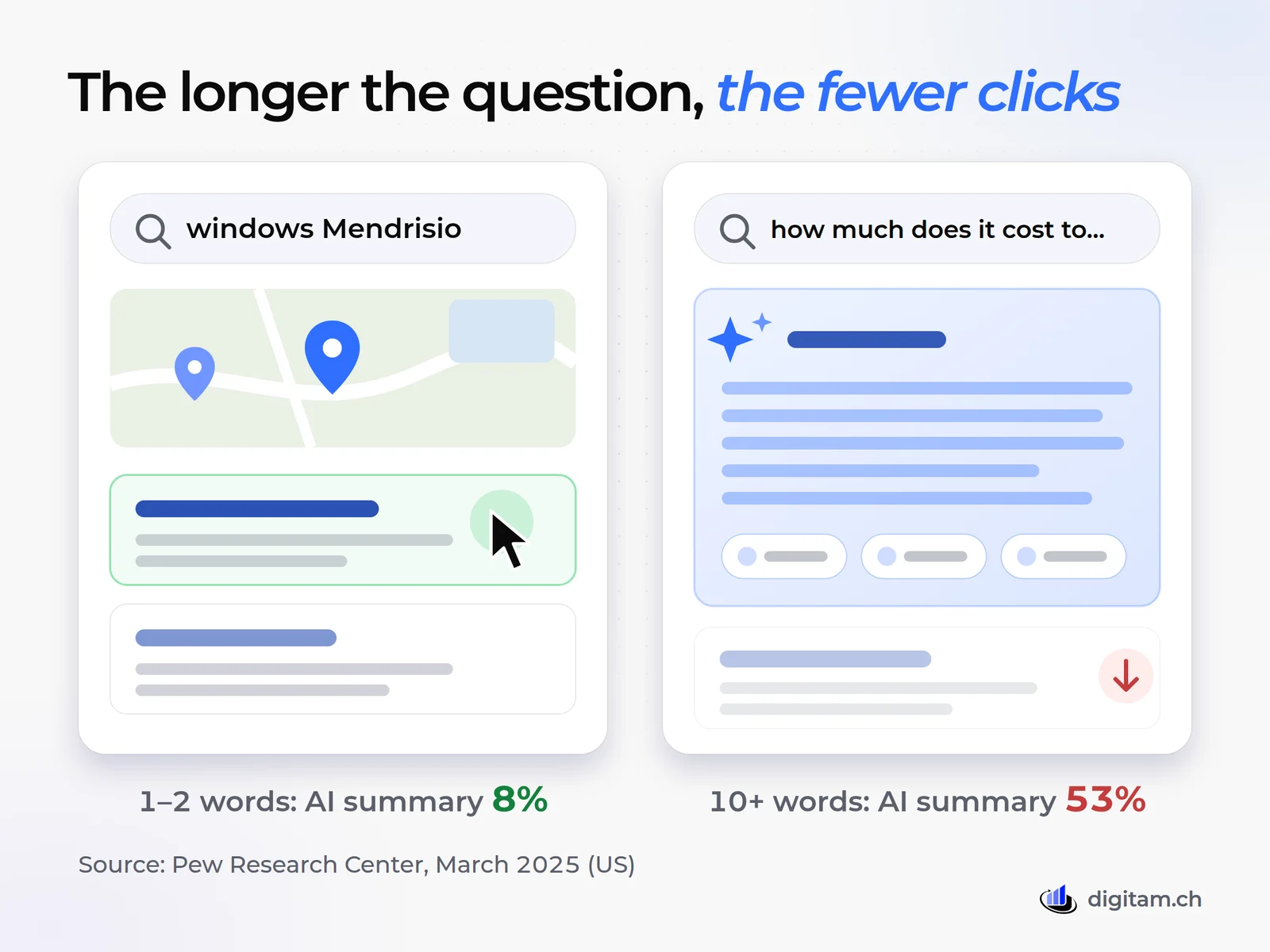
- The summary mostly shows up for long questions: in 8% of one- or two-word searches, in 53% of searches with ten words or more (Pew Research).
- Since 31 August 2026, Search Console has a generative AI report: it shows impressions per page, but no clicks.
- The method: compare each page's clicks with the same month last year and cross-check them against AI impressions.
- Generic pages lose the most: rewrite them with cases, prices and photos that only your business has.
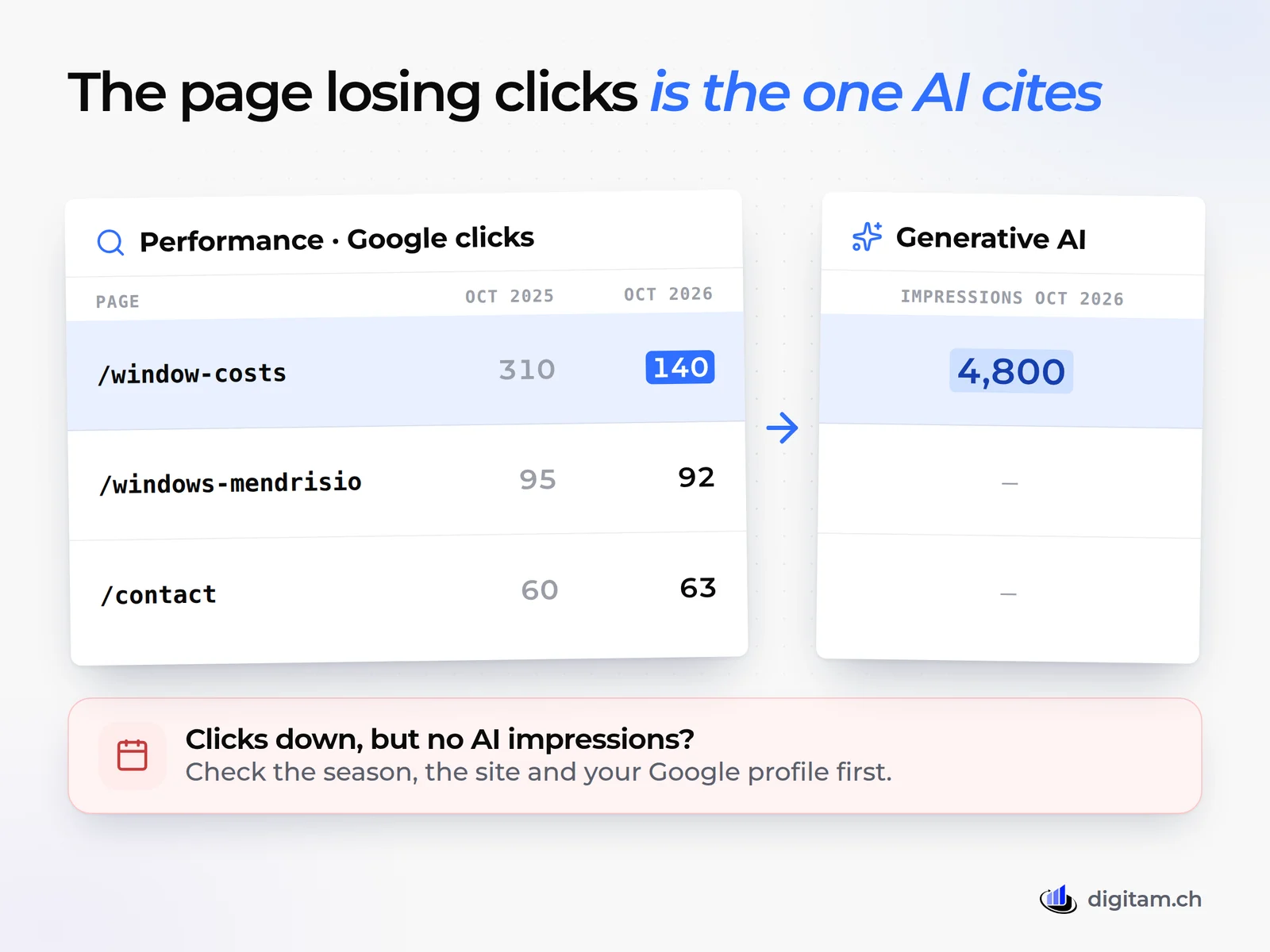
Monday 9 November, 7:40 am, Mendrisio. Laura, who owns a small window and door company, opens Search Console before the crew arrives. She compares October 2026 with October 2025 and can't make sense of it: the site showed up on Google more often than a year ago, yet clicks are down. The page "How much does it cost to replace windows?", which had been bringing in quote requests for two years, went from 310 clicks to 140. Nobody touched the site. The ranking hasn't moved. What changed is above her result: a box with the answer already written by Google's AI.
The company is made up and the figures are an example. The mechanism is real, though, and since the end of August 2026 you can actually measure it. This article explains how to tell whether your site's drop comes from AI Overviews, which pages they hit, and what is worth changing.
What are AI Overviews, and since when do people in Ticino see them?
Google AI Overviews are the AI-written summary placed at the top of the results, with a few links to sources. They reached Switzerland on 26 March 2025, in English, French, German and Italian, at first only for people signed in to a Google account and aged 18 or over1. On 8 October 2025 AI Mode followed: a separate tab next to the results where you ask complex questions and get a long answer with links to sources. In Switzerland it's available in German, French and Italian2.
Why does this matter for a business in Ticino? Because in Switzerland almost all searching happens there: in October 2026 Google had 81.25% of searches, Bing 11.55%3. And because the habit of letting an AI answer is spreading fast: according to the Federal Statistical Office, 47% of the population say they use generative AI, and no digital technology has ever spread so quickly4.
How many searches show a summary? There is no reliable public series for Switzerland. The closest is SISTRIX's German one, which tracks about 100 million keywords: the share rose from 10% in June 2025 to 57.9% on 6 November 20265. SISTRIX sells SEO tools, so it has an interest in the topic, but the direction is clear.
Keywords with an AI Overview in Germany
- 10 %10.06.2025
- 20 %15.11.2025
- 30 %10.07.2026
- 40 %11.09.2026
- 50 %02.11.2026
- 57.9 %06.11.2026
Which searches trigger a summary, and which don't?
Not all searches are equal, and this is the most useful thing to know. Pew Research Center analysed 68,879 real searches by 900 US adults in March 20256. A summary appeared:
- in 8% of searches with one or two words;
- in 36% of searches written as a full sentence;
- in 53% of searches with ten words or more;
- in 60% of those starting with "who", "what", "when" or "why".
SISTRIX sees the same pattern from the other side: summaries appear less often for searches with a company name, for many shopping searches and for local searches5. And AI Mode stretches questions even further: Google writes that early users asked questions two to three times longer than typical searches2.
For a business in Ticino, this splits the website in two. "Electrician Lugano" or "windows Mendrisio" still bring the click, because whoever types them wants a name, a number, a map. "Why does my circuit breaker trip when I turn on the oven" or "how much does it cost to replace the windows in a 1985 house" get a ready-made answer, and often no click follows.
How many clicks are really lost?
It depends on who's measuring, and it's worth hearing both sides.
Independent studies see a clear drop. In Pew's sample, people who saw a summary clicked a traditional result in 8% of visits, against 15% for those who didn't; links inside the summary were clicked 1% of the time6. In Germany, SISTRIX calculated that the click share for position 1 drops on average from 27% to 11% when an AI Overview sits above it5.
33%
of searches with an AI Overview end in an organic click; without one it's 57% (Germany, February 2026)
SISTRIX26%
of searches with an AI summary end the browsing session, against 16% of the others (US, March 2025)
Pew Research Center21.03%
traffic loss for health websites in Germany, among the hardest-hit sectors
SISTRIXGoogle sees it differently. In August 2025 Liz Reid, head of Google Search, wrote that total organic click volume to websites is "relatively stable" year over year, and that "quality" clicks, where users don't quickly come back, have slightly increased7. On the same page, though, the post acknowledges that traffic is shifting: some sites lose, others gain.
Both things can be true. The drop is concentrated on pages that answer a generic question, while people looking for a supplier keep clicking. For a small business the right question isn't "how much traffic am I losing", but "am I losing the visits that became customers, or the ones that never would have?".
How can you tell whether your drop comes from AI?
Since June 2026 Search Console has a generative AI performance report, and since 31 August 2026 every website in the world has it8. It shows how often links to your site appeared in AI Overviews and AI Mode, page by page, with country, device and date9.
It has three limits worth knowing before you open it:
- It shows impressions, not clicks. Clicks coming from AI summaries are counted together with all the others in the Performance report, under the "Web" search type10.
- It lumps together AI Overviews and AI Mode, without separating them.
- It doesn't say after which question the page was shown: there is no query dimension9.
So on its own it isn't enough. It works when you cross-check it with the Performance report, like this:
The check, in half an hour
- Compare the same monthIn the Performance report, Pages tab, put October 2026 next to October 2025. Never September against October: in Ticino, seasons matter.
- List the pages that loseWrite down the five pages that lost the most clicks, and check whether their impressions rose or fell.
- Open the generative AI reportSame period, country filter Switzerland. See which of those pages appear in summaries.
- Cross-checkClicks down and high AI impressions: it's the AI. Clicks down and no AI impressions: the cause is something else.
If AI isn't the cause: other reasons to rule out
A click drop without AI impressions almost always has a more mundane cause. Before rewriting anything, look here:
| What you see | Likely cause | Where to look |
|---|---|---|
| Drop across the whole site from the same day | Site rebuilt, page addresses changed without redirects, pages excluded by mistake | Search Console, page indexing report |
| Drop only in certain months | Seasonality: tourism, building season, year end | Same month last year |
| Drop on "trade + town" searches | Neglected Google profile, stalled reviews, better-kept competitors | Google Business Profile |
| Drop on searches for your company name | Less awareness, or a name confused with another | Performance report, Queries tab |
For the third row, the practical guide is our article on local SEO in Switzerland. Google also writes that a Business Profile helps a local business appear both in AI responses and in regular results11.
What should you change on pages that lose clicks?
First, what you don't need. Google says it plainly: there are no additional requirements or special optimisations to appear in AI Overviews10. No llms.txt file, no special markup, no need to chop text into small pieces, no ideal page length11. Anyone selling you an "AI Overview package" built on these things is selling thin air.
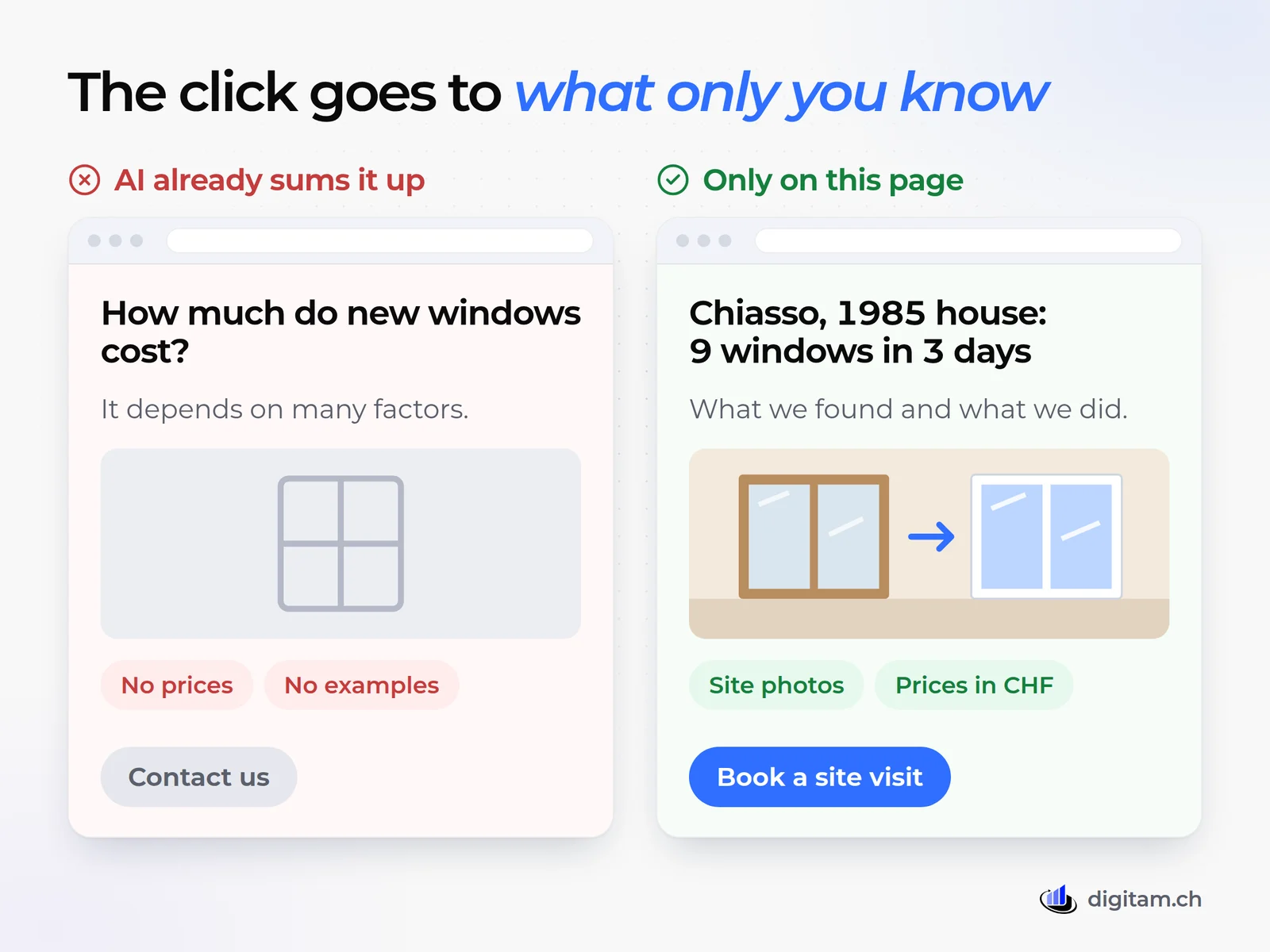
What counts is giving the page something the summary can't. Google asks for "unique", "expert-led" content that goes beyond common knowledge11. Liz Reid adds that users increasingly click on first-hand perspectives, in-depth reviews and original analysis7. For a window company in Mendrisio, that means:
- Real cases instead of generic answers. "It depends on many factors" is something the AI already summarises. "A 1985 house in Chiasso: what we found, what we did, how many days it took" is not.
- Your own prices in francs, even as a range, with what pushes them up or down. That's the data readers look for and generic pages don't have.
- Your own photos, not stock images.
- The next step on the page: site visit, phone, form. Someone arriving after reading the summary already understands the problem and is looking for someone to fix it.
One last point: measure requests, not just clicks. If Laura's page drops from 310 to 140 clicks but form requests stay the same, the 170 lost clicks were people reading and leaving. Google itself claims that clicks coming from a summary are potentially higher quality, because those visitors stay longer on the site2. What counts is the number of quotes, not the visits curve.
When it's not worth worrying
- If customers find you by name or by "trade + town". These are the searches where summaries appear least: your useful traffic is safer than the total suggests.
- If the pages losing clicks were generic articles read across Switzerland and Italy. Those clicks rarely turned into customers in Ticino.
- If your site gets a few dozen clicks a month. At those numbers the difference between two months is noise: look at the trend over a year.
- Don't block Google in protest. With nosnippet or noindex you leave the summary, but you also lose the preview, or the whole page, in regular results10. Google-Extended concerns other Google systems, not Search.
- Be wary of anyone guaranteeing a spot in the summary. Google writes that no third-party tool has access to its ranking or AI systems11.
What to do starting tomorrow
- This week: open Search Console (if your site isn't verified yet, ask whoever manages it). Compare October 2026 with October 2025, page by page.
- Open the generative AI report and mark the pages that appear in summaries while losing clicks. There are usually only a few.
- Pick the three most important ones and rewrite them with cases, prices in CHF and your own photos. Add the next step at the end.
- Check your Google Business Profile: opening hours, services, photos, replies to reviews.
- Count the requests (form, phone, email) coming from those pages, month by month.
- Check again in two months, always year on year.
Google's AI summary is only part of the picture: your customers ask the same questions to ChatGPT and Copilot, which choose their sources in their own way. We cover this in how to get found on ChatGPT and in how to fix wrong information AI gives about your business.
If you'd rather do this with someone, with AI Visibility we start with a free thirty-minute session: together we look at what Google and AI assistants answer to your customers' questions, and which pages on your site really matter. If it's not worth acting in your case, we'll tell you. Write to us here.
Frequently asked questions
Can I remove my site from AI Overviews?
Yes, with the controls Google lists for Search: nosnippet, data-nosnippet, max-snippet or noindex. But they apply to all of Search, not just the AI: with nosnippet your page also loses its preview in the regular results, with noindex it disappears completely. For a small business that is usually a bad trade.
Does the Search Console report tell me what people ask the AI?
No. The generative AI report groups data by page, country, device and date, not by search query. You learn which page was shown in a summary, not after which question. To work that out, look at the queries that used to bring visitors to that page in the Performance report, and try the long questions on Google yourself.
Why can't I find the generative AI report in my Search Console?
Google gives two reasons: your site hasn't had enough impressions in generative AI features yet, or it has been excluded from them (with nosnippet, for example). For a small site the first is common, and not necessarily bad news: it means any lost clicks come from somewhere else.
Does this report also cover ChatGPT or Copilot?
No, it only covers Google's AI Overviews and AI Mode. ChatGPT searches the web with its own crawlers and picks its own sources: we explain how to show up there in our ChatGPT article.
How often should I look at these numbers?
Once a month is enough, always compared with the same month last year. The most recent days in the report are preliminary and can change within hours, and dates follow Pacific Time: don't draw conclusions from yesterday's figure.
Sources
- Google – Übersicht mit KI startet in Deutschland und weiteren Ländern (26.03.2025). AI Overviews launch in Switzerland in English, French, German and Italian, for signed-in users aged 18 and over.
- Google – Der KI-Modus startet in Deutschland, Österreich und der Schweiz (08.10.2025). AI Mode in Switzerland in German, French and Italian; questions two to three times longer than typical searches.
- Statcounter – Search Engine Market Share Switzerland. Google's share in Switzerland in October 2026: 81.25%.
- Swiss Federal Statistical Office (FSO) – Use of generative AI by the population, 2025 (21.04.2026). 47% of the Swiss population say they use generative AI; Switzerland ranks third in Europe.
- SISTRIX – AI Overviews: Übersicht mit KI (updated 06.11.2026). German data on about 100 million keywords: share of searches with an AI Overview and click rates with and without. SISTRIX sells SEO tools.
- Pew Research Center – Google users are less likely to click on links when an AI summary appears (22.07.2025). 900 US adults, 68,879 searches in March 2025: clicks with and without an AI summary, searches by length.
- Google – AI in Search: driving more queries and higher quality clicks (06.08.2025). Google's position: organic click volume "relatively stable", first-hand content clicked more.
- Google Search Central – Introducing Search Generative AI performance reports (03.06.2026). Report announcement; available to all websites since 31 August 2026.
- Search Console Help – Generative AI performance report (Search). What the report measures: impressions by page, country, device and date; why it may not appear.
- Google Search Central – AI features and your website. Requirements for AI Overviews, clicks counted under the "Web" search type, nosnippet and noindex controls.
- Google Search Central – Optimizing for generative AI search. What's needed and what isn't: no llms.txt or special markup, unique expert content, Business Profile.
Written by Alessandro Scerpella. Sources checked on 24 November 2026.










 About Markets